
Penny Dreadfuls, 1854 · page 276 of 394
Joseph Wilmot, or, The Memoirs of a Man-Servant — page 276: what you’re looking at
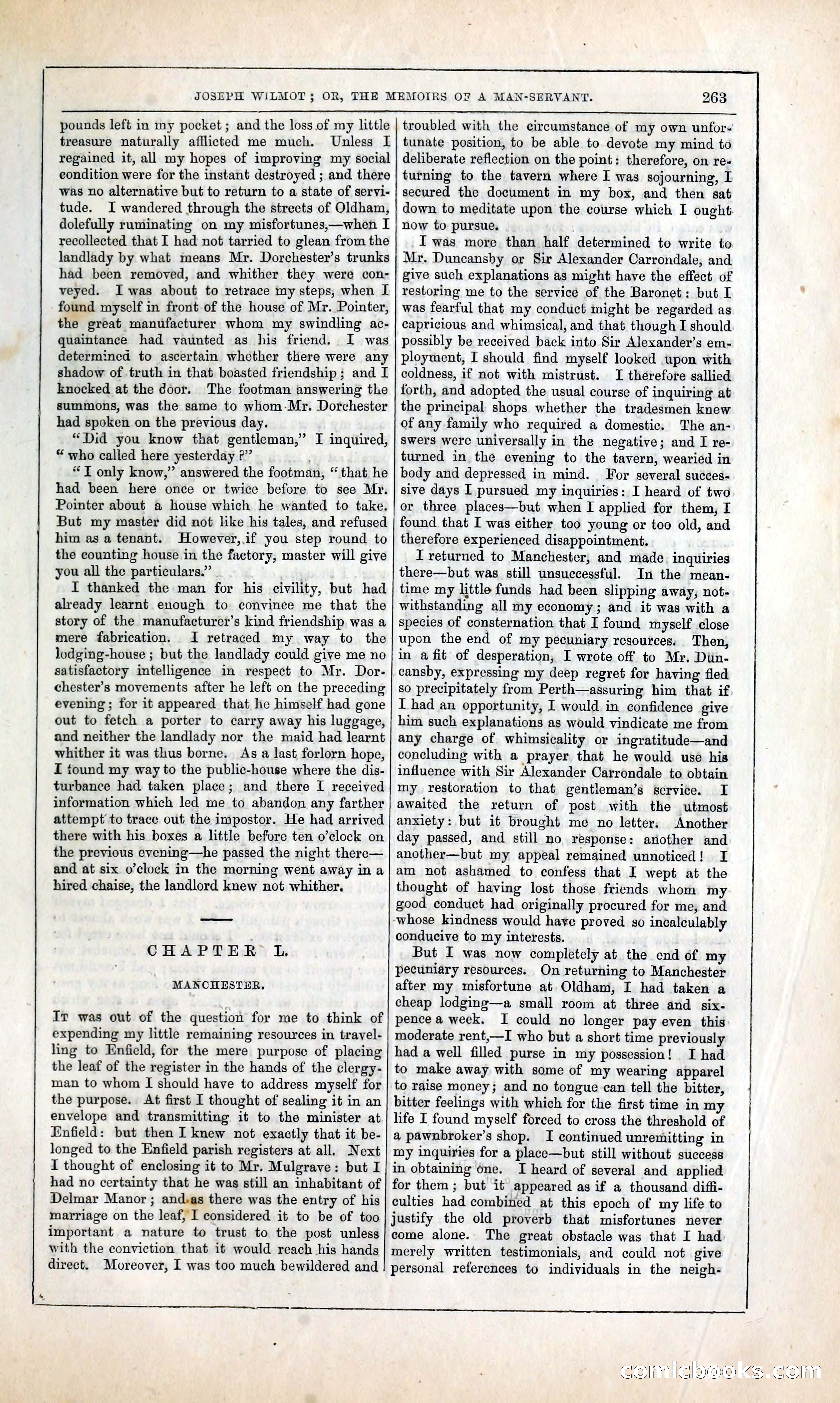
A restored page from Penny Dreadfuls, 1854. Page through the whole issue in the reader above.
📄 Transcribed text from this page (OCR, searchable)
Machine-transcribed from the original scan — historical spelling and the odd misread are preserved.
JOSEPH WILMOT 5 OR, THE MEMOIRS OF A MAN-SERVANT. 263 pounds left in my pocket; and the loss of my little treasure naturally afflicted me much. Unless I regained it, all my hopes of improving my social eondition were for the instant destroyed ; and there was no alternative but to return to a state of servi- tude. I wandered through the streets of Oldham, dolefully ruminating on my misfortunes,—when I recollected that I had not tarried to glean from the landlady by what means Mr. Dorchester’s trunks had been removed, and whither they were con- veyed. Iwas about to retrace my steps, when I found myself in front of the house of Mr. Pointer, the great manufacturer whom my swindling ac- quaintance had vaunted as his friend, I was determined to ascertain whether there were any shadow of truth in that boasted friendship ; and I knocked at the door. The footman answering the summons, was the same to whom-Mr. Dorchester had spoken on the previous day. “Did you know that gentleman,” I inquired, “ who called here yesterday ?” *T only know,” answered the footman, “that he had been here once or twice before to see Mr. Pointer about a house which he wanted to take. But my master did not like his tales, and refused him as a tenant. However,.if you step round to the counting house in the factory, master will give you all the particulars.” I thanked the man for his civility, but had already learnt enough to convince me that the story of the manufacturer’s kind friendship was a mere fabrication. I retraced my way to the lodging-house ; but the landlady could give me no satisfactory intelligence in respect to Mr. Dor- chester’s movements after he left on the preceding evening ; for it appeared that he himself had gone out to fetch a porter to carry away his luggage, and neither the landlady nor the maid had learnt whither it was thus borne. As a last forlorn hope, I found my way to the public-house where the dis- turbance had taken place; and there I received information which led me to abandon any farther attempt to trace out the impostor. He had arrived there with his boxes a little before ten o’clock on the previous evening—he passed the night there— and at six o’clock in the morning went away in a hired chaise, the landlord knew not whither. CHAPTER L. MANCHESTER. It was out of the question for me to think of expending my little remaining resources in trayel- ling to Enfield, for the mere purpose of placing the leaf of the register in the hands of the clergy- man to whom I should have to address myself for the purpose. At first I thought of sealing it in an envelope and transmitting it to the minister at Infield: but then I knew not exactly that it be- longed to the Enfield parish registers at all. Next I thought of enclosing it to Mr. Mulgrave: but I had no certainty that he was still an inhabitant of Delmar Manor ; andsas there was the entry of his marriage on the leaf, I considered it to be of too important a nature to trust to the post unless with the conviction that it would reach his hands direct. Moreover, I was too much bewildered and troubled with the circumstance of my own unfor- tunate position, to be able to devote my mind to deliberate reflection on the point: therefore, on re- turning to the tavern where I was sojourning, I secured the document in my box, and then sat down to meditate upon the course which I ought now to pursue. I was more than half determined to write to Mr. Duncansby or Sir Alexander Carrondale, and give such explanations as might have the effect of restoring me to the service of the Baronet: but I was fearful that my conduct might be regarded as capricious and whimsical, and that though I should possibly be received back into Sir Alexander’s em- ployment, I should find myself looked upon with coldness, if not with mistrust. I therefore sallied forth, and adopted the usual course of inquiring at the principal shops whether the tradesmen knew of any family who required a domestic, The an- Swers were universally in the negative; and I re- turned in the evening to the tavern, wearied in body and depressed in mind. For several succes- sive days I pursued my inquiries: I heard of two or three places—but when I applied for them, I found that I was either too young or too old, and therefore experienced disappointment. I returned to Manchester, and made. inquiries there—but was still unsuccessful. In the mean- time my little funds had been slipping away, not- withstanding all my economy; and it was with a species of consternation that I found myself close upon the end of my pecuniary resources. Then, in a fit of desperation, I wrote off to Mr. Din- cansby, expressing my deep regret for having fled so precipitately from Perth—assuring him that if I had an opportunity, I would in confidence give him such explanations as would vindicate me from any charge of whimsicality or ingratitude—and concluding with a prayer that he would use his influence with Sir Alexander Carrondale to obtain my restoration to that gentleman’s service. I awaited the return of post with the utmost anxiety: but it brought me no letter, Another day passed, and still no response: another and another—but my appeal remained unnoticed! I am not ashamed to confess that I wept at the thought of having lost those friends whom my good conduct had originally procured for me, and ‘whose kindness would have proved so incaleulably conducive to my interests. But I was now completely at the end of my pecuniary resources. On returning to Manchester after my misfortune at. Oldham, I had taken a cheap lodging—a small room at three and six- pence a week. I could no longer pay even this moderate rent,—I who but a short time previously had a well filled purse in my possession! I had to make away with some of my wearing apparel to raise money; and no tongue can tell the bitter, bitter feelings with which for the first time in my life I found myself forced to cross the threshold of a pawnbroker’s shop. I continued unremitting in my inquiries for a place—but still without success in obtaining one. I heard of several and applied for them ; but it appeared as if a thousand diffi- culties had combined at this epoch of my life to justify the old proverb that misfortunes never come alone. The great obstacle was that I had merely written testimonials, and could not give personal references to individuals in the neigh- Elyoo <S (©) im