
Penny Dreadfuls, 1854 · page 277 of 394
Joseph Wilmot, or, The Memoirs of a Man-Servant — page 277: what you’re looking at
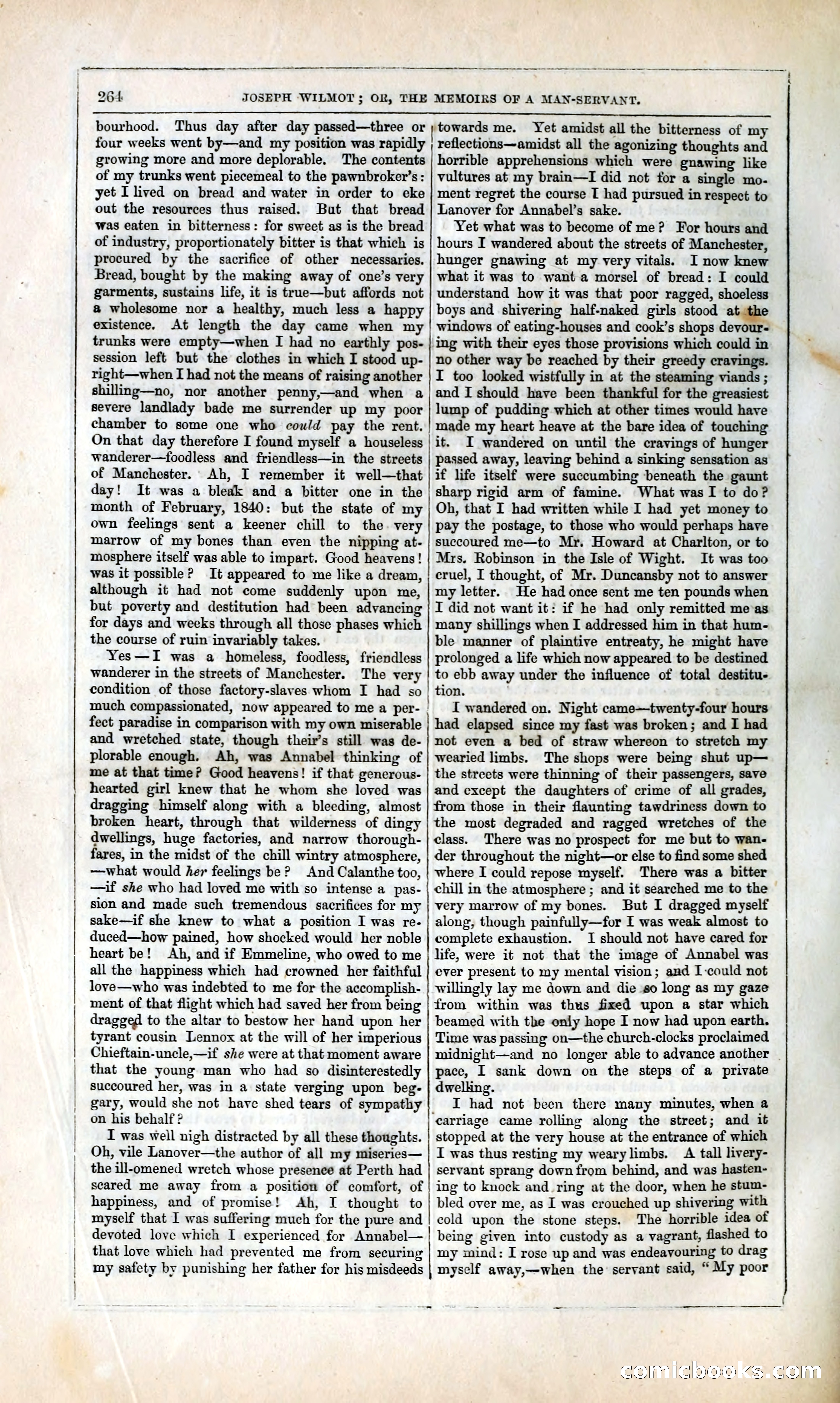
A restored page from Penny Dreadfuls, 1854. Page through the whole issue in the reader above.
📄 Transcribed text from this page (OCR, searchable)
Machine-transcribed from the original scan — historical spelling and the odd misread are preserved.
} i ——— 264 JOSEPH WILMOT; OR, THE bourhood. Thus day after day passed—three or ES ES TT Sn ies Ss seat MEMOIRS OF A MAN-SERVANT. ‘towards me. Yet amidst all the bitterness of my four weeks went by—and my position was rapidly | reflections—amidst all the agonizing thoughts and growing more and more deplorable. The contents | horrible apprehensions which were gnawing like of my trunks went piecemeal to the pawnbroker’s: | vultures at my brain—I did not for a single mo- yet I lived on bread and water in order to eke out the resources thus raised. But that bread was eaten in bitterness: for sweet as is the bread of industry, proportionately bitter is that which is procured by the sacrifice of other necessaries. Bread, bought by the making away of one’s very garments, sustains life, it is true—but affords not &@ wholesome nor a healthy, much less a happy existence. At length the day came when my trunks were empty—when I had no earthly pos- session left but the clothes in which I stood up- right—when I had not the means of raising another shilling—no, nor another penny,—and when a severe landlady bade me surrender up my poor chamber to some one who could pay the rent. On that day therefore I found myself a houseless wanderer—foodless and friendless—in the streets of Manchester. Ah, I remember it well—that day! It was a bleak and a bitter one in the month of February, 1840: but the state of my own feelings sent a keener chill to the. very marrow of my bones than even the nipping at- mosphere itself was able to impart. Good heavens! was it possible? It appeared to me like a dream, although it had not come suddenly upon me, but poverty and destitution had been advancing for days and weeks through all those phases which the course of ruin invariably takes. Yes—I was a homeless, foodless, friendless wanderer in the streets of Manchester. The very | condition of those factory-slares whom I had so | much compassionated, now appeared to me a per- ment regret the course L had pursued in respect to Lanover for Annabel’s sake. Yet what was to become of me? For hours and hours I wandered about the streets of Manchester, hunger gnawing at my very vitals. I now knew what it was to want a morsel of bread: I could understand how it was that poor ragged, shoeless boys and shivering half-naked girls stood e windows of eating-houses and cook’s shops devour- ‘ing with their eyes those provisions which could in no other way be reached by their greedy cravings. I too looked wistfully in at the steaming viands ; and I should have been thankful for the greasiest lump of pudding which at other times would have made my heart heave at the bare idea of touching it. I wandered on until the cravings of hunger passed away, leaving behind a sinking sensation as if life itself were succumbing beneath the gaunt sharp rigid arm of famine. What wasI to do? Oh, that I had written while I had yet money to pay the postage, to those who would perhaps have succoured me—to Myr. Howard at Charlton, or to Mrs. Robinson in the Isle of Wight. It was too cruel, I thought, of Mr. Duncansby not to answer my letter. He had once sent me ten pounds when I did not want it: if he had only remitted meas many shillings when I addressed him in that hum- ble manner of plaintive entreaty, he might have prolonged a life which now appeared to be destined to ebb away under the influence of total destitu- tion. , I wandered on. Night came—twenty-four hours fect paradise in comparison with my own miserable | had elapsed since my fast was broken; and I had and wretched state, though their’s still was de- plorable enough. Ah, was Annabel thinking of me at that time? Good heavens! if that generous- hearted girl knew that he whom she loved was dragging himself along with a bleeding, almost broken heart, through that wilderness of dingy dwellings, huge factories, and narrow thorough- fares, in the midst of the chill wintry atmosphere, —what would her feelings be? And Calanthe too, —if she who had loved me with so intense a pas- sion and made such tremendous sacrifices for my sake—if she knew to what a position I was re- duced—how pained, how shocked would her noble heart be! Ah, and if Emmeline, who owed to me all the happiness which had crowned her faithful love—who was indebted to me for the accomplish- ment of that flight which had saved her from being dragged to the altar to bestow her hand upon her tyrant cousin Lennox at the will of her imperious Chieftain-uncle,—if she were at that moment aware that the young man who had so disinterestedly succoured her, was in a state verging upon beg- gary, would she not have shed tears of sympathy | on his behalf ? I was well nigh distracted by all these thoughts. Oh, vile Lanover—the author of all my miseries— the ill-omened wretch whose presence at Perth had scared me away from a position of comfort, of happiness, and of promise! Ah, I thought to myself that I was suffering much for the pure and devoted love which I experienced for Annabel— that love which had prevented me from securing my safety by punishing her father for his misdeeds not even a bed of straw whereon to stretch my wearied limbs. The shops were being shut up— the streets were thinning of their passengers, save and except the daughters of crime of all grades, from those in their flaunting tawdriness down to the most degraded and ragged wretches of the class. There was no prospect for me but to wan- der throughout the night—or else to find some shed where I could repose myself. There was a bitter chill in the atmosphere ; and it searched me to the very marrow of my bones. But I dragged myself along, though painfully—for I was weak almost to complete exhaustion. I should not have cared for life, were it not that the image of Annabel was ever present to my mental vision; and I-could not willingly lay me down and die so long as my gaze from within was thus fixed upon a star which beamed with the only hope I now had upon earth. Time was passing on—the church-clocks proclaimed _ i 4 midnight—and no longer able to advance another | pace, I sank down on the steps of a private dwelkng. I had not been there many minutes, when a carriage came rolling along the street; and it stopped at the very house at the entrance of which I was thus resting my weary limbs. A tall livery- servant sprang down from behind, and was hasten- ing to knock and_ ring at the door, when he stum- bled over me, as I was crouched up shivering with cold upon the stone steps. The horrible idea of being given into custody as a vagrant, flashed to my mind: I rose up and was endeavouring to drag myself away,—when the servant said, * My poor Gbooks (C@)