
Penny Dreadfuls, 1854 · page 288 of 394
Joseph Wilmot, or, The Memoirs of a Man-Servant — page 288: what you’re looking at
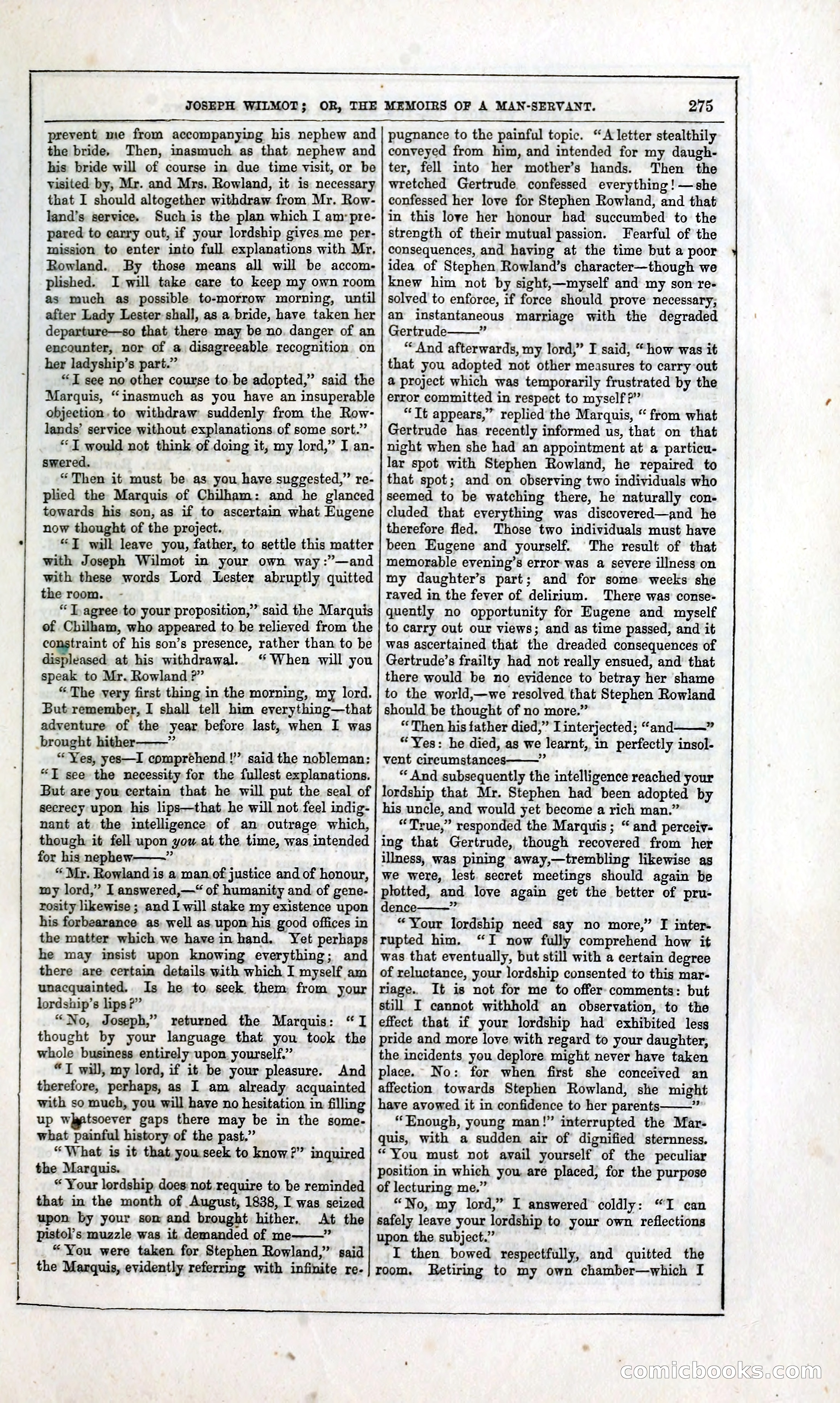
A restored page from Penny Dreadfuls, 1854. Page through the whole issue in the reader above.
📄 Transcribed text from this page (OCR, searchable)
Machine-transcribed from the original scan — historical spelling and the odd misread are preserved.
ee | JOSEPH WILMOT; prevent me from accompanying his nephew and the bride, Then, inasmuch as that nephew and his bride will of course in due time visit, or be visited by, Mr. and Mrs. Rowland, it is necessary that I should altogether withdraw from Mr. Row- land’s service. Such is the plan which I am:pre- pared to carry out, if your lordship giyes me per- mission to enter inio full explanations with Mr, Rowland. By those means all will be accom- plished. I will take care to keep my own room as much as possible to-morrow morning, until after Lady Lester shall, as a bride, have taken her departure—so that there may be no. danger of an encounter, nor of a disagreeable recognition on her ladyship’s part.” “I see no other course to. be adopted,” said the Marquis, “inasmuch as you have an insuperable objection. to withdraw suddenly from the Row- lands’ service without explanations. of some sort.” ““T would not think of doing it, my lord,” I an- swered. : “Then it must be as you have suggested,” re- plied the Marquis of Chilham: and he glanced towards his son, as if to ascertain what Eugene now thought of the project.. “T will leave you, father, to settle this matter with Joseph Wilmot in your own way :”—and with these words Lord Lester abruptly quitted the room. “'T agree to your proposition,” said the Marquis of Chilham, who appeared to be relieved from the constraint of his son’s presence, rather than to be “When will you displeased at his withdrawal. speak to Mr. Rowland ?” “The very first thing in the morning, my lord. But remember, I shall tell him everything—that adventure of the year before last, when I was brought hither ? “Yes, yes—I comprehend !’’ said the nobleman: “TI see the necessity for the fullest explanations. But are you certain that he will put the seal of secrecy upon his lips—that. he will not feel indig- nant at the intelligence of an outrage which, though it fell upon you. at the time, was intended for his nephew “< “ Mr. Rowland is a, man.of justice and of honour, my lord,” I answered,—“ of humanity and of gene- rosity likewise ; and I will stake my existence upon his forbearance as, well as, upon his good offices in the matter which we have in hand. Yet perhaps he may insist upon knowing everything; and there are certain details with which I myself am unacquainted. Is he to seek them from your lordship’s lips?” “No, Joseph,” returned the Marquis: “I thought by your language that you took the whole business entirely upon. yourself.” “I wil), my lord, if it be your pleasure. And therefore, perhaps, as I am already acquainted with so much, you will have no hesitation in filling up whtsoever gaps there may be in the some- what painful history of the past,” “What is it that. youseek to know?” inquired the Marquis. “ Your lordship does: not require to be reminded that in the month of August, 1838, T was seized upon by your som and brought hither. At the pistol’s:muzzle was. it. demanded of me——” “You were taken for Stephen Rowland,” said the Marquis, evidently referring with infinite re- OR, THE MEMOIRS OF A MAN-SERVANT. 275 pugnance to the painful topic. “A letter stealthily conveyed from him, and intended for my daugh- ter, fell into her mother’s hands. Then the wretched Gertrude confessed everything! —she confessed her love for Stephen Rowland, and that in this love her honour had succumbed to the strength of their mutual passion. Fearful of the consequences, and having at the time but a poor idea of Stephen. Rowland’s character—though we knew him not by sight,—myself and my son re- solved to enforce, if force should prove necessary; an instantaneous marriage with the degraded Gertrude r “And afterwards, my lord,” T said, “how was it that you adopted not other measures to carry out & project which was temporarily frustrated by the error committed in respect to myself?” “Tt appears,” replied the Marquis, “ from what Gertrude has recently informed us, that on that night when she had an appointment at a particu- lar spot with Stephen Rowland, he repaired to that spot; and on observing two individuals who seemed to be watching there, he naturally con- cluded that everything was discovered—and he therefore fled. Those two individuals must have been Eugene and yourself. The result of that memorable evening’s error was a severe illness on my daughter’s part; and for some weeks she raved in the fever of delirium. There was conse- quently no opportunity for Eugene and myself to carry out our views; and as time passed, and it was ascertained that the dreaded consequences of Gertrude’s frailty had not really ensued, and that there would be no evidence to betray her shame to the world,—we resolved that Stephen Rowland should be thought of no more.” “Then his father died,” I interjected; “and “4 “Yes: he died, as we learnt, in perfectly insol- vent cireumstances——” “ And subsequently the intelligence reached your lordship that Mr. Stephen had been adopted by his uncle, and would yet become a rich man.” “True,” responded the Marquis; “ and perceiv- ing that Gertrude, though recovered from her illness, was pining away,—trembling likewise as we were, lest. secret meetings should again be plotted, and love again get the better of pru- dence ” “Your lordship need say no more,” I inter- rupted him. “I now fully comprehend how it was that eventually, but still with a certain degree of reluctance, your lordship consented to this mar- riage. It is not for me to offer-comments: but still I cannot withhold an observation, to the effect that if your lordship had exhibited less pride and more love with regard to your daughter, the incidents you deplore might never have taken place. No: for when first she conceived an affection towards Stephen Rowland, she might have avowed it in confidence to her parents - “Enough, young man!” interrupted the Mar- quis, with a sudden air of dignified sternness. * You must not avail yourself of the peculiar position in which you are placed, for the purpose of lecturing me.” “No, my lord,” I answered coldly: “I can safely leave your lordship to your own reflections upon the subject.” I then bowed respectfully, and quitted the room. Retiring to my own chamber—which I Glaoo <S) A co