
Penny Dreadfuls, 1854 · page 289 of 394
Joseph Wilmot, or, The Memoirs of a Man-Servant — page 289: what you’re looking at
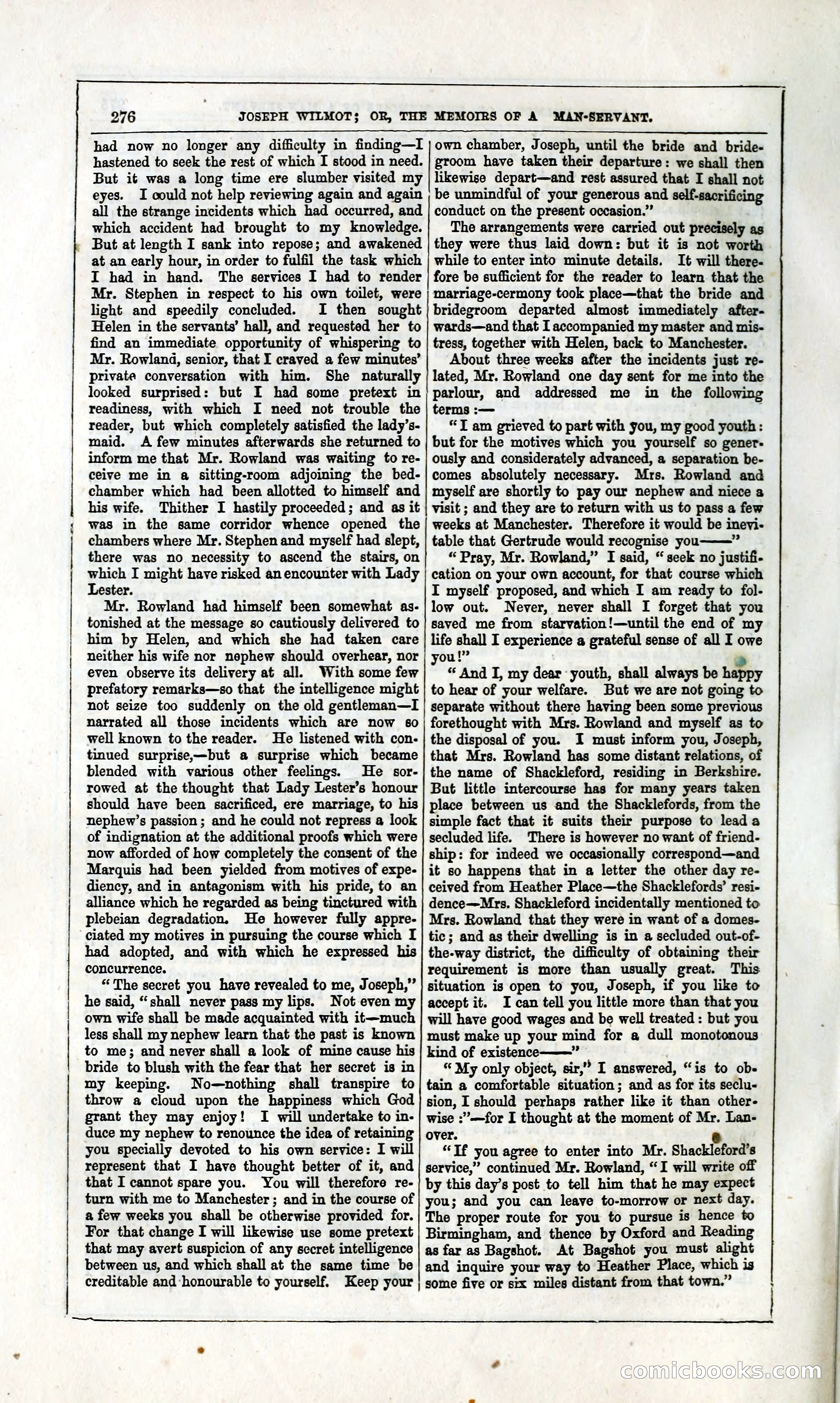
A restored page from Penny Dreadfuls, 1854. Page through the whole issue in the reader above.
📄 Transcribed text from this page (OCR, searchable)
Machine-transcribed from the original scan — historical spelling and the odd misread are preserved.
SE en ett -—- LLL LLL LLL LL LP tt tte 276 JOSEPH WILMOT; OR, THE MEMOIRS OF A MAN-SERVANT. had now no longer any difficulty in finding—I hastened to seek the rest of which I stood in need. But it was a long time ere slumber visited my eyes. I could not help reviewing again and again all the strange incidents which had occurred, and which accident had brought to my knowledge. But at length I sank into repose; and awakened at an early hour, in order to fulfil the task which I had in hand. The services I had to render Mr. Stephen in respect to his own toilet, were light and speedily concluded. I then sought Helen in the servants’ hall, and requested her to find an immediate opportunity of whispering to Mr. Rowland, senior, that I craved a few minutes’ private conversation with him. She naturally looked surprised: but I had some pretext in readiness, with which I need not trouble the reader, but which completely satisfied the lady’s- maid. A few minutes afterwards she returned to inform me that Mr. Rowland was waiting to re- ceive me in a sitting-room adjoining the bed- chamber which had been allotted to himself and his wife. Thither I hastily proceeded; and as it was in the same corridor whence opened the chambers where Mr. Stephen and myself had slept, there was no necessity to ascend the stairs, on which I might have risked an encounter with Lady Lester. Mr. Rowland had himself been somewhat as- tonished at the message so cautiously delivered to him by Helen, and which she had taken care neither his wife nor nephew should overhear, nor even observe its delivery at all. With some few prefatory remarks—so that the intelligence might not seize too suddenly on the old gentleman—I narrated all those incidents which are now 680 well known to the reader. He listened with con- tinued surprise,—but a surprise which became blended with various other feelings. He sor- rowed at the thought that Lady Lester’s honour should have been sacrificed, ere marriage, to his nephew’s passion; and he could not repress a look of indignation at the additional proofs which were now afforded of how completely the consent of the Marquis had been yielded from motives of expe- diency, and in antagonism with his pride, to an alliance which he regarded as being tinctured with plebeian degradation. He however fully appre- ciated my motives in pursuing the course which I had adopted, and with which he expressed his concurrence. “‘The secret you have revealed to me, Joseph,” he said, “shall never pass my lips. Not even my own wife shall be made acquainted with it—much less shall my nephew learn that the past is known to me; and never shall a look of mine cause his bride to blush with the fear that her secret is in my keeping. No—nothing shall transpire to throw a cloud upon the happiness which God grant they may enjoy! I will undertake to in- duce my nephew to renounce the idea of retaining you specially devoted to his own service: I will represent that I have thought better of it, and that I cannot spare you. You will therefore re- turn with me to Manchester ; and in the course of a few weeks you shall be otherwise provided for. For that change I will likewise use some pretext that may avert suspicion of any secret intelligence between us, and which shall at the same time be own chamber, Joseph, until the bride and bride- groom have taken their departure: we shall then likewise depart—and rest assured that I shall not be unmindful of your generous and self-sacrificing conduct on the present occasion.” The arrangements were carried out precisely as they were thus laid down: but it is not worth while to enter into minute details. It will there. fore be sufficient for the reader to learn that the marriage-cermony took place—that the bride and bridegroom departed almost immediately after- wards—and that I accompanied my master and mis- tress, together with Helen, back to Manchester. About three weeks after the incidents just re- lated, Mr. Rowland one day sent for me into the parlour, and addressed me in the following terms :— “TI am grieved to part with you, my good youth: but for the motives which you yourself so gener- ously and considerately advanced, a separation be- comes absolutely necessary. Mrs. Rowland and myself are shortly to pay our nephew and niece a visit ; and they are to return with us to pass a few weeks at Manchester. Therefore it would be inevi- table that Gertrude would recognise you x “Pray, Mr. Rowland,” I said, “seek no justifi- cation on your own account, for that course which I myself proposed, and which I am ready to fol- low out. Never, never shall I forget that you saved me from starvation!—until the end of my life shall I experience a grateful sense of all I owe ou!” “ And I, my dear youth, shall always be happy to hear of your welfare. But we are not going to separate without there having been some previous forethought with Mrs. Rowland and myself as to the disposal of you. I must inform you, Joseph, that Mrs. Rowland has some distant relations, of the name of Shackleford, residing in Berkshire. But little intercourse has for many years taken place between us and the Shacklefords, from the simple fact that it suits their purpose to leada secluded life. There is however no want of friend- ship: for indeed we occasionally correspond—and it so happens that in a letter the other day re- ceived from Heather Place—the Shacklefords’ resi- dence—Mrs. Shackleford incidentally mentioned to Mrs. Rowland that they were in want of a domes- tic; and as their dwelling is in a secluded out-of- the-way district, the difficulty of obtaining their requirement is more than usually great. This situation is open to you, Joseph, if you like to accept it. I can tell you little more than that you will have good wages and be well treated: but you must make up your mind for a dull monotonous kind of existence “ My only object, sir,”” I answered, “is to ob- tain a comfortable situation; and as for its seclu- sion, I should perhaps rather like it than other- wise :”—=for I thought at the moment of Mr. Lan- over. e ‘“‘Tf you agree to enter into Mr. Shackleford’s service,” continued Mr. Rowland, “I will write off by this day’s post to tell him that he may expect you; and you can leave to-morrow or next day. The proper route for you to pursue is hence to Birmingham, and thence by Oxford and Reading as far as Bagshot. At Bagshot you must alight and inquire your way to Heather Place, which is creditable and:‘honourable to yourself. Keep your | some five or six miles distant from that town.” ElOOOlKS (CO) m }