
Penny Dreadfuls, 1854 · page 346 of 394
Joseph Wilmot, or, The Memoirs of a Man-Servant — page 346: what you’re looking at
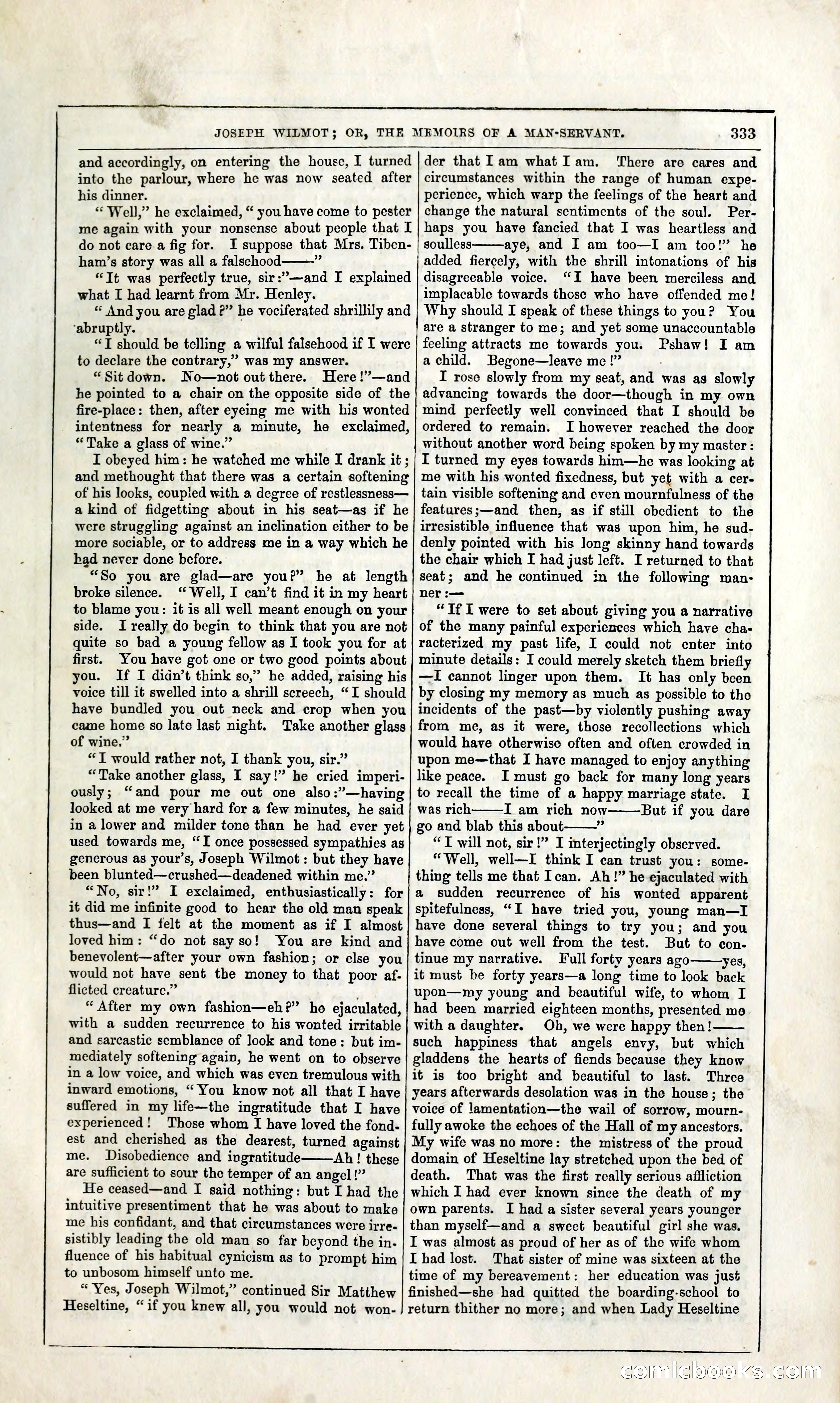
A restored page from Penny Dreadfuls, 1854. Page through the whole issue in the reader above.
📄 Transcribed text from this page (OCR, searchable)
Machine-transcribed from the original scan — historical spelling and the odd misread are preserved.
en ee ee JOSEPH WILMOT; OR, THE MEMOIRS OF A MAN-SERVANT. 300 der that Lam what Iam. ‘There are cares and circumstances within the range of human expe- perience, which warp the feelings of the heart and change the natural sentiments of the soul. Per- haps you have fancied that I was heartless and soulless aye, and I am too—I am too!” he added fiercely, with the shrill intonations of his disagreeable voice. “I have been merciless and implacable towards those who have offended me! Why should I speak of these things to you? You are a stranger to me; and yet some unaccountable feeling attracts me towards you. Pshaw! I am achild. Begone—leave me!” I rose slowly from my seat, and was as slowly advancing towards the door—though in my own mind perfectly well convinced that I should be ordered to remain. I however reached the door and accordingly, on entering the house, I turned into the parlour, where he was now seated after his dinner. “ Well,” he exclaimed, “ you have come to pester me again with your nonsense about people that I do not care a fig for. I suppose that Mrs. Tiben- ham’s story was all a falsehooda-———”’ “Tt was perfectly true, sir:”—and I explained what I had learnt from Mr. Henley. “ And you are glad 2” he vociferated shrillily and ‘abruptly. “T should be telling a wilful falsehood if I were to declare the contrary,” was my answer. “Sitdown. No—not outthere. Here !”’—and he pointed to a chair on the opposite side of the fire-place: then, after eyeing me with his wonted intentness for nearly a minute, he exclaimed, “Take a glass of wine.” without another word being spoken by my master: I obeyed him: he watched me while I drank it ; | I turned my eyes towards him—he was looking at and methought that there was a certain softening | me with his wonted fixedness, but yet with a cer- of his looks, coupied with a degree of restlessness— | tain visible softening and even mournfulness of the a kind of fidgetting about in his seat—as if he| features;—and then, as if still obedient to the were struggling against an inclination either to be | irresistible influence that was upon him, he sud- more sociable, or to address me in a way which he | denly pointed with his long skinny hand towards had never done before. the chair which I had just left. I returned to that “So you are glad—are you?” he at length] seat; and he continued in the following man- broke silence. “Well, I can’t find it in my heart | ner :— to blame you: it is all well meant enough on your| “IfI were to set about giving you a narrative side. I really do begin to think that you are not | of the many painful experiences which have cha- quite so bad a young fellow as I took you for at | racterized my past life, I could not enter into first. You have got one or two good points about | minute details: I could merely sketch them briefly you. If I didn’t think so,” he added, raising his| —I cannot linger upon them. It has only been voice till it swelled into a shrill screech, “I should | by closing my memory as much as possible to the have bundled you out neck and crop when you| incidents of the past—by violently pushing away came home so late last night. Take another glass; from me, as it were, those recollections which of wine.” would have otherwise often and often crowded in “T would rather not, I thank you, sir.” upon me—that I have managed to enjoy anything “Take another glass, I say!” he cried imperi-| like peace. I must go back for many long years ously; “and pour me out one also:”—having| to recall the time of a happy marriage state. I looked at me very hard for a few minutes, he said | was rich I am rich now But if you dare in a lower and milder tone than he had ever yet | go and blab this about 3 used towards me, “I once possessed sympathies as} “I will not, sir!” I interjectingly observed. generous as your’s, Joseph Wilmot: but they have; “Well, well—I think I can trust you: some- been blunted—crushed—deadened within me.” thing tells me that Ican. Ah!” he ejaculated with “No, sir!” I exclaimed, enthusiastically: for|a sudden recurrence of his wonted apparent it did me infinite good to hear the old man speak | spitefulness, “I have tried you, young man—I thus—and I felt at the moment as if I almost} have done several things to try you; and you loved him: “do not say so! You are kind and| have come out well from the test. But to con- benevolent—after your own fashion; or else you| tinue my narrative. Full forty years ago yes, would not have sent the money to that poor af-| it must be forty years—a long time to look back flicted creature.” upon—my young and beautiful wife, to whom I “After my own fashion—eh?” ho ejaculated, | had been married eighteen months, presented me with a sudden recurrence to his wonted irritable | with a daughter. Oh, we were happy then! and sarcastic semblance of look and tone: but im-| such happiness that angels envy, but which mediately softening again, he went on to observe | gladdens the hearts of fiends because they know in a low voice, and which was even tremulous with| it is too bright and beautiful to last. Three inward emotions, “You know not all that I have | years afterwards desolation was in the house; the suffered in my life—the ingratitude that I have | voice of lamentation—the wail of sorrow, mourn- experienced! Those whom I have loved the fond- | fully awoke the echoes of the Hall of my ancestors. est and cherished as the dearest, turned against | My wife was no more: the mistress of the proud me. Disobedience and ingratitude Ah ! these | domain of Heseltine lay stretched upon the bed of are sufficient to sour the temper of an angel!” death. That was the first really serious affliction _ He ceased—and I said nothing: but I had the| which I had ever known since the death of my intuitive presentiment that he was about to make | own parents. I had a sister several years younger me his confidant, and that circumstances were irre- | than myself—and a sweet beautiful girl she was. sistibly leading the old man so far beyond the in- | I was almost as proud of her as of the wife whom fluence of his habitual cynicism as to prompt him | I had lost. That sister of mine was sixteen at the to unbosom himself unto me. time of my bereavement: her education was just “ Yes, Joseph Wilmot,” continued Sir Matthew | finished—she had quitted the boarding-school to Heseltine, “if you knew all, you would not won-/ return thither no more; and when Lady Heseltine GOMIIGIOOKSTEO