
Penny Dreadfuls, 1854 · page 347 of 394
Joseph Wilmot, or, The Memoirs of a Man-Servant — page 347: what you’re looking at
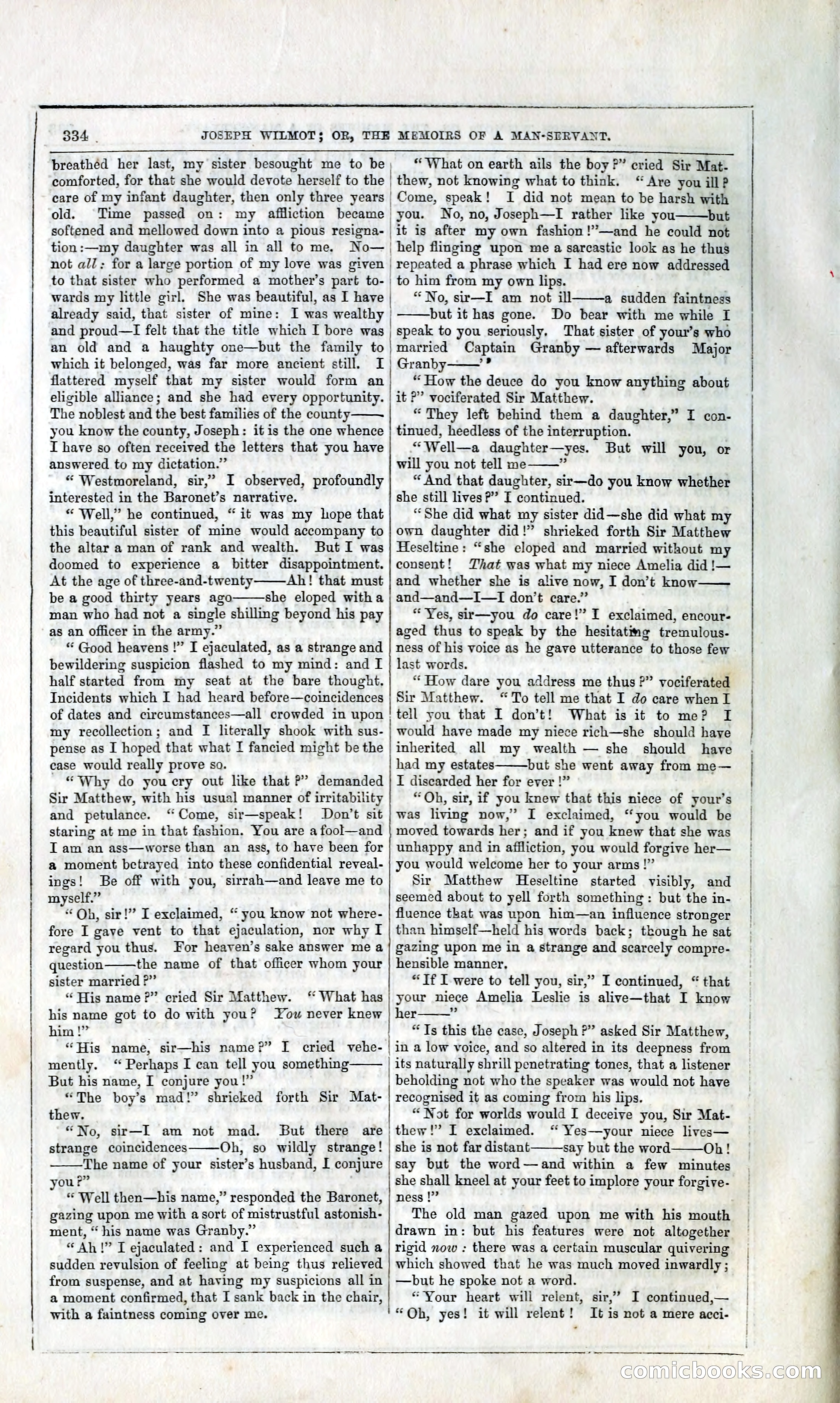
A restored page from Penny Dreadfuls, 1854. Page through the whole issue in the reader above.
📄 Transcribed text from this page (OCR, searchable)
Machine-transcribed from the original scan — historical spelling and the odd misread are preserved.
334 | JOSEPH WILMOT; OR, THE MEMOIRS OF A MAN-SERVANT. breathéd her last, my sister besought me to be) comforted, for that she would devote herself to the | care of my infant daughter, then only three years | old. Time passed on: my afiliction became softened and mellowed down into a pious resigna- | tion :—my daughter was all in all to me. No—) not all; for a large portion of my love was given | to that sister who performed a mother’s part to- | wards my little girl. She was beautiful, as I have | already said, that sister of mine: I was wealthy | and proud—I felt that the title which I bore was an old and a haughty one—but the family to | which it belonged, was far more ancient still. I | flattered myself that my sister would form an eligible alliance; and she had every opportunity. The noblest and the best families of the county you know the county, Joseph: it is the one whence I have so often received the letters that you have answered to my dictation.” “ Westmoreland, sir,’ I observed, profoundly interested in the Baronet’s narrative. “ Well,” he continued, “it was my hope that this beautiful sister of mine would accompany to the altar a man of rank and wealth. But I was doomed to experience a bitter disappointment. At the age of three-and-twenty Ah! that must be a good thirty years ago she eloped witha man who had not a single shilling beyond his pay as an officer in the army.” “ Good heavens !” I ejaculated, as a strange and bewildering suspicion flashed to my mind: and I half started from my seat at the bare thought, Incidents which I had heard before—coincidences of dates and circumstances—all crowded in upon | my recollection; and I literally shook with sus- pense as I hoped that what I fancied might be the ease would really prove so. “Why do youcry out like that P’? demanded Sir Matthew, with his usual manner of irritability and petulance. “Come, sir—speak! Don’t sit staring at me in that fashion. You are a fool—and IT am an ass—worse than an ass, to have been for a moment betrayed into these confidential reveal- ings! Be off with you, sirrah—and leave me to myself.” “Oh, sir!” I exclaimed, “ you know not where- fore I gaye vent to that ejaculation, nor why I regard you thus. For heaven’s sake answer me a question the name of that officer whom your sister married ?” “ His name?” cried Sir Matthew. “ What has You never knew his name got to do with you? him !” “His name, sir—his name?” I cried vehe- mently. ‘‘ Perhaps I can tell you something But his name, I conjure you !” “The boy’s mad!” shrieked forth Sir Mat- thew. “No, sir—I am not mad. But there are strange coincidences Oh, so wildly strange! The name of your sister’s husband, I conjure ou P” “ Well then—his name,” responded the Baronet, gazing upon me with a sort of mistrustful astonish- ment, “his name was Granby.” “Ah!” T ejaculated: and I experienced such a sudden revulsion of feeling at being thus relieved from suspense, and at having my suspicions all in a moment confirmed, that I sank back in the chair, with a faintness coming over me. * What on earth ails the boy?” cried Sir Mat- thew, not knowing what to think. “Are you ill? Come, speak! I did not mean to be harsh with you. No, no, Joseph—I rather like you but it is after my own fashion !”—and he could not help flinging upon me a sarcastic look as he thus repeated a phrase which I had ere now addressed to him from my own lips. “No, sir—I am not ill a sudden faintness but it has gone. Do bear with me while I speak to you seriously. That sister of your’s who married Captain Granby — afterwards Major Granby ie “ How the deuce do you know anything about it ?” vociferated Sir Matthew. “They left behind them a daughter,” I con- tinued, heedless of the interruption. “'Well—a daughter—yes. But will you, or will you not tell me sg “ And that daughter, sir—do you know whether she still lives?” I continued. “She did what my sister did—she did what my own daughter did!” shrieked forth Sir Matthew Heseltine: “she eloped and married without my consent! That was what my niece Amelia did !— and whether she is alive now, I don’t know and—and—I—TI don’t care.” “Yes, sir—you do care!” I exclaimed, encour- aged thus to speak by the hesitatine tremulous- ness of his voice as he gave utterance to those few last words. “How dare you address me thus ?” vociferated Sir Matthew. “To tell me that I do care when I tell you that I don’t! What is it to me? I would have made my niece rich—she should haye inherited all my wealth — she should have had my estates but she went away from me— I discarded her for ever !” “Oh, sir, if you knew that this niece of your’s was living now,” I exclaimed, ‘“‘you would be moved towards her; and if you knew that she was unhappy and in affliction, you would forgive her— you would welcome her to your arms!” Sir Matthew MHeseltine started visibly, and seemed about to yell forth something: but the in- fluence that was upon him—an influence stronger than himself—held his words back; tkough he sat gazing upon me in a strange and scarcely compre- hensible manner, “Tf I were to tell you, sir,’ I continued, “ that your niece Amelia Leslie is alive—that I know her “ “Ts this the case, Joseph ?” asked Sir Matthew, in a low voice, and so altered in its deepness from its naturally shrill penetrating tones, that a listener beholding not who the speaker was would not have recognised it as coming from his lips. “Not for worlds would I deceive you, Sir Mat- thew!’ I exclaimed. ‘“ Yes—your niece lives— she is not far distant say but the word Oh! say but the word—and within a few minutes she shall kneel at your feet to implore your forgive- ness !” The old man gazed upon me with his mouth drawn in: but his features were not altogether rigid now : there was a certain muscular quivering which showed that he was much moved inwardly ; —but he spoke not a word. “Your heart will reljent, sir,” I continued,— “Oh, yes! it will relent! It is not a mere acci- ee a te er en (CO) CORNICE OO@ . | | i