
Penny Dreadfuls, 1854 · page 351 of 394
Joseph Wilmot, or, The Memoirs of a Man-Servant — page 351: what you’re looking at
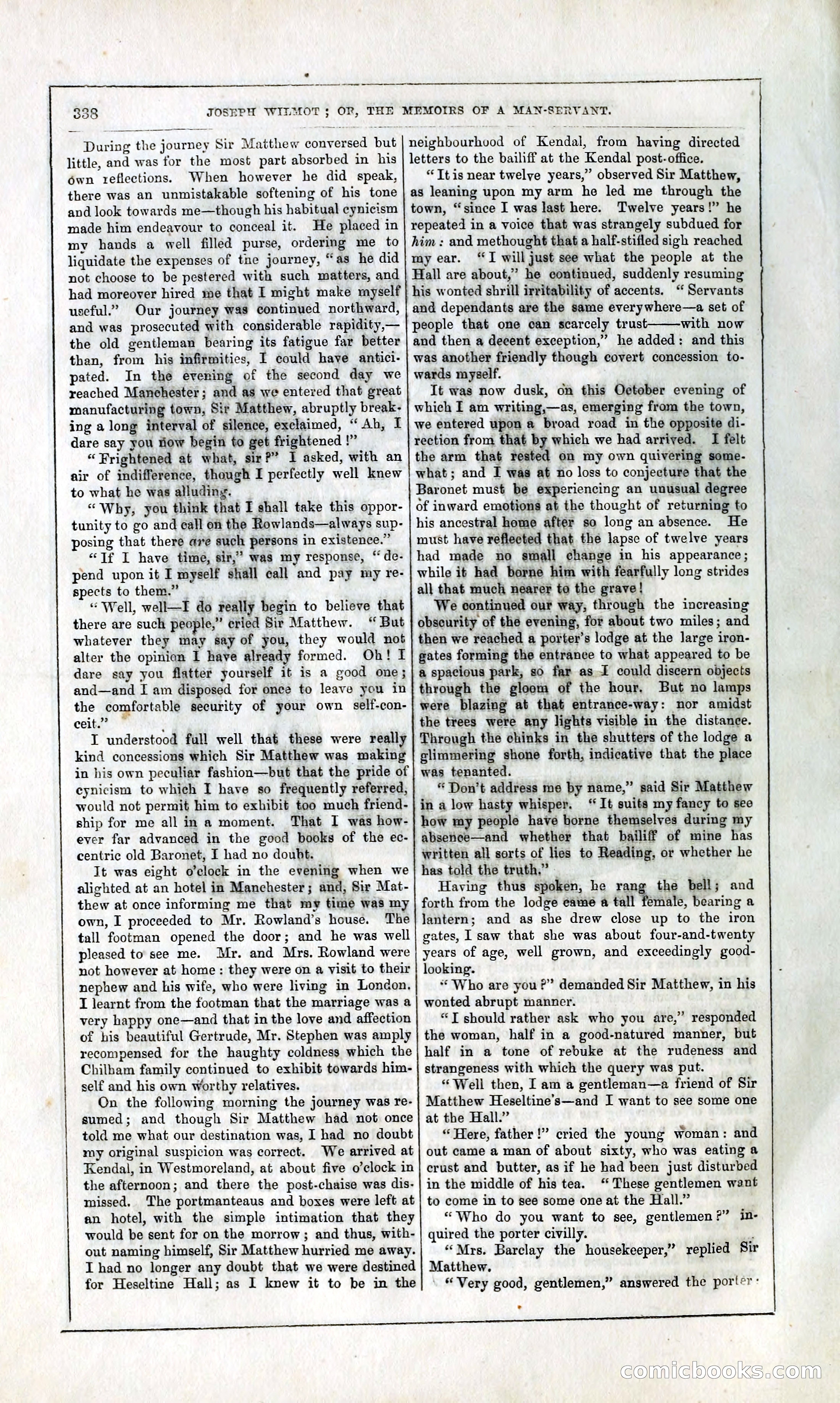
A restored page from Penny Dreadfuls, 1854. Page through the whole issue in the reader above.
📄 Transcribed text from this page (OCR, searchable)
Machine-transcribed from the original scan — historical spelling and the odd misread are preserved.
—_ > err a ee 508 = ais — .: 3 During the journey Sir Matthew conversed but little, and was for the most part absorbed in his éwn reflections. When however he did speak, there was an unmistakable softening of his tone and look towards me—though his habitual cynicism made him endeavour to conceal it. He placed in my hands a well filled purse, ordering me to liquidate the expenses of tne journey, “as he did not choose to be pestered with such matters, and had moreover hired me that I might make myself useful.” Our journey was continued northward, and was prosecuted with considerable rapidity,— the old gentleman bearing its fatigue far better than, from his infirmities, I could have antici- pated. In the evening of the second day we reached Manchester; and as we entered that great manufacturing town, Sir Matthew, abruptly break- ing a long interval of silence, exclaimed, “Ab, I dare say you How begin to get frightened !” “Frightened at what, sir?” I asked, with an air of indifferenee, though I perfectly well knew to what he was alluding. “Why, you think that I shall take this oppor- tunity to go and call of the Rowlands—always sup- posing that there ave such persons in existence.” “If I have time, sir,’ was my response, “ de- pend upon it I myself shall call and pay my re- spects to them.” “ Well, well—I do really begin to believe that there are such people,” cried Sir Matthew. “But whatever they may say of you, they would not alter the opinion I have already formed. Oh! I dare say you fitter yourself it is a good one; and—and I am disposed for once to leave you in the comfortable security of your own self-con- ceit.” I understood full well that these were really kind concessions which Sir Matthew was making in his own peculiar fashion—but that the pride of cynicism to which I have so frequently referred, would not permit him to exhibit too much friend- ship for me all in a moment. That I was how- ever far advanced in the good books of the ec- centric old Baronet, I had no douht. It was eight o’clock in the evening when we alighted at an hotel in Manchester; and, Sir Mat- thew at once informing me that my time was my own, I proceeded to Mr. Rowland’s house. The tall footman opened the door; and he was well pleased to see me. Mr. and Mrs. Rowland were not however at home : they were on a visit to their nephew and his wife, who were living in London, I learnt from the footman that the marriage was a very happy one—and that in the love and affection of his beautiful Gertrude, Mr. Stephen was amply recompensed for the haughty coldness which the Chilham family continued to exhibit towards him- self and his own Worthy relatives. On the following morning the journey was re- sumed; and though Sir Matthew had not once told me what our destination was, I had no doubt my original suspicion was correct. We arrived at Kendal, in Westmoreland, at about five o’clock in the afternoon; and there the post-chaise was dis- missed. The portmanteaus and boxes were left at an hotel, with the simple intimation that they would be sent for on the morrow; and thus, with- out naming himself, Sir Matthew hurried me away. I had no longer any doubt that we were destined for Heseltine Hall; as I knew it to be in the JOSEPH WITMOT ; OR, THE MEMOIRS OF A MAN-SERVANT. neighbourhvod of Kendal, from having directed letters to the bailiff at the Kendal post-office. “Ttis near twelve years,” observed Sir Matthew, as leaning upon my arm he led me through the town, “since I was last here. Twelve years!” he repeated in a voice that was strangely subdued for him : and methought that a half-stifled sigh reached my ear. ‘TI will just see what the people at the Hall are about,’ he continued, suddenly resuming his wonted shrill irritability of accents. “ Servants and dependants are the same every where—a set of people that one can scarcely trust——-with now and then a decent exception,” he added: and this was another friendly though covert concession to- wards myself. It was now dusk, on this October evening of which I am writing,—as, emerging from the town, we entered upon a broad road in the opposite di- rection from that by which we had arrived. I felt the arm that rested on my own quivering some- what; and I was at no loss to conjecture that the Baronet must be experiencing an unusual degree of inward emotions at the thought of returning to his ancestral home after so long an absence. He must have reflected that the lapse of twelve years had made no small change in his appearance; while it had borne him with fearfully long strides all that much nearer to the grave! We continued our way, through the increasing obscurity of the evening, for about two miles; and then we reached a porter’s lodge at the large iron- gates forming the entrance to what appeared to be a spacious park, so far as I could discern objects through the gloom of the hour, But no lamps were blazing at that entrance-way: nor amidst the trees were any lights visible in the distance. Through the chinks in the shutters of the lodge a elimmering shone forth, indicative that the place was tenanted. “ Don’t address me by name,” said Sir Matthew in a low hasty whisper. ‘It suits my fancy to see how my people have borne themselves during my absence—and whether that bailiff of mine has written all sorts of lies to Reading, or whether he has told the truth,” - Having thus spoken, he rang the bell; and forth from the lodge eame a tall female, bearing a Jantern; and as she drew close up to the iron gates, I saw that she was about four-and-twenty years of age, well grown, and exceedingly good- looking. “Who are you ?” demanded Sir Matthew, in his wonted abrupt manner. “T should rather ask who you are,” responded the woman, half in a good-natured manner, but half in a tone of rebuke at the rudeness and strangeness with which the query was put. “Well then, I am a gentleman—a friend of Sir Matthew Heseltine’s—and I want to see some one at the Hall.” “Here, father!” cried the young woman: and out came a man of about sixty, who was eating a crust and butter, as if he had been just disturbed in the middle of his tea. ‘“‘ These gentlemen want to come in to see some one at the Hall.” “Who do you want to see, gentlemen?” in- quired the porter civilly. “Mrs. Barclay the housekeeper,” replied Sir Matthew. . © Very good, gentlemen,” answered the porter: . Pe hee li ace lla alae e — Go OOO AUC KS (CO) im