
Penny Dreadfuls, 1854 · page 352 of 394
Joseph Wilmot, or, The Memoirs of a Man-Servant — page 352: what you’re looking at
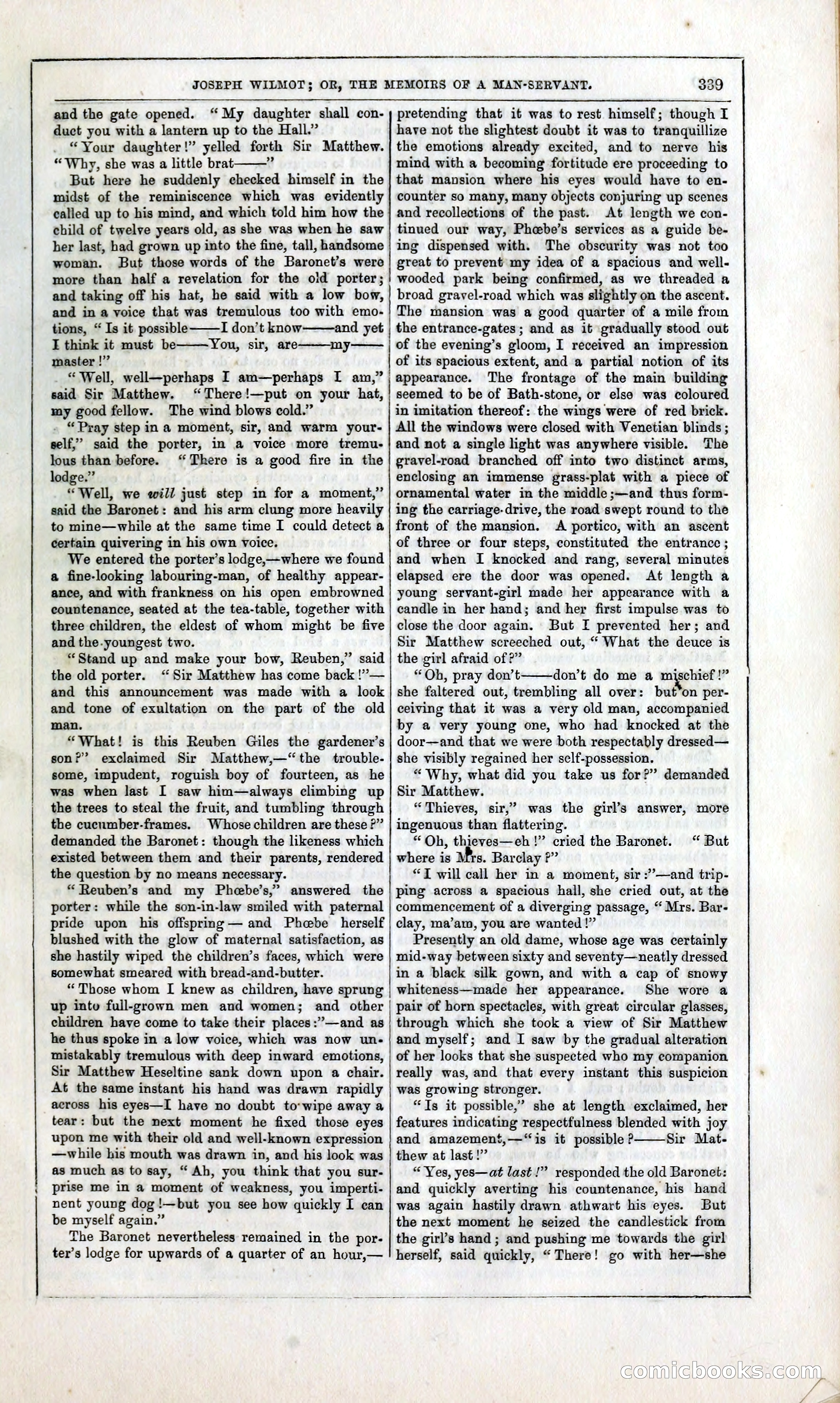
A restored page from Penny Dreadfuls, 1854. Page through the whole issue in the reader above.
📄 Transcribed text from this page (OCR, searchable)
Machine-transcribed from the original scan — historical spelling and the odd misread are preserved.
LT Ne te al JOSEPH WILMOT; OR, THE MEMOIRS OF A MAN-SERVANT. —_——— 039 and the gate opened. “My daughter shall con- duct you with a lantern up to the Hall.” “Your daughter!” yelled forth Sir Matthew. “Why, she was a little brat iv But here he suddenly checked himself in the midst of the reminiscence which was evidently ealled up to his mind, and which told him how the child of twelve years old, as she was when he saw her last, had grown up into the fine, tall, handsome woman. But those words of the Baronet’s were more than half a revelation for the oid porter; and taking off his hat, he said with a low bow, and in a voice that was tremulous too with emo- tions, “ Is it possible-———I don’t know and yet I think it must be You, sir, are m master |” “ Well, well—perhaps I am—perhaps I am,” said Sir Matthew. “There!—put on your hat, my good fellow. The wind blows cold.” . “Pray step in a moment, sir, and warm your- self,’ said the porter, in a voice more tremu- lous than before. ‘There is a good fire in the lodge.” “Well, we will just step in for a moment,” said the Baronet: and his arm clung more heavily to mine—while at the same time I could detect a certain quivering in his own voice. We entered the porter’s lodge,—where we found a fine-looking labouring-man, of healthy appear- ance, and with frankness on his open embrowned countenance, seated at the tea-table, together with three children, the eldest of whom might be five and the-youngest two. “Stand up and make your bow, Reuben,” said the old porter. “Sir Matthew has come back !”— and this announcement was made with a look and tone of exultation on the part of the old man. “What! is this Reuben Giles the gardener’s son?” exclaimed Sir Matthew,—“ the trouble- some, impudent, roguish boy of fourteen, as he was when last I saw him—always climbing up the trees to steal the fruit, and tumbling through the cucumber-frames. Whose children are these ?” demanded the Baronet: though the likeness which existed between them and their parents, rendered the question by no means necessary. “ Reuben’s and my Phebe’s,’ answered the porter: while the son-in-law smiled with paternal pride upon his offspring — and Phebe herself blushed with the glow of maternal satisfaction, as she hastily wiped the children’s faces, which were somewhat smeared with bread-and-butter. “Those whom I knew as children, have sprung up into full-grown men and women; and other children have come to take their places :”—and as he thus spoke in a low voice, which was now un- mistakably tremulous with deep inward emotions, Sir Matthew Heseltine sank down upon a chair. At the same instant his hand was drawn rapidly across his eyes—I have no doubt to-wipe away a tear: but the mext moment he fixed those eyes upon me with their old and well-known expression —while his mouth was drawn in, and his look was as much as to say, “Ah, you think that you sur- prise me in a moment of weakness, you imperti- nent young dog!—but you see how quickly I can be myself again.” The Baronet nevertheless remained in the por. ter’s lodge for upwards of a quarter of an hour,— ? pretending that it was to rest himself; though I have not the slightest doubt it was to tranquillize the emotions already excited, and to nerve his mind with a becoming fortitude ere proceeding to that mansion where his eyes would have to en- counter so many, many objects conjuring up scenes and recollections of the past. At length we con- tinued our way, Phebe’s services as a guide be- ing dispensed with. The obscurity was not too great to prevent my idea of a spacious and well- wooded park being confirmed, as we threaded a broad gravel-road which was slightly on the ascent. The mansion was a good quarter of a mile from the entrance-gates; and as it gradually stood out of the evening’s gloom, I received an impression of its spacious extent, and a partial notion of its appearance. The frontage of the main building seemed to be of Bath-stone, or else was coloured in imitation thereof: the wings were of red brick. All the windows were closed with Venetian blinds ; and not a single light was anywhere visible. The gravel-road branched off into two distinct arms, enclosing an immense grass-plat with a piece of ornamental water in the middle ;—and thus form- ing the carriage-drive, the road swept round to the front of the mansion. A portico, with an ascent of three or four steps, constituted the entrance ; and when I knocked and rang, several minutes elapsed ere the door was opened. At length a young servant-girl made her appearance with a candle in her hand; and her first impulse was to close the door again. But I prevented her; and Sir Matthew screeched out, “ What the deuce is the girl afraid of ?” “Oh, pray don’t don’t do me a mischief ” she faltered out, trembling all over: but’on per- ceiving that it was a very old man, accompanied by a very young one, who had knocked at the door—and that we were both respectably dressed— she visibly regained her sclf-possession. “Why, what did you take us for?” demanded Sir Matthew. “Thieves, sir,” was the girl’s answer, more ingenuous than flattering. * Oh, thieves—eh !” cried the Baronet. where is Mrs. Barclay ?” “J will call her in a moment, sir :’”’—and trip- ping across a spacious hall, she cried out, at the commencement of a diverging passage, “ Mrs. Bar- clay, ma’am, you are wanted!” Presently an old dame, whose age was certainly mid-way between sixty and seventy—neatly dressed in a black silk gown, and with a cap of snowy whiteness—made her appearance. She wore a pair of horn spectacles, with great circular glasses, through which she took a view of Sir Matthew and myself; and I saw by the gradual alteration of her looks that she suspected who my companion really was, and that every instant this suspicion was growing stronger. “Is it possible,” she at length exclaimed, her features indicating respectfulness blended with joy and amazement,—‘“‘is it possible ? Sir Mat- thew at last!” “Yes, yes—at last!” responded the old Baronet: and quickly averting his countenance, his hand was again hastily drawn athwart his eyes. But the next moment he seized the candlestick from the girl’s hand; and pushing me towards the girl herself, said quickly, “There! go with her—she “ But ELO@QO) S co im