
Penny Dreadfuls, 1854 · page 361 of 394
Joseph Wilmot, or, The Memoirs of a Man-Servant — page 361: what you’re looking at
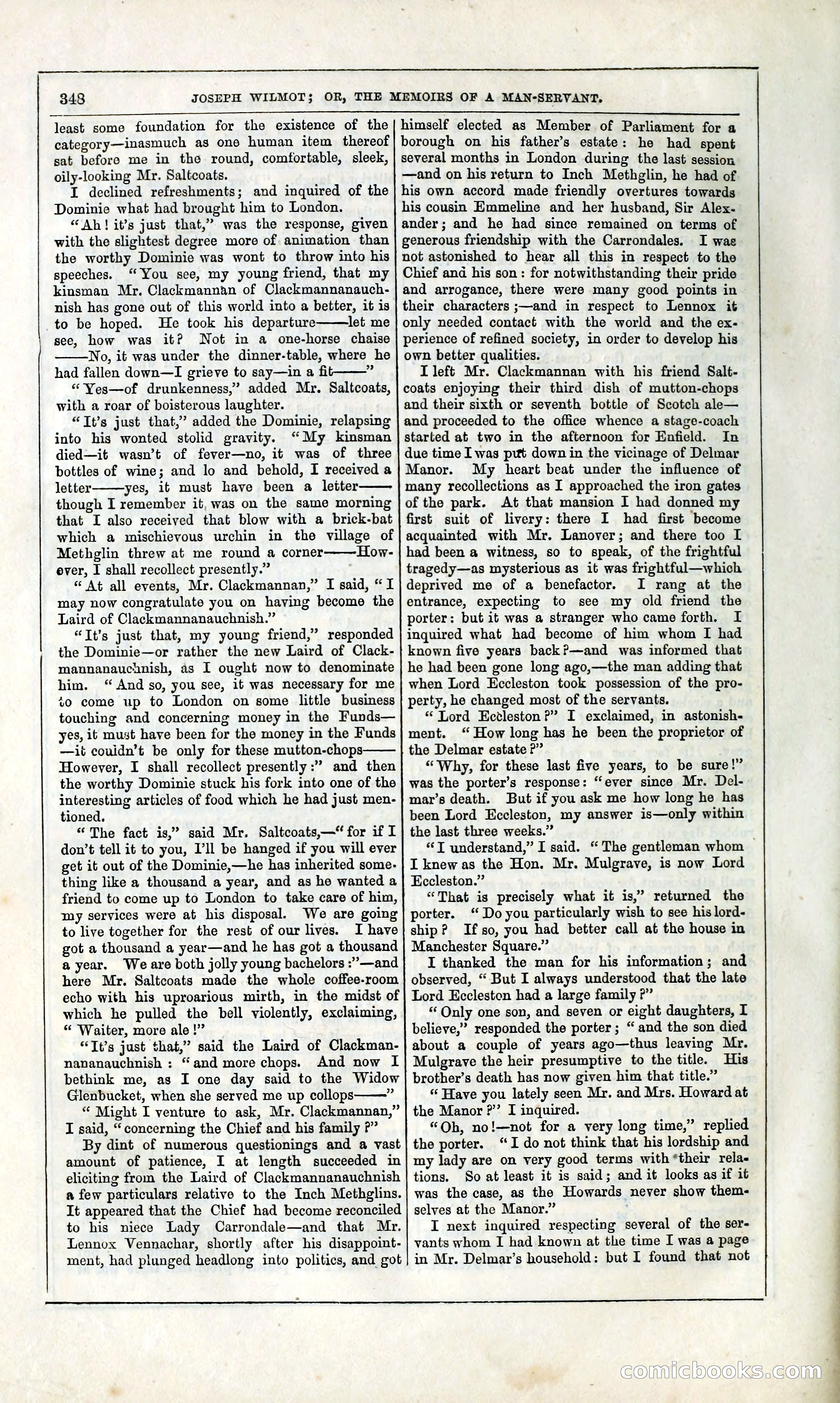
A restored page from Penny Dreadfuls, 1854. Page through the whole issue in the reader above.
📄 Transcribed text from this page (OCR, searchable)
Machine-transcribed from the original scan — historical spelling and the odd misread are preserved.
ee CC I —T 348 least some foundation for the existence of the category—inasmuch as one human item thereof sat before me in the round, comfortable, sleek, oily-looking Mr. Saltcoats. I declined refreshments; and inquired of the Dominie what had brought him to London. “Ah! it’s just that,” was the response, given with the slightest degree more of animation than the worthy Dominie was wont to throw into his speeches. “You see, my young friend, that my kinsman Mr. Clackmannan of Clackmannanauch- nish has gone out of this world into a better, it 1s to be hoped. He took his departure let me see, how was itr Not in a one-horse chaise No, it was under the dinner-table, where he had fallen down—I grieve to say—in a fit——” ‘‘ Yes—of drunkenness,” added Mr. Saltcoats, with a roar of boisterous laughter. “Tt’s just that,’ added the Dominie, relapsing into his wonted stolid gravity. “My kinsman died—it wasn’t of fever—no, it was of three bottles of wine; and lo and behold, I received a letter yes, it must have been a leiter though I remember it, was on the same morning that I also received that blow with a brick-bat which a mischievous urchin in the village of Methglin threw at me round a corner How- ever, I shall recollect presently.” «At all events, Mr. Clackmannan,” I said, “I may now congratulate you on having become the Laird of Clackmannanauchnish.” “Tt’s just that, my young friend,” responded the Dominie—or rather the new Laird of Clack- mannanaucanish, as I ought now to denominate him. “And so, you see, it was necessary for me to come up to London on some little business touching and concerning money in the Funds— yes, it must have been for the money in the Funds —it couidn’t be only for these mutton-chops However, I shall recollect presently :” and then the worthy Dominie stuck his fork into one of the interesting articles of food which he had just men- tioned, “The fact is,” said Mr. Saltcoats,—“ for if L don’t tell it to you, I’ll be hanged if you will ever get it out of the Dominie,—he has inherited some- thing like a thousand a year, and as he wanted a friend to come up to London to take care of him, my services were at his disposal. We are going to live together for the rest of our lives. I have got a thousand a year—and he has got a thousand a year. Weare both jolly young bachelors :”—and here Mr. Saltcoats made the whole coffee-room echo with his uproarious mirth, in the midst of which he pulled the bell violently, exclaiming, “ Waiter, more ale !” “Tt’s just that,” said the Laird of Clackman- nananauchnish : “and more chops. And now I bethink me, as I one day said to the Widow Glenbucket, when she served me up collops “ Might I venture to ask, Mr. Clackmannan,” I said, “ concerning the Chief and his family ?” By dint of numerous questionings and a vast amount of patience, I at length succeeded in eliciting from the Laird of Clackmannanauchnish a few particulars relative to the Inch Methglins. It appeared that the Chief had become reconciled to his niece Lady Carrondale—and that Mr. Lennox Vennachar, shortly after his disappoint- ment, had plunged headlong into politics, and got JOSEPH WILMOT; OR, THE MEMOIRS OF A MAN-SERVANT, himself elected as Member of Parliament for a borough on his father’s estate: he had spent several months in London during the last session —and on his return to Inch Methglin, he had of his own accord made friendly overtures towards his cousin Emmeline and her husband, Sir Alex. ander; and he had since remained on terms of generous friendship with the Carrondales. not astonished to hear all this in respect to the Chief and his son: for notwithstanding their pride and arrogance, there were many good points in their characters ;—and in respect to Lennox it only needed contact with the world and the ex- perience of refined society, in order to develop his I was own better qualities. I left Mr. Clackmannan with his friend Salt- coats enjoying their third dish of mutton-chops and their sixth or seventh bottle of Scotch ale— and proceeded to the office whence a stage-coach started at two in the afternoon for Hafield. In due time I was prt down in the vicinage of Delmar Manor. My heart beat under the influence of many recollections as I approached the iron gates of the park. At that mansion I had donned my first suit of livery: there I had first become acquainted with Mr. Lanover; and there too L had been a witness, so to speak, of the frightful tragedy—as mysterious as it was frightful—which deprived me of a benefactor. I rang at the entrance, expecting to see my old friend the porter: but it was a stranger who came forth. I inquired what had become of him whom I had known five years back?—and was informed that he had been gone long ago,—the man adding that when Lord Eccleston took possession of the pro- perty, he changed most of the servants. ‘“ Lord Ectleston P”? I exclaimed, in astonish- ment. ‘ How long has he been the proprietor of the Delmar estate ?””’ “Why, for these last five years, to be sure!” was the porter’s response: “ever since Mr. Del- mar’s death. But if you ask me how long he has been Lord Eccleston, my answer is—only within the last three weeks.” “T understand,” I said. “The gentleman whom — I knew as the Hon. Mr. Mulgrave, is now Lord Eccleston.” “That is precisely what it is,’ returned the porter. ‘ Do you particularly wish to see his lord- ship? Ifso, you had better call at the house in Manchester Square.” I thanked the man for his information; and observed, “ But I always understood that the late Lord Eccleston had a large family ?” ‘Only one son, and seven or eight daughters, I believe,” responded the porter; “and the son died about a couple of years ago—thus leaving Mr. Mulgrave the heir presumptive to the title. His brother’s death has now given him that title.” “ Have you lately seen Mr. and Mrs. Howard at the Manor ?”’ I inquired. “Oh, no!—not for a very long time,” replied the porter. “I do not think that his lordship and my lady are on very good terms with *thei rela- tions. So at least it is said; and it looks as if it was the case, as the Howards never show them- selves at the Manor.” , I next inquired respecting several of the ser- vants whom I had known at the time I was a page in Mr. Delmar’s household: but I found that not GoOaks (CO) — ee eee im — ——— a ae