
Penny Dreadfuls, 1854 · page 362 of 394
Joseph Wilmot, or, The Memoirs of a Man-Servant — page 362: what you’re looking at
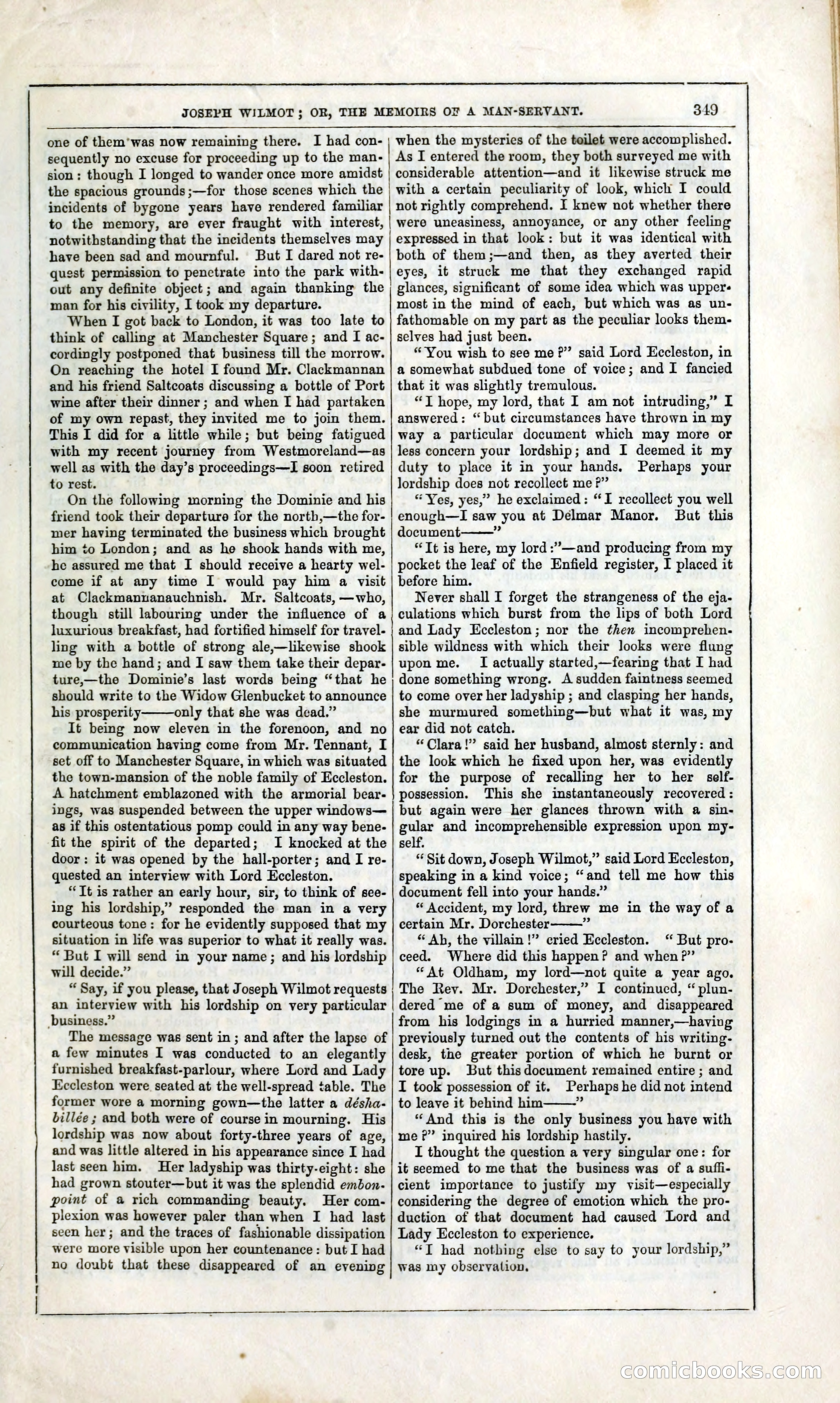
A restored page from Penny Dreadfuls, 1854. Page through the whole issue in the reader above.
📄 Transcribed text from this page (OCR, searchable)
Machine-transcribed from the original scan — historical spelling and the odd misread are preserved.
JOSEPH WILMOT; OR, THE MEMOIRS OF A MAN-SERVANT. one of them’was now remaining there. I had con- sequently no excuse for proceeding up to the man- sion; though I longed to wander once more amidst the spacious grounds ;—for those scenes which the incidents of bygone years have rendered familiar to the memory, are ever fraught with interest, notwithstanding that the incidents themselves may have been sad and mournful. But I dared not re- quest permission to penctrate into the park with- out any definite object; and again thanking the man for his civility, I took my departure. When I got back to London, it was too late to think of calling at Manchester Square; and I ac- cordingly postponed that business till the morrow. On reaching the hotel I found Mr. Clackmannan and his friend Saltcoats discussing a bottle of Port wine after their dinner ; and when I had partaken of my own repast, they invited me to join them. This I did for a little while; but being fatigued with my recent journey from Westmoreland—as well as with the day’s proceedings—I soon retired to rest. On the following morning the Dominie and his friend took their departure for the north,—the for- mer haying terminated the business which brought him to London; and as he shook hands with me, he assured me that I should receive a hearty wel- come if at any time I would pay him a visit at Clackmanuanauchnish. Mr. Saltcoats, —who, though still labouring under the influence of a luxurious breakfast, had fortified himself for travel- ling with a bottle of strong ale,—likewise shook me by the hand; and I saw them take their depar- ture,—the Dominie’s last words being “that he should write to the Widow Glenbucket to announce his prosperity only that she was dead.” It being now eleven in the forenoon, and no communication having come from Mr. Tennant, I set off to Manchester Square, in which was situated the town-mansion of the noble family of Eccleston. A hatchment emblazoned with the armorial bear- ings, was suspended between the upper windows— as if this ostentatious pomp could in any way bene- fit the spirit of the departed; I knocked at the door : it was opened by the hall-porter; and I re- quested an interview with Lord Eccleston. “Tt is rather an early hour, sir, to think of see- ing his lordship,” responded the man in a very courteous tone: for he evidently supposed that my situation in life was superior to what it really was. “ But I will send in your name; and his lordship will decide.” “ Say, if you please, that Joseph Wilmot requests an interview with his lordship on very particular business.” The message was sent in ; and after the lapse of a few minutes I was conducted to an elegantly furnished breakfast-parlour, where Lord and Lady Eccleston were seated at the well-spread table. The former wore a morning gown—the latter a désha- billée ; and both were of course in mourning. His lordship was now about forty-three years of age, | and was little altered in his appearance since I had last seen him. Her ladyship was thirty-eight: she had grown stouter—but it was the splendid embon- point of a rich commanding beauty. Her com- plexion was however paler than when I had last seen her; and the traces of fashionable dissipation were more visible upon her countenance: but I had no doubt that these disappeared of an evening i ee 349 when the mysteries of the toilet were accomplished. As I entered the room, they both surveyed me with considerable attention—and it likewise struck me with a certain peculiarity of look, which I could not rightly comprehend. I knew not whether there were uneasiness, annoyance, or any other feeling expressed in that look: but it was identical with both of them ;—and then, as they averted their eyes, it struck me that they exchanged rapid glances, significant of some idea which was uppers most in the mind of each, but which was as un- fathomable on my part as the peculiar looks them- selves had just been. “You wish to see me 2” said Lord Eccleston, in a somewhat subdued tone of voice; and I fancied that it was slightly tremulous. “T hope, my lord, that I am not intruding,” I answered: “but circumstances have thrown in my way a particular document which may more or less concern your lordship; and I deemed it my duty to place it in your hands. Perhaps your lordship does not recollect me ?” “Yes, yes,” he exclaimed: “I recollect you well enough—I saw you at Delmar Manor. But this document f “Tt is here, my lord:”—and producing from my pocket the leaf of the Enfield register, I placed it before him. Never shall I forget the strangeness of the eja- culations which burst from the lips of both Lord and Lady Eccleston; nor the then incomprehen- sible wildness with which their looks were flung upon me. I actually started,—fearing that I had done something wrong. A sudden faintness seemed to come over her ladyship ; and clasping her hands, she murmured something—but what it was, my ear did not catch. “Clara!” said her husband, almost sternly: and the look which he fixed upon her, was evidently for the purpose of recalling her to her self- possession. This she instantaneously recovered : but again were her glances thrown with a sin- gular and incomprehensible expression upon my- self. “Sit down, Joseph Wilmot,” said Lord Eccleston, speaking in a kind voice; “and tell me how this document fell into your hands.” * Accident, my lord, threw me in the way of a certain Mr. Dorchester 3 “ Ah, the villain!” cried Eccleston. ‘“ But pro- ceed. Where did this happen? and when?” “At Oldham, my lord—not quite a year ago. The Rev. Mr. Dorchester,” I continued, “ plun- dered me of a sum of money, and disappeared from his lodgings in a hurried manner,—haviug previously turned out the contents of his writing- desk, the greater portion of which he burnt or tore up. But thisdocument remained entire ; and I took possession of it. Perhaps he did not intend to leave it behind him——~” “And this is the only business you have with me ?” inquired his lordship hastily. I thought the question a very singular one: for it seemed to me that the business was of a sufli- cient importance to justify my visit—especially considering the degree of emotion which the pro- duction of that document had caused Lord and Lady Eccleston to experience. “T had nothing else to say to your lordship,” was my observation. re OOO) S (CO) AA