
Penny Dreadfuls, 1854 · page 73 of 394
Joseph Wilmot, or, The Memoirs of a Man-Servant — page 73: what you’re looking at
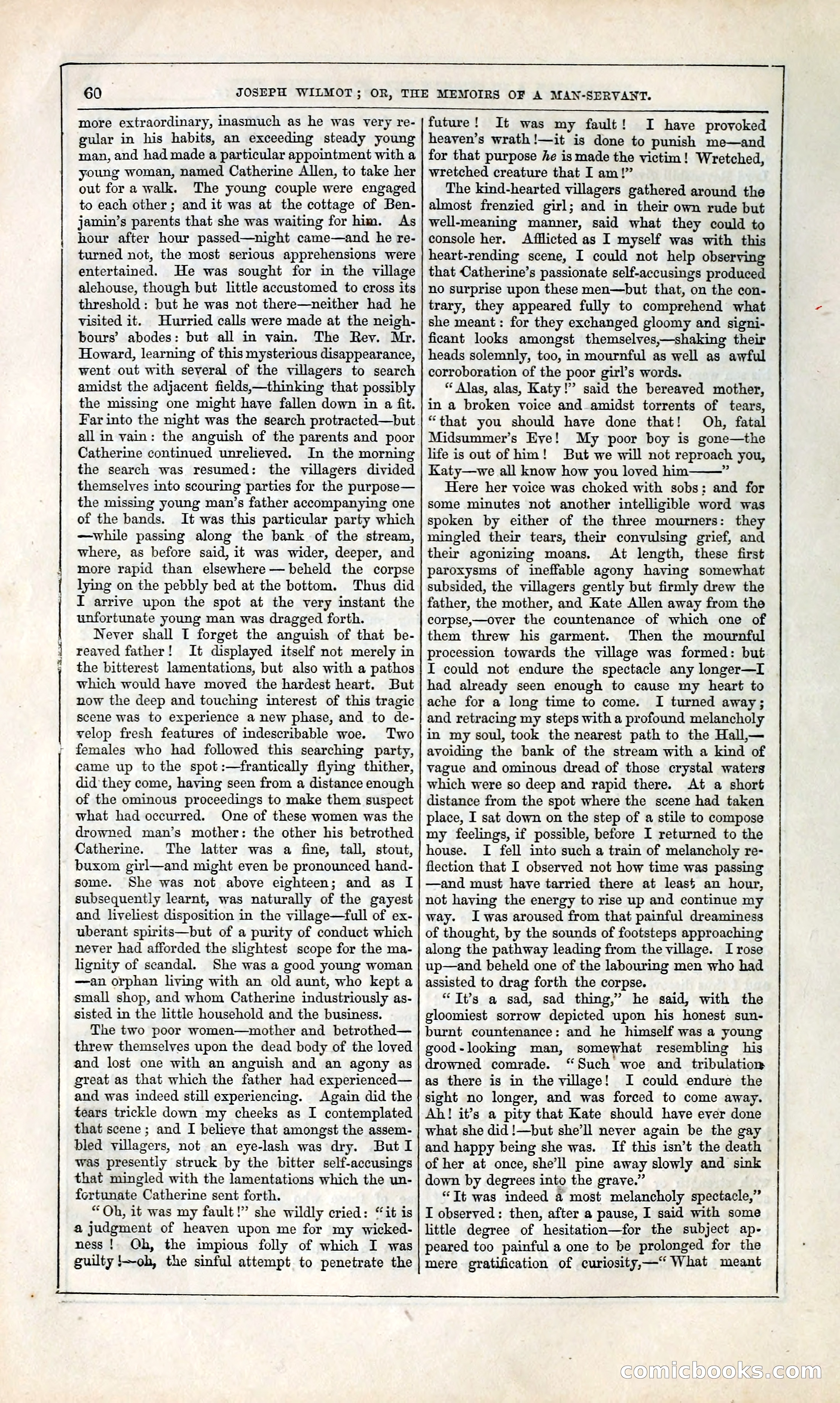
A restored page from Penny Dreadfuls, 1854. Page through the whole issue in the reader above.
📄 Transcribed text from this page (OCR, searchable)
Machine-transcribed from the original scan — historical spelling and the odd misread are preserved.
60 more extraordinary, inasmuch as he was very re- gular in his habits, an exceeding steady young man, and had made a particular appointment with a young woman, named Catherine Allen, to take her out for a walk. The young couple were engaged to each other; and it was at the cottage of Ben- jamin’s parents that she was waiting for him. As hour after hour passed—night came—and he re- turned not, the most serious apprehensions were entertained. He was sought for in the village alehouse, though but little accustomed to cross its threshold: but he was not there—neither had he visited it. Hurried calls were made at the neigh- bours’ abodes: but all in vain. The Rev. Mr. Howard, learning of this mysterious disappearance, went out with several of the villagers to search amidst the adjacent fields,—thinking that possibly the missing one might have fallen down in a fit. Far into the night was the search protracted—but. all in vain: the anguish of the parents and poor Catherine continued unrelieved. In the morning the search was resumed: the villagers divided themselves into scouring parties for the purpose— the missing young man’s father accompanying one of the bands. It was this particular party which —while passing along the bank of the stream, where, as before said, it was wider, deeper, and more rapid than elsewhere — beheld the corpse lying on the pebbly bed at the bottom. Thus did I arrive upon the spot at the very instant the unfortunate young man was dragged forth. Never shall [ forget the anguish of that be- reaved father! It displayed itself not merely in the bitterest lamentations, but also with a pathos which would have moved the hardest heart. But now the deep and touching interest of this tragic scene was to experience a new phase, and to de- velop fresh features of indescribable woe. Two females who had followed this searching party, came up to the spot:—frantically flying thither, did they come, having seen from a distance enough of the ominous proceedings to make them suspect what had occurred. One of these women was the drowned man’s mother: the other his betrothed Catherine. The latter was a fine, tall, stout, buxom girl—and might even be pronounced hand- some. She was not above eighteen; and as I subsequently learnt, was naturally of the gayest and liveliest disposition in the village—full of ex- uberant spirits—but of a purity of conduct which never had afforded the slightest scope for the ma- lignity of scandal. She was a good young woman —an orphan living with an old aunt, who kept a small shop, and whom Catherine industriously as- sisted in the little household and the business. The two poor women—mother and betrothed— threw themselves upon the dead body of the loved and lost one with an anguish and an agony as great as that which the father had experienced— and was indeed still experiencing. Again did the tears trickle down my cheeks as I contemplated that scene ; and I believe that amongst the assem- bled villagers, not an eye-lash was dry. But I was presently struck by the bitter self-accusings that mingled with the lamentations which the un- fortunate Catherine sent forth. “Oh, it was my fault!” she wildly cried: “it is a judgment of heaven upon me for my wicked- ness ! Qh, the impious folly of which I was guilty !~oh, the sinful attempt to penetrate the JOSEPH WILMOT; OR, THE MEMOIRS OF A MAN-SERVANT. future! It was my fault! I have provoked heayen’s wrath!—it is done to punish me—and for that purpose he is made the victim! Wretched, wretched creature that I am!” The kind-hearted villagers gathered around the almost frenzied girl; and in their own rude but well-meaning manner, said what they could to console her. Afflicted as I myself was with this heart-rending scene, I could not help observing that Catherine’s passionate self-accusings produced no surprise upon these men—but that, on the con- trary, they appeared fully to comprehend what she meant: for they exchanged gloomy and signi- ficant looks amongst themselves,—shaking their heads solemnly, too, in mournful as well as awful corroboration of the poor girl’s words. “ Alas, alas, Katy!’ said the bereaved mother, in a broken voice and amidst torrents of tears, “that you should have done that! Oh, fatal Midsummer’s Eye! My poor boy is gone—the life is out of him! But we will not reproach you, Katy—we all know how you loved him * Here her voice was choked with sobs: and for some minutes not another intelligible word was spoken by either of the three mourners: they mingled their tears, their convulsing grief, and their agonizing moans. At length, these first paroxysms of ineffable agony having somewhat subsided, the villagers gently but firmly drew the father, the mother, and Kate Allen away from the corpse,—over the countenance of which one of them threw his garment. Then the mournful procession towards the village was formed: but I could not endure the spectacle any longer—I had already seen enough to cause my heart to ache for a long time to come. I turned away; and retracing my steps with a profound melancholy in my soul, took the nearest path to the Hall— avoiding the bank of the stream with a kind of vague and ominous dread of those crystal waters which were so deep and rapid there. At a short distance from the spot where the scene had taken place, I sat down on the step of a stile to compose my feelings, if possible, before I returned to the house. I fell into such a train of melancholy re- flection that I observed not how time was passing —and must have tarried there at least an hour, not having the energy to rise up and continue my way. Iwas aroused from that painful dreaminess of thought, by the sounds of footsteps approaching along the pathway leading from the village. I rose up—and beheld one of the labouring men who had assisted to drag forth the corpse. “Tt’s a sad, sad thing,” he said, with the gloomiest sorrow depicted upon his honest sun- burnt countenance: and he himself was a young good-looking man, somewhat resembling his drowned comrade. “Such woe and tribulation as there is in the village! I could endure the sight no longer, and was forced to come away. Ah! it’s a pity that Kate should have ever done what she did !—but she’ll never again be the gay and happy being she was. If this isn’t the death of her at once, she’ll pine away slowly and sink down by degrees into the grave.” “Tt was indeed a most melancholy spectacle,” I observed: then, after a pause, I said with some little degree of hesitation—for the subject ap- peared too painful a one to be prolonged for the mere gratification of curiosity,—“ What meant Gboaks (C©) im