
Penny Dreadfuls, 1854 · page 74 of 394
Joseph Wilmot, or, The Memoirs of a Man-Servant — page 74: what you’re looking at
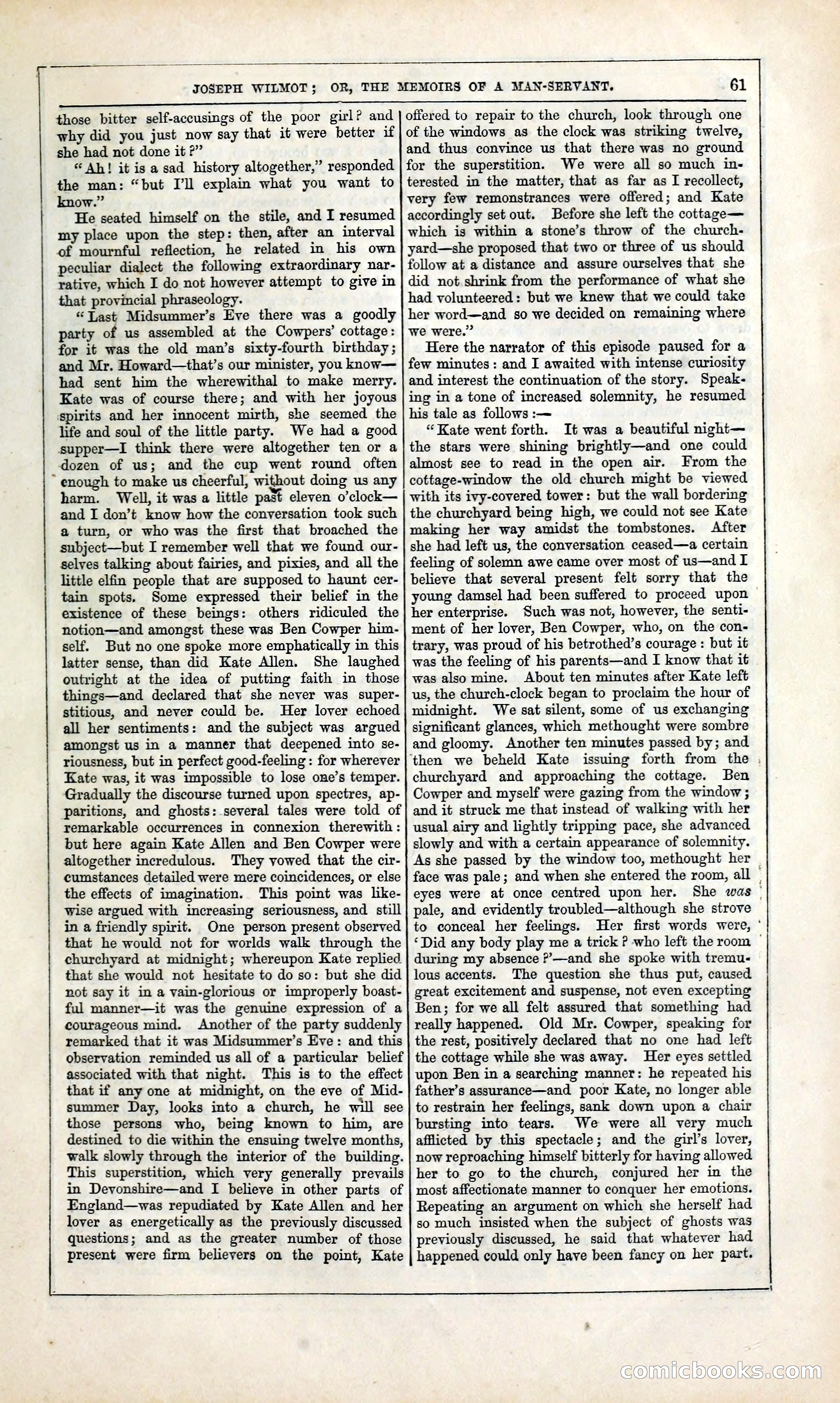
A restored page from Penny Dreadfuls, 1854. Page through the whole issue in the reader above.
📄 Transcribed text from this page (OCR, searchable)
Machine-transcribed from the original scan — historical spelling and the odd misread are preserved.
JOSEPH WILMOT ; those bitter self-accusings of the poor girl? and why did you just now say that it were better if she had not done it ?” “ Ah! it is a sad history altogether,” responded the man: “but Ill explain what you want to know.” He seated himself on the stile, and I resumed my place upon the step: then, after an interval of mournful reflection, he related in his own peculiar dialect the following extraordinary nar- rative, which I do not however attempt to give in that provincial phraseology. “Tast Midsummer’s Eve there was a goodly party of us assembled at the Cowpers’ cottage: for it was the old man’s sixty-fourth birthday; and Mr. Howard—that’s our minister, you know— had sent him the wherewithal to make merry. Kate was of course there; and with her joyous spirits and her innocent mirth, she seemed the life and soul of the little party. We had a good supper—lI think there were altogether ten or a dozen of us; and the cup went round often * enough to make us cheerful, without doing us any harm. Well, it was a little past eleven o’clock— and I don’t know how the conversation took such a turn, or who was the first that broached the subject—but I remember well that we found our- selves talking about fairies, and pixies, and all the little elfin people that are supposed to haunt cer- tain spots. Some expressed their belief in the existence of these beings: others ridiculed the notion—and amongst these was Ben Cowper him- self. But no one spoke more emphatically in this latter sense, than did Kate Allen. She laughed outright at the idea of putting faith in those things—and declared that she never was super- stitious, and never could be. Her lover echoed all her sentiments: and the subject was argued amongst us in a manner that deepened into se- riousness, but in perfect good-feeling : for wherever Kate was, it was impossible to lose one’s temper. Gradually the discourse turned upon spectres, ap- paritions, and ghosts: several tales were told of remarkable occurrences in connexion therewith: but here again Kate Allen and Ben Cowper were altogether incredulous. They yowed that the cir- cumstances detailed were mere coincidences, or else the effects of imagination. This point was like- wise argued with increasing seriousness, and still in a friendly spirit. One person present observed that he would not for worlds walk through the churchyard at midnight; whereupon Kate replied that she would not hesitate to do so: but she did not say it in a vain-glorious or improperly boast- ful manner—it was the genuine expression of a courageous mind. Another of the party suddenly remarked that it was Midsummer’s Eve: and this observation reminded us all of a particular belief associated with that night. This is to the effect that if any one at midnight, on the eve of Mid- summer Day, looks into a church, he will see those persons who, being known to him, are destined to die within the ensuing twelve months, walk slowly through the interior of the building. This superstition, which very generally prevails in Devonshire—and I believe in other parts of England—was repudiated by Kate Allen and her lover as energetically as the previously discussed questions; and as the greater number of those present were firm believers on the point, Kate OR, THE MEMOIRS OF A MAN-SERVANT. 61 offered to repair to the church, look through one of the windows as the clock was striking twelve, and thus convince us that there was no ground for the superstition. We were all so much in- terested in the matter, that as far as I recollect, very few remonstrances were offered; and Kate accordingly set out. Before she left the cottage— which is within a stone’s throw of the church- yard—she proposed that two or three of us should follow at a distance and assure ourselves that she did not shrink from the performance of what she had volunteered: but we knew that we could take her word—and so we decided on remaining where we were.” Here the narrator of this episode paused for a few minutes: and I awaited with intense curiosity and interest the continuation of the story. Speak- ing in a tone of increased solemnity, he resumed his tale as follows :— “Kate went forth. It was a beautiful night— the stars were shining brightly—and one could almost see to read in the open air. From the cottage-window the old church might be viewed with its ivy-covered tower: but the wall bordering the churchyard being high, we could not see Kate making her way amidst the tombstones. After she had left us, the conversation ceased—a certain feeling of solemn awe came over most of us—and I believe that several present felt sorry that the young damsel had been suffered to proceed upon her enterprise. Such was not, however, the senti- ment of her lover, Ben Cowper, who, on the con- trary, was proud of his betrothed’s courage : but it was the feeling of his parents—and I know that it was also mine. About ten minutes after Kate left us, the church-clock began to proclaim the hour of midnight. We sat silent, some of us exchanging significant glances, which methought were sombre and gloomy. Another ten minutes passed by; and then we beheld Kate issuing forth from the . churchyard and approaching the cottage. Ben Cowper and myself were gazing from the window ; and it struck me that instead of walking with her usual airy and lightly tripping pace, she advanced slowly and with a certain appearance of solemnity. As she passed by the window too, methought her — face was pale; and when she entered the room, all _ She was ° eyes were at once centred upon her. pale, and evidently troubled—although she strove to conceal her feelings. during my absence ??—and she spoke with tremu- lous accents. The question she thus put, caused great excitement and suspense, not even excepting Ben; for we all felt assured that something had really happened. Old Mr. Cowper, speaking for the rest, positively declared that no one had left the cottage while she was away. Her eyes settled upon Ben in a searching manner: he repeated his father’s assurance—and poor Kate, no longer able to restrain her feelings, sank down upon a chair bursting into tears. We were all very much afflicted by this spectacle; and the girl’s lover, now reproaching himself bitterly for having allowed her to go to the church, conjured her in the most affectionate manner to conquer her emotions. Repeating an argument on which she herself had so much insisted when the subject of ghosts was previously discussed, he said that whatever had happened could only have been fancy on her part. Her first words were, ° ‘Did any body play me a trick P who left the room ~ Ghboo cS (C(O) im