
Penny Dreadfuls, 1854 · page 162 of 399
Joseph Wilmot, or, The Memoirs of a Man-Servant — page 162: what you’re looking at
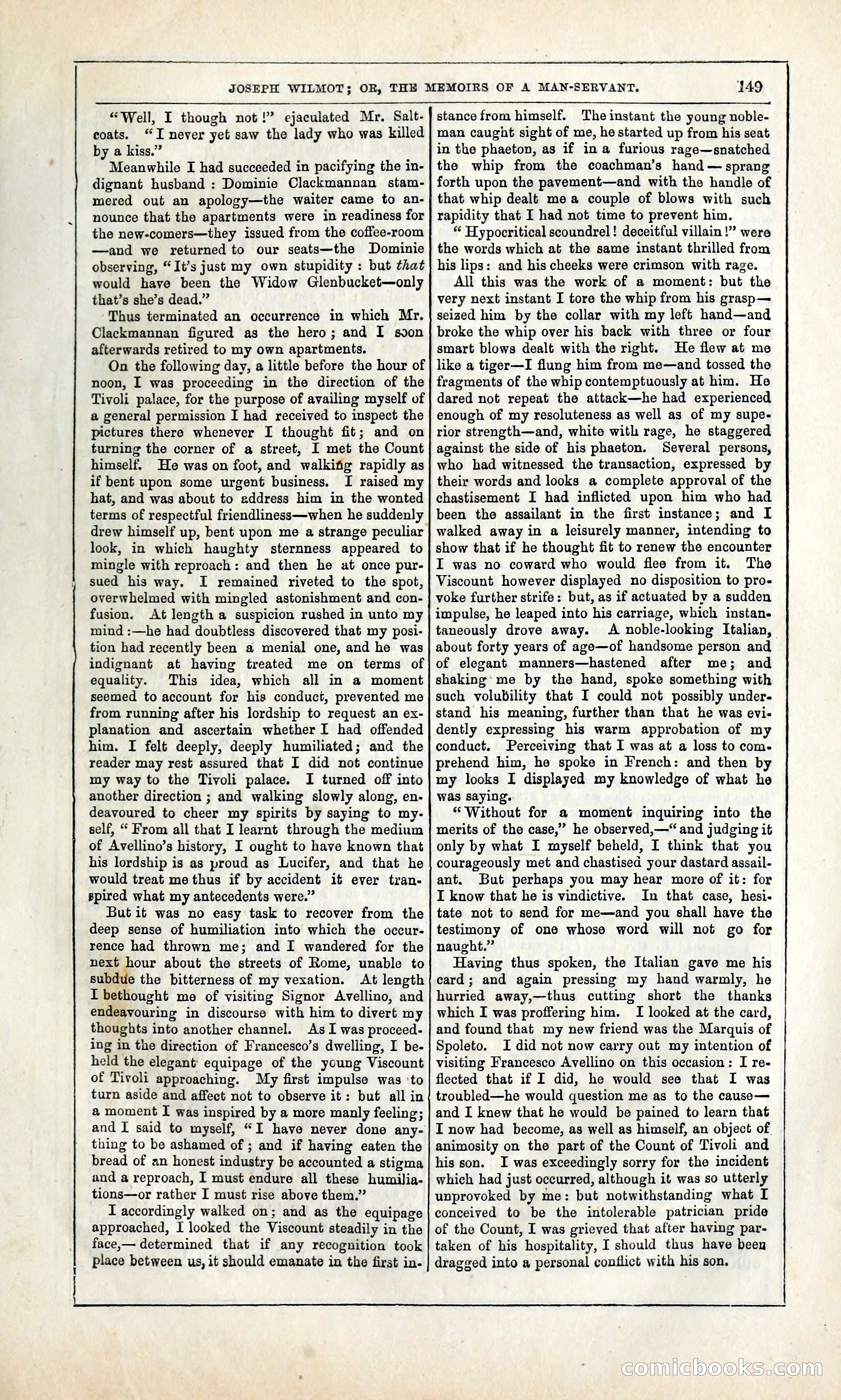
A restored page from Penny Dreadfuls, 1854. Page through the whole issue in the reader above.
📄 Transcribed text from this page (OCR, searchable)
Machine-transcribed from the original scan — historical spelling and the odd misread are preserved.
— es JOSEPH WILMOT; OR, THE MEMOIRS OF A MAN-SERVANT. “Well, I though not!” ejaculated Mr. Salt- coats. “I never yet saw the lady who was killed by a kiss.” Meanwhile I had succeeded in pacifying the in- dignant husband : Dominie Clackmannan stam- mered out an apology—the waiter came to an- nounce that the apartments were in readiness for the new-comers—they issued from the coffee-room —and we returned to our seats—the Dominie observing, “It’s just my own stupidity : but that would have been the Widow Glenbucket—only that’s she’s dead.” Thus terminated an occurrence in which Mr. Clackmannan figured as the hero; and I svon afterwards retired to my own apartments. On the following day, a little before the hour of noon, I was proceeding in the direction of the Tivoli palace, for the purpose of availing myself of a general permission I had received to inspect the pictures there whenever I thought fit; and on turning the corner of a street, I met the Count himself. He was on foot, and walkifig rapidly as if bent upon some urgent business. I raised my hat, and was about to address him in the wonted terms of respectful friendliness—when he suddenly drew himself up, bent upon me a strange peculiar look, in which haughty sternness appeared to mingle with reproach: and then he at once pur- sued his way. I remained riveted to the spot, overwhelmed with mingled astonishment and con- fusion. At length a suspicion rushed in unto my mind :—he had doubtless discovered that my posi- tion had recently been a menial one, and he was indignant at having treated me on terms of equality. This idea, which all in a moment seemed to account for his conduct, prevented me from running after his lordship to request an ex- planation and ascertain whether I had offended him. I felt deeply, deeply humiliated; and the reader may rest assured that I did not continue my way to the Tivoli palace. I turned off into another direction ; and walking slowly along, en- deavoured to cheer my spirits by saying to my- self, “ From all that I learnt through the medium of Avellino’s history, I ought to have known that his lordship is as proud as Lucifer, and that he would treat me thus if by accident it ever tran- ppired what my antecedents were.” But it was no easy task to recover from the deep sense of humiliation into which the occur- rence had thrown me; and I wandered for the next hour about the streets of Rome, unable to subdue the bitterness of my vexation. At length I bethought me of visiting Signor Avellino, and endeavouring in discourse with him to divert my thoughts into another channel. As I was proceed- ing in the direction of Francesco’s dwelling, I be- held the elegant equipage of the young Viscount of Tivoli approaching. My first impulse was ‘to turn aside and affect not to observe it: but all in a moment I was inspired by a more manly feeling; and I said to myself, “I have never done any- thing to be ashamed of ; and if having eaten the bread of an honest industry be accounted a stigma and a reproach, I must endure all these humilia- tions—or rather I must rise above them.” I accordingly walked on; and as the equipage approached, I looked the Viscount steadily in the face,— determined that if any recognition took place between us, it should emanate in the first in- 149 stance from himself. The instant the young noble- man caught sight of me, he started up from his seat in the phaeton, as if ina furious rage—snatched the whip from the coachman’s hand — sprang forth upon the pavement—and with the handle of that whip dealt mea couple of blows with such rapidity that I had not time to prevent him. “ Hypocritical scoundrel! deceitful villain !” were the words which at the same instant thrilled from his lips: and his cheeks were crimson with rage. All this was the work of a moment: but the very next instant I tore the whip from his grasp— seized him by the collar with my left hand—and broke the whip over his back with three or four smart blows dealt with the right. He flew at me like a tiger—I flung him from me—and tossed the fragments of the whip contemptuously at him. He dared not repeat the attack—he had experienced enough of my resoluteness as well as of my supe- rior strength—and, white with rage, he staggered against the side of his phaeton. Several persons, who had witnessed the transaction, expressed by their words and looks a complete approval of the chastisement I had inflicted upon him who had been the assailant in the first instance; and I walked away in a leisurely manner, intending to show that if he thought fit to renew the encounter I was no coward who would flee from it. The Viscount however displayed no disposition to pro- voke further strife: but, as if actuated by a sudden impulse, he leaped into his carriage, which instane taneously drove away. about forty years of age—of handsome person and of elegant manners—hastened after me; and shaking’ me by the hand, spoke something with such volubility that I could not possibly under- stand his meaning, further than that he was evi- dently expressing his warm approbation of my conduct. Perceiving that I was at a loss to com- prehend him, he spoke in French: and then by my looks I displayed my knowledge of what he was saying. ‘Without for a moment inquiring into the merits of the case,” he observed,—“ and judging it only by what I myself beheld, I think that you courageously met and chastised your dastard assail- ant. But perhaps you may hear more of it: for I know that he is vindictive. In that case, hesi- tate not to send for me—and you shall have the testimony of one whose word will not go for | naught.” Having thus spoken, the Italian gave me his card; and again pressing my hand warmly, he hurried away,—thus cutting short the thanks which I was proffering him. I looked at the card, and found that my new friend was the Marquis of Spoleto. I did not now carry out my intention of visiting Francesco Avellino on this occasion: I re- flected that if I did, he would see that I was troubled—he would question me as to the cause— and I knew that he would be pained to learn that I now had become, as well as himself, an object of. animosity on the part of the Count of Tivoli and his son. I was exceedingly sorry for the incident which had just occurred, although it was so utterly unprovoked by me: but notwithstanding what I conceived to be the intolerable patrician pride of the Count, I was grieved that after having par- taken of his hospitality, I should thus have been drageed into a personal conflict with his son. A noble-looking Italian, DOOLKS co