
Penny Dreadfuls, 1854 · page 163 of 399
Joseph Wilmot, or, The Memoirs of a Man-Servant — page 163: what you’re looking at
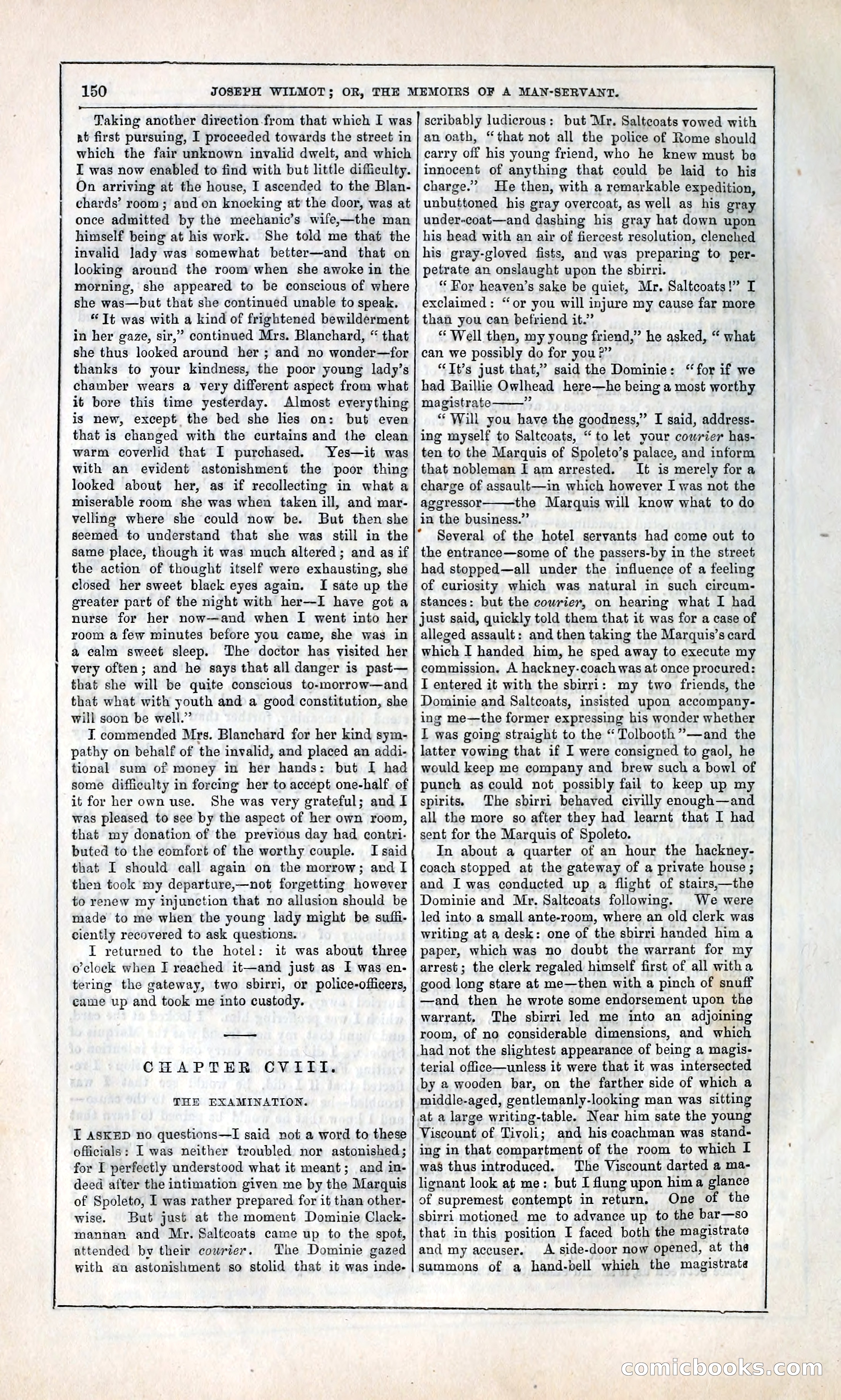
A restored page from Penny Dreadfuls, 1854. Page through the whole issue in the reader above.
📄 Transcribed text from this page (OCR, searchable)
Machine-transcribed from the original scan — historical spelling and the odd misread are preserved.
LDL 150 JOSEPH WILMOT; OR, THE MEMOIRS OF A MAN-SERVANT. Taking another direction from that which I was nt first pursuing, I proceeded towards the street in which the fair unknown invalid dwelt, and which I was now enabled to find with but little difficulty. On arriving at the house, I ascended to the Blan- chards’ room; and on knocking at’ the door, was at once admitted by the mechanic’s wife,—the man himself being at his work. She told me that the invalid lady was somewhat better—and that on looking around the room when she awoke in the morning, she appeared to be conscious of where she was—but that she continued unable to speak, It was with a kind of frightened bewilderment in her gaze, sir,” continued Mrs. Blanchard, “ that she thus looked around her ; and no wonder—for thanks to your kindness, the poor young lady’s chamber wears a very different aspect from what it bore this time yesterday. Almost everything is new, except the bed she lies on: but even that is changed with the curtains and the clean warm coverlid that I purchased. Yes—it was with an evident astonishment the poor thing looked about her, as if recollecting in what a miserable room she was when taken ill, and mar- velline where she could now be. But then she seemed to understand that she was still in the |° same place, though it was much altered; and as if the action of thought itself were exhausting, she closed her sweet black eyes again. [ sate up the ereater part of the night with her—I have got a nurse for her now-—and when I went into her room a few minutes before you came, she was in a calm sweet sleep. The doctor has visited her very often; and he says that all danger is past— that she will be quite conscious to-morrow—and that what with youth and a good constitution, she will soon be well.” T commended Mrs. Blanchard for her kind sym- pathy on behalf of the invalid, and placed an addi- tional sum of money in her hands: but I had some difficulty in forcing her to accept one-half of it for her own use. She was very grateful; and I was pleased to see by the aspect of her own room, that my donation of the previous day had contri- buted to the comfort of the worthy couple. I said that I should call again on the morrow; and I then took my departure,—not forgetting however to renew my injunction that no allusion should be made to me when the young lady might be suffi- ciently recovered to ask questions. I returned to the hotel: it was about three o’cloeck when I reached it—and just as I was en- tering the gateway, two sbirri, or police-officers, came up and took me into custody. eee CHAPTER CVIII. THE EXAMINATION. I ASKED no questions—I said not a word to these officials: I was neither troubled nor astonished; for I perfectly understood what it meant; and in- deed after the intimation given me by the Marquis of Spoleto, I was rather prepared for it than other- wise. But just at the moment Dominie Clack- mannan and Mr. Saltecoats came up to the spot, attended by their cowrier. The Dominie gazed with au astonishment so stolid that it was inde- scribably ludicrous: but Mr. Saltcoats vowed with an oath, “that not all the police of Rome should carry off his young friend, who he knew must be innocent of anything that could be laid to his charge.’ He then, with a remarkable expedition, unbuttoned his gray overcoat, as well as his gray under-coat—and dashing his gray hat down upon his head with an air of fiercest resolution, clenched his gray-gloved fists, aud was preparing to per- petrate an onslaught upon the sbirri. “‘ For heaven’s sake be quiet, Mr. Saltcoats!” T exclaimed: “or you will injure my cause far more than you can befriend it.” “ Well then, my young friend,” he asked, “ what can we possibly do for you ?” “Tt’s just that,” said the Dominie: “for if we had Baillie Owlhead here—he being a most worthy magistrate + “‘ Will you have the goodness,” I said, address- ing myself to Saltcoats, “to let your cowrier has- ten to the Marquis of Spoleto’s palace, and inform that nobleman I am arrested. It is merely for a charge of assault—in which however I was not the agaressor the Marquis will know what to do in the business.” Several of the hotel servants had come out to the entrance—some of the passers-by in the street had stopped—all under the influence of a feeling of curiosity which was natural in such circum- stances: but the cowrier, on hearing what I had just said, quickly told them that it was for a case of alleged assault: and then taking the Marquis’s card which I handed him, he sped away to execute my commission. A hackney-coach was at once procured: I entered it with the sbirri: my two friends, the Dominie and Saltcoats, insisted upon accompany- ing me—the former expressing his wonder whether I was going straight to the “Tolbooth”—and the latter vowing that if I were consigned to gaol, he would keep me company and brew such a bowl of punch ascould not possibly fail to keep up my spirits. The sbirri behaved civilly enough—and all the more so after they had learnt that I had sent for the Marquis of Spoleto. In about a quarter of an hour the hackney- coach stopped at the gateway of a private house ; and I was conducted up a flight of stairs,—the Dominie and Mr. Saltcoats following. We were led into a small ante-room, where an old clerk was writing at a desk: one of the sbirri handed him a paper, which was no doubt the warrant for my arrest ; the clerk regaled himself first of all witha good long stare at me—then with a pinch of snuff —and then he wrote some endorsement upon the warrant, The sbirri led me into an adjoining room, of no considerable dimensions, and which had not the slightest appearance of being a magis- terial office—unless it were that it was intersected by 2 wooden bar, on the farther side of which a middle-aged, gentlemanly-looking man was sitting at a large writing-table. Near him sate the young Viscount of Tivoli; and his coachman was stand- ing in that compartment of the room to which I was thus introduced. The Viscount darted a ma- lignant look at me: but I flung upon hima glance of supremest contempt in return. One of the sbirri motioned me to advance up to the bar—so that in this position I faced both the magistrate and my accuser. A side-door now opened, at the summons of a hand-bell which the magistrate CoOmicooolks (C@)