
Penny Dreadfuls, 1854 · page 177 of 399
Joseph Wilmot, or, The Memoirs of a Man-Servant — page 177: what you’re looking at
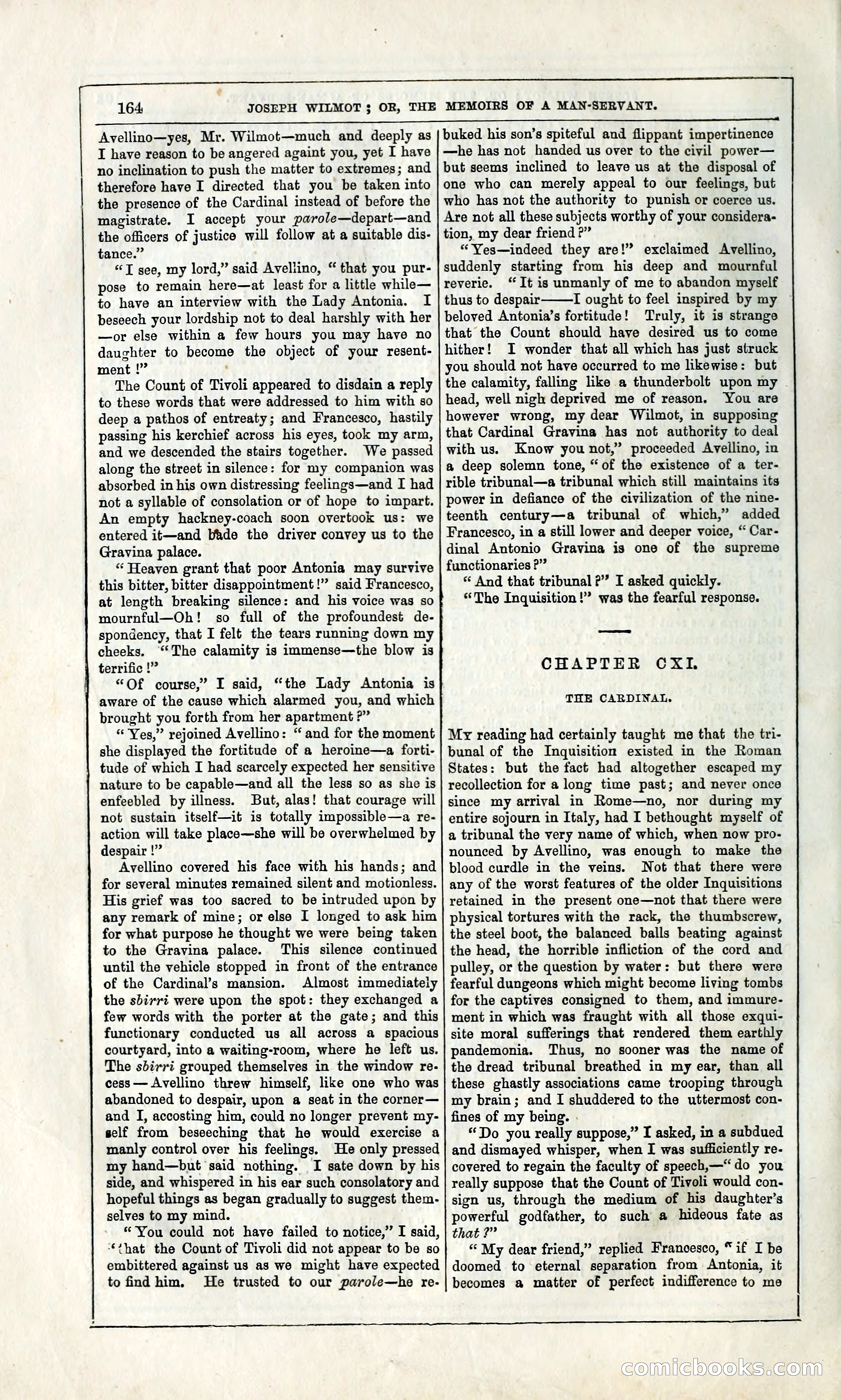
A restored page from Penny Dreadfuls, 1854. Page through the whole issue in the reader above.
📄 Transcribed text from this page (OCR, searchable)
Machine-transcribed from the original scan — historical spelling and the odd misread are preserved.
164: Avellino—yes, Mr. Wilmot—much and deeply as I have reason to be angered againt you, yet I have no inclination to push the matter to extremes; and therefore have I directed that you be taken into the presence of the Cardinal instead of before the magistrate. I accept your parole—depart—and the officers of justice will follow at a suitable dis- tance.” “T see, my lord,” said Aveliino, “ that you pur- pose to remain here—at least for a little while— to have an interview with the Lady Antonia. I beseech your lordship not to deal harshly with her —or else within a few hours you may have no daughter to become the object of your resent- ment !” The Count of Tivoli appeared to disdain a reply to these words that were addressed to him with so deep a pathos of entreaty; and Francesco, hastily passing his kerchief across his eyes, took my arm, and we descended the stairs together. We passed along the street in silence: for my companion was absorbed in his own distressing feelings—and I had not a syllable of consolation or of hope to impart. An empty hackney-coach soon overtook us: we entered it—and bade the driver convey us to the Gravina palace. “‘ Heaven grant that poor Antonia may survive this bitter, bitter disappointment!” said Francesco, at length breaking silence: and his voice was so mournful—Oh! so full of the profoundest de- spondency, that I felt the tears running down my cheeks. “The calamity is immense—the blow is terrific !” “Of course,” I said, “the Lady Antonia is aware of the cause which alarmed you, and which brought you forth from her apartment ?” “Yes,” rejoined Avellino: “and for the moment she displayed the fortitude of a heroine—a forti- tude of which I had scarcely expected her sensitive nature to be capable—and all the less so as she is enfeebled by illness. But, alas! that courage will not sustain itself—it is totally impossible—a re- action will take place—she will be overwhelmed by despair !” Avellino covered his face with his hands; and for several minutes remained silent and motionless. His grief was too sacred to be intruded upon by any remark of mine; or else I longed to ask him for what purpose he thought we were being taken to the Gravina palace. This silence continued until the vehicle stopped in front of the entrance of the Cardinal’s mansion. Almost immediately the sbirrit were upon the spot: they exchanged a few words with the porter at the gate; and this functionary conducted us all across a spacious courtyard, into a waiting-room, where he left us. The sbirri grouped themselves in the window re- cess — Avellino threw himself, like one who was abandoned to despair, upon a seat in the corner— and I, accosting him, could no longer prevent my- self from beseeching that he would exercise a manly control over his feelings. He only pressed my hand—but said nothing. I sate down by his side, and whispered in his ear such consolatory and hopeful things as began gradually to suggest them- selves to my mind. “You could not have failed to notice,” I said, “that the Count of Tivoli did not appear to be so embittered against us as we might have expected to find him, He trusted to our parole—he re- JOSEPH WILMOT ; OR, THE MEMOIRS OF A MAN-SERVANT. buked his son’s spiteful and flippant impertinence —he has not handed us over to the civil power— but seems inclined to leave us at the disposal of one who can merely appeal to our feelings, but who has not the authority to punish or coerce us. Are not all these subjects worthy of your considera- tion, my dear friend ?” “Yes—indeed they are!” exclaimed Avellino, suddenly starting from his deep and mournful reverie. “It is unmanly of me to abandon myself thus to despair I ought to feel inspired by my beloved Antonia’s fortitude! Truly, it is strange that the Count should have desired us to come hither! I wonder that all which has just struck you should not have occurred to me likewise: but the calamity, falling like a thunderbolt upon my head, well nigh deprived me of reason. You are however wrong, my dear Wilmot, in supposing that Cardinal Gravina has not authority to deal with us. Know you not,” proceeded Aveilino, in a deep solemn tone, “of the existence of a ter- rible tribunal—a tribunal which still maintains its power in defiance of the civilization of the nine- teenth century—a tribunal of which,” added Francesco, in a still lower and deeper voice, “ Car- dinal Antonio Gravina is one of the supreme functionaries ?” « And that tribunal ?”’ I asked quickly. “The Inquisition!” was the fearful response. CHAPTER CXl. THE CARDINAL. My reading had certainly taught me that the tri- bunal of the Inquisition existed in the Roman States: but the fact had altogether escaped my recollection for a long time past; and never once since my arrival in Rome—no, nor during my entire sojourn in Italy, had I bethought myself of a tribunal the very name of which, when now pro- nounced by Avellino, was enough to make the blood curdle in the veins. Not that there were any of the worst features of the older Inquisitions retained in the present one—not that there were physical tortures with the rack, the thumbscrew, the steel boot, the balanced balls beating against the head, the horrible infliction of the cord and pulley, or the question by water: but there were fearful dungeons which might become living tombs for the captives consigned to them, and immure- ment in which was fraught with all those exqui- site moral sufferings that rendered them earthly pandemonia. Thus, no sooner was the name of the dread tribunal breathed in my ear, than all these ghastly associations came trooping through my brain; and I shuddered to the uttermost con- fines of my being. . “Do you really suppose,” I asked, in a subdued and dismayed whisper, when I was sufficiently re- covered to regain the faculty of speech,—“do you really suppose that the Count of Tivoli would con- sign us, through the medium of his daughter’s powerful godfather, to such a hideous fate as that ?” “‘ My dear friend,” replied Francesco, “if I be doomed to eternal separation from Antonia, if becomes a matter of perfect indifference to me Le CORNICLOO@ Ss (CO)