
Penny Dreadfuls, 1854 · page 178 of 399
Joseph Wilmot, or, The Memoirs of a Man-Servant — page 178: what you’re looking at
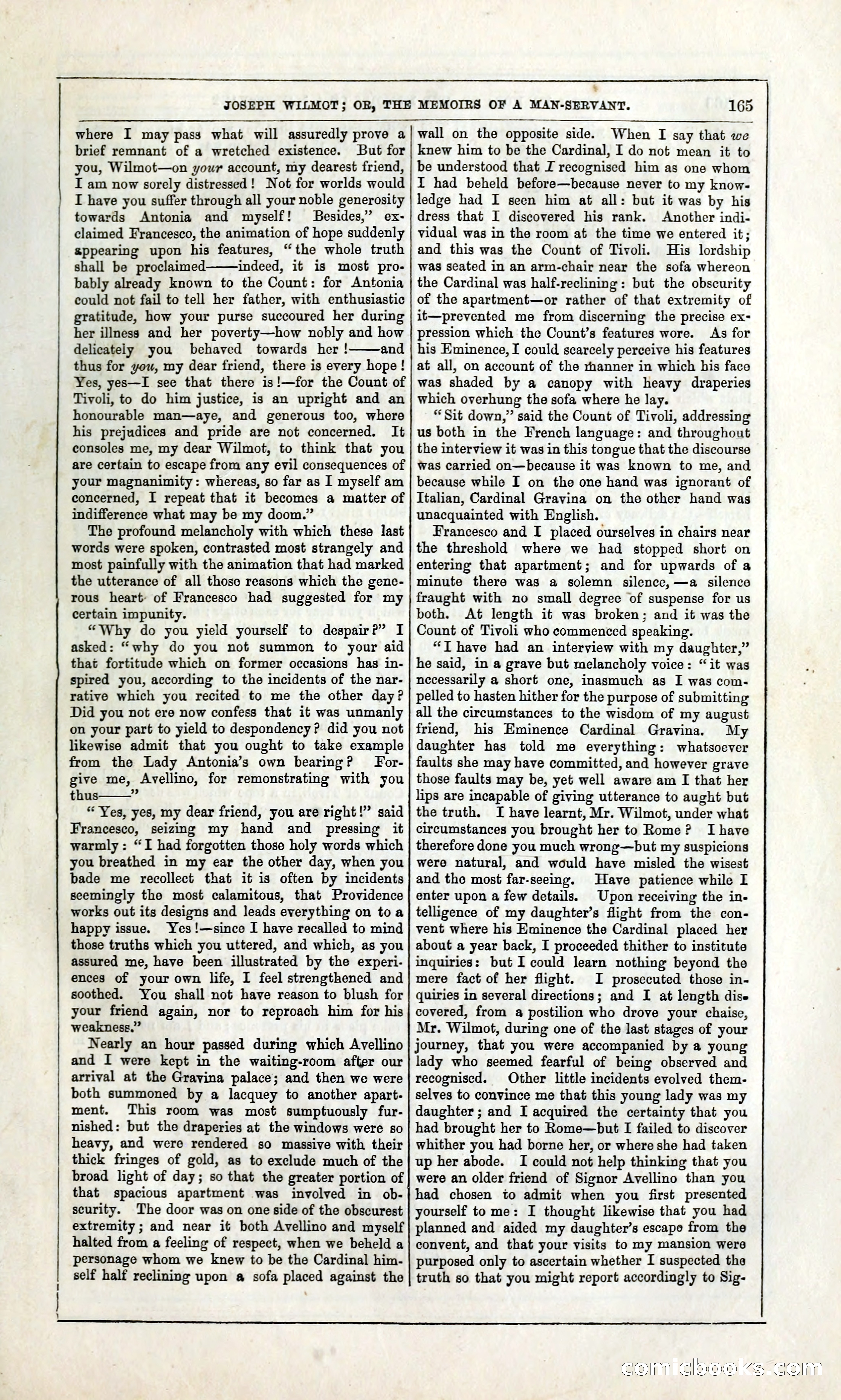
A restored page from Penny Dreadfuls, 1854. Page through the whole issue in the reader above.
📄 Transcribed text from this page (OCR, searchable)
Machine-transcribed from the original scan — historical spelling and the odd misread are preserved.
; JOSEPH WILMOT; OR, THE MEMOIRS OF A MAN-SERVANT. 165 where I may pass what will assuredly prove a brief remnant of a wretched existence. But for you, Wilmot—on your account, my dearest friend, I am now sorely distressed! Not for worlds would I have you suffer through all your noble generosity towards Antonia and myself! Besides,’ ex- claimed Francesco, the animation of hope suddenly appearing upon his features, “the whole truth shall be proclaimed indeed, it is most pro- bably already known to the Count: for Antonia could not fail to tell her father, with enthusiastic gratitude, how your purse succoured her during her illness and her poverty—how nobly and how delicately you behaved towards her! and thus for you, my dear friend, there is every hope! Yes, yes—I see that there is!—for the Count of Tivoli, to do him justice, is an upright and an honourable man—aye, and generous too, where his prejudices and pride are not concerned. It consoles me, my dear Wilmot, to think that you are certain to escape from any evil consequences of your magnanimity: whereas, so far as I myself am concerned, I repeat that it becomes a matter of indifference what may be my doom.” The profound melancholy with which these last words were spoken, contrasted most strangely and most painfully with the animation that had marked the utterance of all those reasons which the gene- rous heart of Francesco had suggested for my certain impunity. “Why do you yield yourself to despair?” I asked: “why do you not summon to your aid that fortitude which on former occasions has in- spired you, according to the incidents of the nar- rative which you recited to me the other day? Did you not ere now confess that it was unmanly on your part to yield to despondency? did you not likewise admit that you ought to take example from the Lady Antonia’s own bearing? For- give me, Avellino, for remonstrating with you thus i “Yes, yes, my dear friend, you are right!” said Francesco, seizing my hand and pressing it warmly: “I had forgotten those holy words which you breathed in my ear the other day, when you bade me recollect that it is often by incidents seemingly the most calamitous, that Providence works out its designs and leads everything on toa happy issue. Yes!—since I have recalled to mind those truths which you uttered, and which, as you assured me, have been illustrated by the experi- ences of your own life, I feel strengthened and soothed. You shall not have reason to blush for your friend again, nor to reproach him for his weakness,” Nearly an hour passed during which Avellino and I were kept in the waiting-room after our arrival at the Gravina palace; and then we were both summoned by a lacquey to another apart- ment. This room was most sumptuously fur- nished: but the draperies at the windows were so heavy, and were rendered so massive with their thick fringes of gold, as to exclude much of the broad light of day; so that the greater portion of that spacious apartment was involved in ob- scurity. The door was on one side of the obscurest extremity; and near it both Avellino and myself halted from a feeling of respect, when we beheld a personage whom we knew to be the Cardinal him- self half reclining upon a sofa placed against the wall on the opposite side. When I say that we knew him to be the Cardinal, I do not mean it to be understood that I recognised him as one whom I had beheld before—because never to my know- ledge had I seen him at all: but it was by his dress that I discovered his rank. Another indi- vidual was in the room at the time we entered it; and this was the Count of Tivoli. His lordship was seated in an arm-chair near the sofa whereon the Cardinal was half-reclining: but the obscurity of the apartment—or rather of that extremity of it—prevented me from discerning the precise ex- pression which the Count’s features wore. As for his Eminence, I could scarcely perceive his features at all, on account of the rhanner in which his face was shaded by a canopy with heavy draperies which overhung the sofa where he lay. “Sit down,” said the Count of Tivoli, addressing us both in the French language: and throughout the interview it was in this tongue that the discourse was carried on—because it was known to me, and because while I on the one hand was ignorant of Italian, Cardinal Gravina on the other hand was unacquainted with English. Francesco and I placed ourselves in chairs near the threshold where we had stopped short on entering that apartment; and for upwards of a minute there was a solemn silence, —a silence fraught with no small degree of suspense for us both. At length it was broken; and it was the Count of Tivoli who commenced speaking. “T have had an interview with my daughter,” he said, in a grave but melancholy voice: “it was necessarily a short one, inasmuch as I was com- pelled to hasten hither for the purpose of submitting all the circumstances to the wisdom of my august friend, his Eminence Cardinal Gravina. My daughter has told me everything: whatsoever faults she may have committed, and however grave those faults may be, yet well aware am I that her lips are incapable of giving utterance to aught but the truth. I have learnt, Mr. Wilmot, under what circumstances you brought her to Rome? Ihave therefore done you much wrong—but my suspicions were natural, and would have misled the wisest and the most far-seeing. Have patience while I enter upon a few details. Upon receiving the in- telligence of my daughter’s flight from the con- vent where his Eminence the Cardinal placed her about a year back, I proceeded thither to institute inquiries: but I could learn nothing beyond the mere fact of her flight. I prosecuted those in- quiries in several directions; and I at length dise covered, from a postilion who drove your chaise, Mr. Wilmot, during one of the last stages of your journey, that you were accompanied by a young lady who seemed fearful of being observed and recognised. Other little incidents evolved them- selves to convince me that this young lady was my daughter ; and I acquired the certainty that you had brought her to Rome—but I failed to discover whither you had borne her, or where she had taken up her abode. I could not help thinking that you were an older friend of Signor Avellino than you had chosen to admit when you first presented yourself to me: I thought likewise that you had planned and aided my daughter’s escape from the convent, and that your visits to my mansion were purposed only to ascertain whether I suspected the truth so that you might report accordingly to Sig- ECORliclboookKks (CO)