
Penny Dreadfuls, 1854 · page 184 of 399
Joseph Wilmot, or, The Memoirs of a Man-Servant — page 184: what you’re looking at
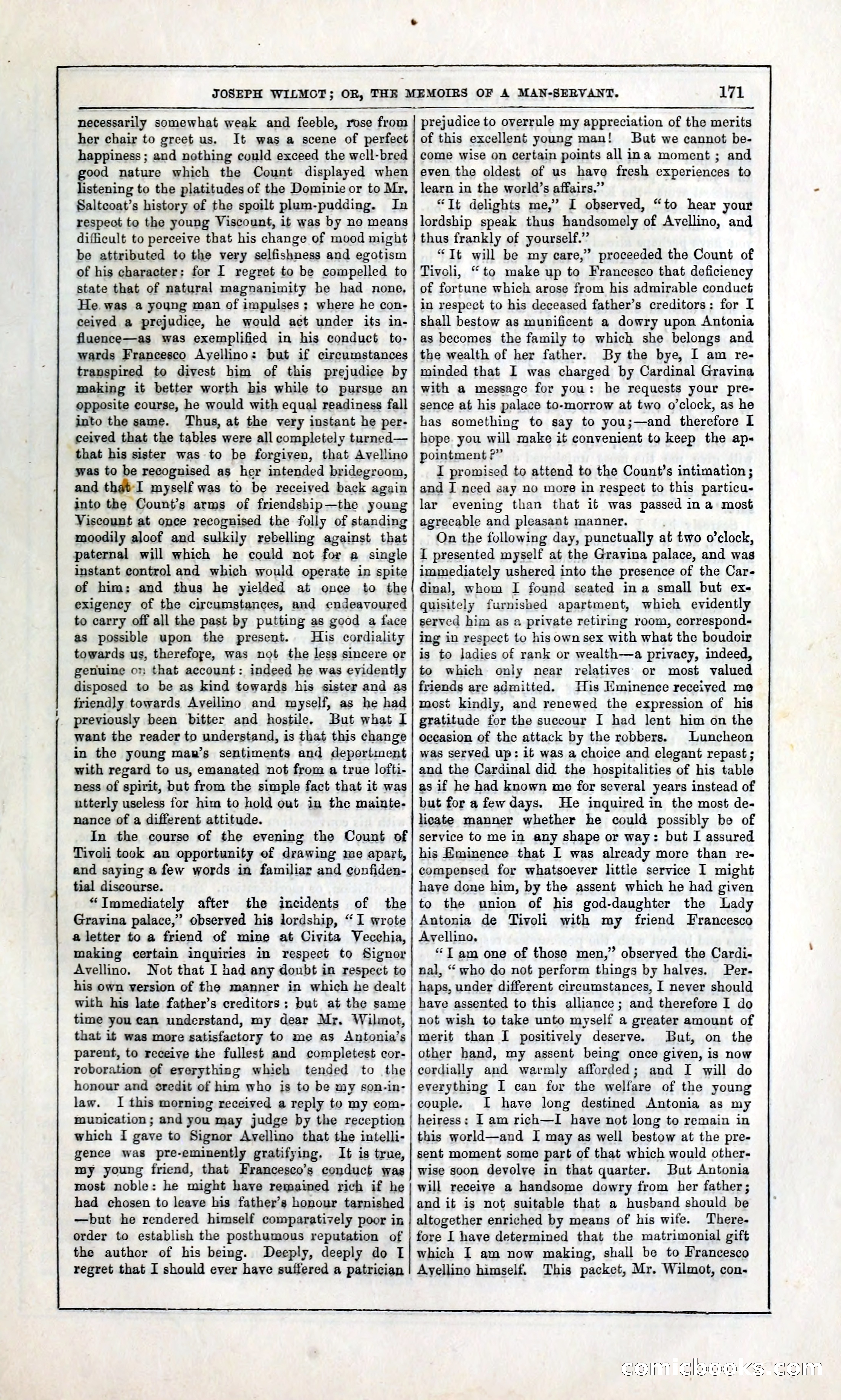
A restored page from Penny Dreadfuls, 1854. Page through the whole issue in the reader above.
📄 Transcribed text from this page (OCR, searchable)
Machine-transcribed from the original scan — historical spelling and the odd misread are preserved.
JOSEPH WILMOT; OR, THE MEMOIRS OF A MAN-SERVANT. 171 necessarily somewhat weak and feeble, rose from her chair to greet us. It was a scene of perfect happiness ; and nothing could exceed the well-bred good nature which the Count displayed when listening to the platitudes of the Dominie or to Mr, Saltcoat’s history of the spoilt plum-pudding. In respect to the young Viscount, it was by no means difficult to perceive that his change of mood might be attributed to the very selfishness and egotism of his character; for I regret to be compelled to state that of natural magnanimity he had none, He. was a young man of impulses; where he con- ceiyed a prejudice, he would act under its in- fluence—as was exemplified in his conduct to- wards Francesco Ayellino: but if circumstances transpired to divest him of this prejudice by making it better worth his while to pursne an opposite course, he would with equal readiness fall into the same. Thus, at the very instant he per- ceived that the tables were all completely turned— that his sister was to be forgiven, that Avellino was to be recognised as her intended bridegroom, and thdt-I myself was to be received back again into the Count’s arms of friendship—the young Viscount at once recognised the folly of standing moodily aloof and sulkily rebelling against that paternal will which he could not for a single instant control and which would operate in spite of him: and thus he yielded at once to the exigency of the circumstances, and endeavoured to carry off all the past by putting as good a face as possible upon the present. His cordiality towards us, therefore, was not the less sincere or genuine or: that account: indeed he was evidently disposed to be as kind towards his sister and as friendly towards Avellino and myself, as he had previously been bitter and hostile, But what I want the reader to understand, is that this change in the young man’s sentiments and deportment with regard to us, emanated not from a true lofti- ness of spirit, but from the simple fact that it was utterly useless for him to hold owt in the mainte- nance of a different attitude. In the course of the evening the Count of Tivoli took an opportunity of drawing me apart, and saying a few words in familiar and confiden- tial discourse. “Immediately after the incidents of the Gravina palace,” observed his lordship, “I wrote a letter to a friend of mine at Civita Vecchia, making certain inquiries in respect to Signor Avellino, Not that I had any doubt in respect to his own version of the manner in which he dealt with his late father’s creditors: but at the same time you can understand, my dear Mr. Wilmot, that it was more satisfactory to me as Antonia’s parent, to receive the fullest and completest cor- roboration of eyerything which tended to the honour and ¢redit of him who is to be my son-in- law. I this morning received a reply to my com- munication; and you may judge by the reception which I gave to Signor Avellino that the intelli- gence was pre-eminently gratifying. It is true, my young friend, that Francesco’s conduct was most noble: he might have remained rich if he had chosen to leave his father’s honour tarnished —but he rendered himself comparatively poor in order to establish the posthumous reputation of the author of his being. Deeply, deeply do I regret that I should ever have suffered a patrician prejudice to overrule my appreciation of the merits of this excellent young man! But we cannot be- come wise on certain points all ina moment ; and even the oldest of us have fresh experiences to learn in the world’s affairs.” “It delights me,’ I observed, “to hear your lordship speak thus handsomely of Avellino, and thus frankly of yourself.” “It will be my care,” proceeded the Count of Tivoli, “to make up to Francesco that deficiency of fortune which arose from his admirable conduct in respect to his deceased father’s creditors: for I shall bestow as munificent a dowry upon Antonia as becomes the family to which she belongs and the wealth of her father. By the bye, I am re- minded that I was charged by Cardinal Gravina with a message for you: he requests your pre- sence at his palace to-morrow at two o’clock, as he has something to say to you;—and therefore I hope you will make it convenient to keep the ap- pointment ?”’ I promised to attend to the Count’s intimation; and I need aay no more in respect to this particu- lar evening than that it was passed ina most agreeable and pleasant manner. | On the following day, punctually at two o’clock, I presented myself at the Gravina palace, and was immediately ushered into the presence of the Car- dinal, whom I found seated ina small but ex- quisitely furnished apartment, which evidently served him as a private retiring room, correspond- ing in respect to his own sex with what the boudoir is to ladies of rank or wealth—a privacy, indeed, to which only near relatives or most valued friends are admitted. His Eminence received me most kindly, and renewed the expression of his gratitude for the succour I had lent him on the oceasion of the attack by the robbers. Luncheon was served up: 16 was a choice and elegant repast; and the Cardinal did the hospitalities of his table as if he had known me for several years instead of but for a few days. He inquired in the most de- licate manner whether he could possibly be of service to me in any shape or way: but I assured his Eminence that I was already more than re- compensed for whatsoever littie service I might haye done him, by the assent which he had given to the union of his god-daughter the Lady Antonia de Tivoli with my friend Francesco Avellino. “T am one of those men,” observed the Cardi- nal, “ who do not perform things by halves, Per. haps, under different circumstances, I never should have assented to this alliance; and therefore I do not wish to take unto myself a greater amount of merit than I positively deserve. But, on the other hand, my assent being once given, is now cordially and warmly afforded; and I will do everything 1 can fur the welfare of the young couple. I have long destined Antonia as my heiress: I am rich—I have not long to remain in this world—and I may as well bestow at the pre- sent moment some part of that which would other- wise soon devolve in that quarter. But Antonia will receive a handsome dowry from her father; and it is not suitable that a husband should be altogether enriched by means of his wife. There- fore I have determined that the matrimonial gift which I am now making, shall be to Francesco Ayellino himself. This packet, Mr. Wilmot, con- CORmlicoookKks co