
Penny Dreadfuls, 1854 · page 185 of 399
Joseph Wilmot, or, The Memoirs of a Man-Servant — page 185: what you’re looking at
A restored page from Penny Dreadfuls, 1854. Page through the whole issue in the reader above.
📄 Transcribed text from this page (OCR, searchable)
Machine-transcribed from the original scan — historical spelling and the odd misread are preserved.
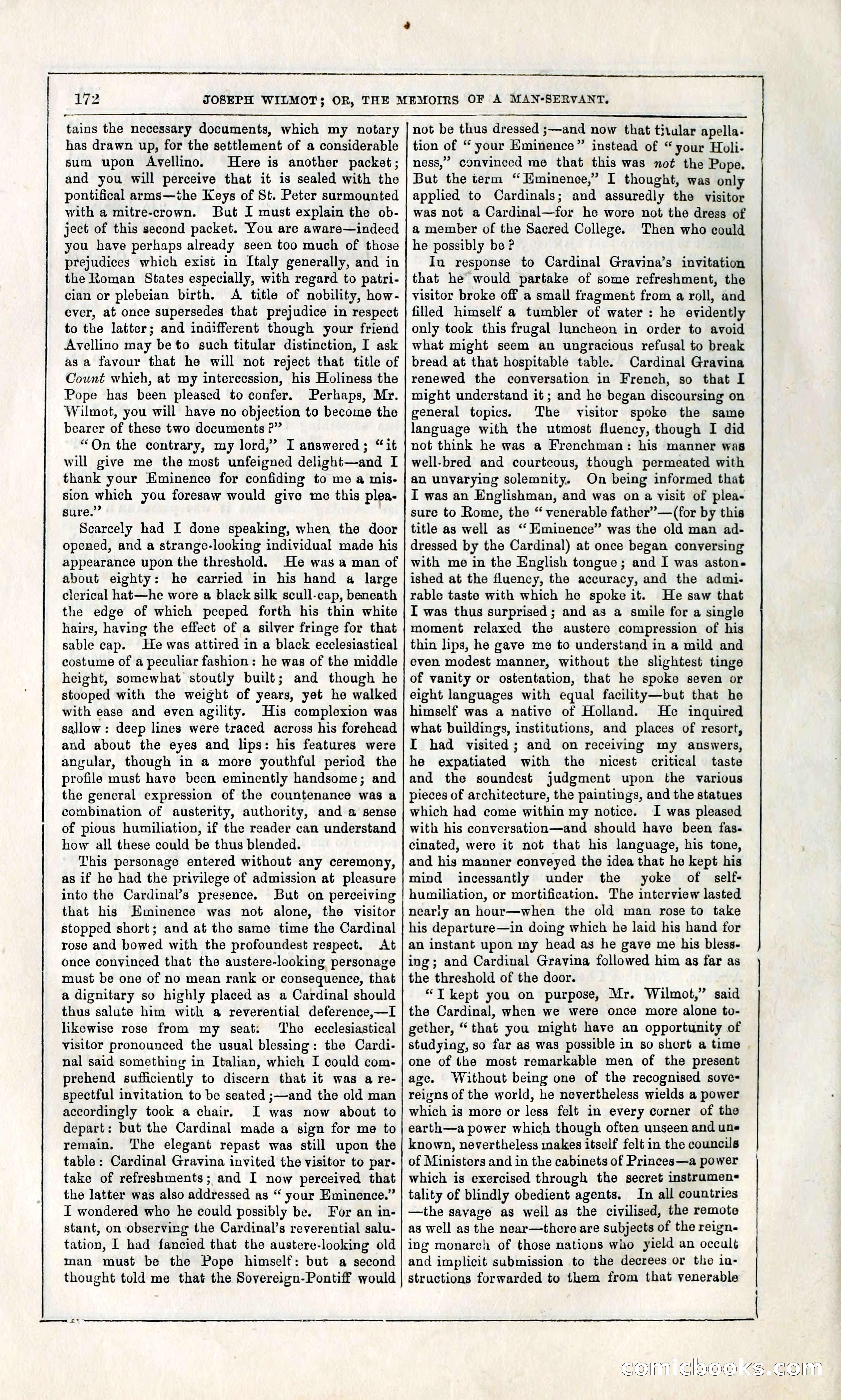
172 _—- tains the necessary documents, which my notary has drawn up, for the settlement of a considerable sum upon Avellino. Here is another packet; and you will perceive that it is sealed with the pontifical arms—the Keys of St. Peter surmounted with a mitre-crown. But I must explain the ob- ject of this second packet. You are aware—indeed you have perhaps already seen too much of those prejudices which exist in Italy generally, and in the Roman States especially, with regard to patri- cian or plebeian birth. A title of nobility, how- ever, at once supersedes that prejudice in respect to the latter; and indifferent though your friend Avellino may be to such titular distinction, I ask asa favour that he will not reject that title of Count whieh, at my intercession, his Holiness the Pope has been pleased to confer. Perhaps, Mr. Wilmot, you will have no objection to become the bearer of these two documents P” “On the contrary, my lord,’ I answered; “it will give me the most unfeigned delight—and I thank your Eminence for confiding to me a mis- sion which you foresaw would give me this plea- sure.” Scarcely had I done speaking, when the door opened, and a strange-looking individual made his appearance upon the threshold. He was a man of about eighty: he carried in his hand a large clerical hat—he wore a black silk scull-cap, beneath the edge of which peeped forth his thin white hairs, having the effect of a silver fringe for that sable cap. He was attired in a black ecclesiastical costume of a peculiar fashion: he was of the middle height, somewhat stoutly built; and though he stooped with the weight of years, yet he walked with ease and even agility. His complexion was sallow: deep lines were traced across his forehead and about the eyes and lips: his features were angular, though in a more youthful period the profile must have been eminently handsome; and the general expression of the countenance was a combination of austerity, authority, and a sense of pious humiliation, if the reader can understand how all these could be thus blended. This personage entered without any ceremony, as if he had the privilege of admission at pleasure into the Cardinal’s presence. But on perceiving that his Eminence was not alone, the visitor stopped short; and at the same time the Cardinal rose and bowed with the profoundest respect. At once convinced that the austere-looking personage must be one of no mean rank or consequence, that a dignitary so highly placed as a Cardinal should thus salute him with a reverential deference,—I likewise rose from my seat: The ecclesiastical visitor pronounced the usual blessing: the Cardi- nal said something in Italian, which I could com- prehend sufficiently to discern that it was a re- spectful invitation to be seated ;—and the old man accordingly took a chair. JI was now about to depart: but the Cardinal made a sign for me to remain. The elegant repast was still upon the table: Cardinal Gravina invited the visitor to par- take of refreshments; and I now perceived that the latter was also addressed as “ your Eminence.” I wondered who he could possibly be. For an in- stant, on observing the Cardinal’s reverential salu- tation, I had fancied that the austere-looking old man must be the Pope himself: but a second thought told me that the Sovereign-Pontiff would JOSEPH WILMOT; OR, THE MEMOIRS OF A MAN-SERVANT. not be thus dressed ;—and now that tivular apella- tion of “ your Eminence” instead of “ your Holi- ness,” convinced me that this was not the Pope. But the term “ Eminence,’ I thought, was only applied to Cardinals; and assuredly the visitor was not a Cardinal—for he wore not the dress of a member of the Sacred College. Then who could he possibly be? In response to Cardinal Gravina’s invitation that he would partake of some refreshment, the visitor broke off a small fragment from a roll, and filled himself a tumbler of water: he evidently only took this frugal luncheon in order to avoid what might seem an ungracious refusal to break bread at that hospitable table. Cardinal Gravina renewed the conversation in French, so that I might understand it; and he began discoursing on general topics. The visitor spoke the same language with the utmost fluency, though I did not think he was a Frenchman: his manner was well-bred and courteous, though permeated with an unvarying solemnity. On being informed that I was an Englishman, and was on a visit of plea- sure to Rome, the “ venerable father”—(for by this title as well as “ Eminence” was the old man ad- dressed by the Cardinal) at once began conversing with me in the English tongue; and I was aston. ished at the fluency, the accuracy, and the admi- rable taste with which he spoke it. He saw that I was thus surprised; and as a smile for a single moment relaxed the austere compression of his thin lips, he gave me to understand in a mild and even modest manner, without the slightest tinge of vanity or ostentation, that he spoke seven or eight languages with equal facility—but that he himself was a native of Holland. He inquired what buildings, institutions, and places of resort, I had visited; and on receiving my answers, he expatiated with the nicest critical taste and the soundest judgment upon the various pieces of architecture, the paintings, and the statues which had come within my notice. I was pleased with his conversation—and should have been fas- cinated, were it not that his language, his tone, and his manner conveyed the idea that he kept his mind incessantly under the yoke of self- humiliation, or mortification. The interview lasted nearly an hour—when the old man rose to take his departure—in doing which he laid his hand for an instant upon my head as he gave me his bless- ing; and Cardinal Gravina followed him as far as the threshold of the door. “Tkept you on purpose, Mr. Wilmot,” said the Cardinal, when we were once more alone to- gether, “that you might have an opportunity of studying, so far as was possible in so short a time one of the most remarkable men of the present age. Without being one of the recognised sove- reigns of the world, he nevertheless wields a power which is more or less felt in every corner of the earth—a power which though often unseen and une known, nevertheless makes itself felt in the councils of Ministers and in the cabinets of Princes—a power which is exercised through the secret instrumens tality of blindly obedient agents. In all countries —the savage as well as the civilised, the remote as well as the near—there are subjects of the reign. ing monarch of those nations who yield an occult and implicit submission to the decrees or the in- structions forwarded to them from that venerable —— = E|N@QO) <S) (c@) fim