
Penny Dreadfuls, 1854 · page 224 of 399
Joseph Wilmot, or, The Memoirs of a Man-Servant — page 224: what you’re looking at
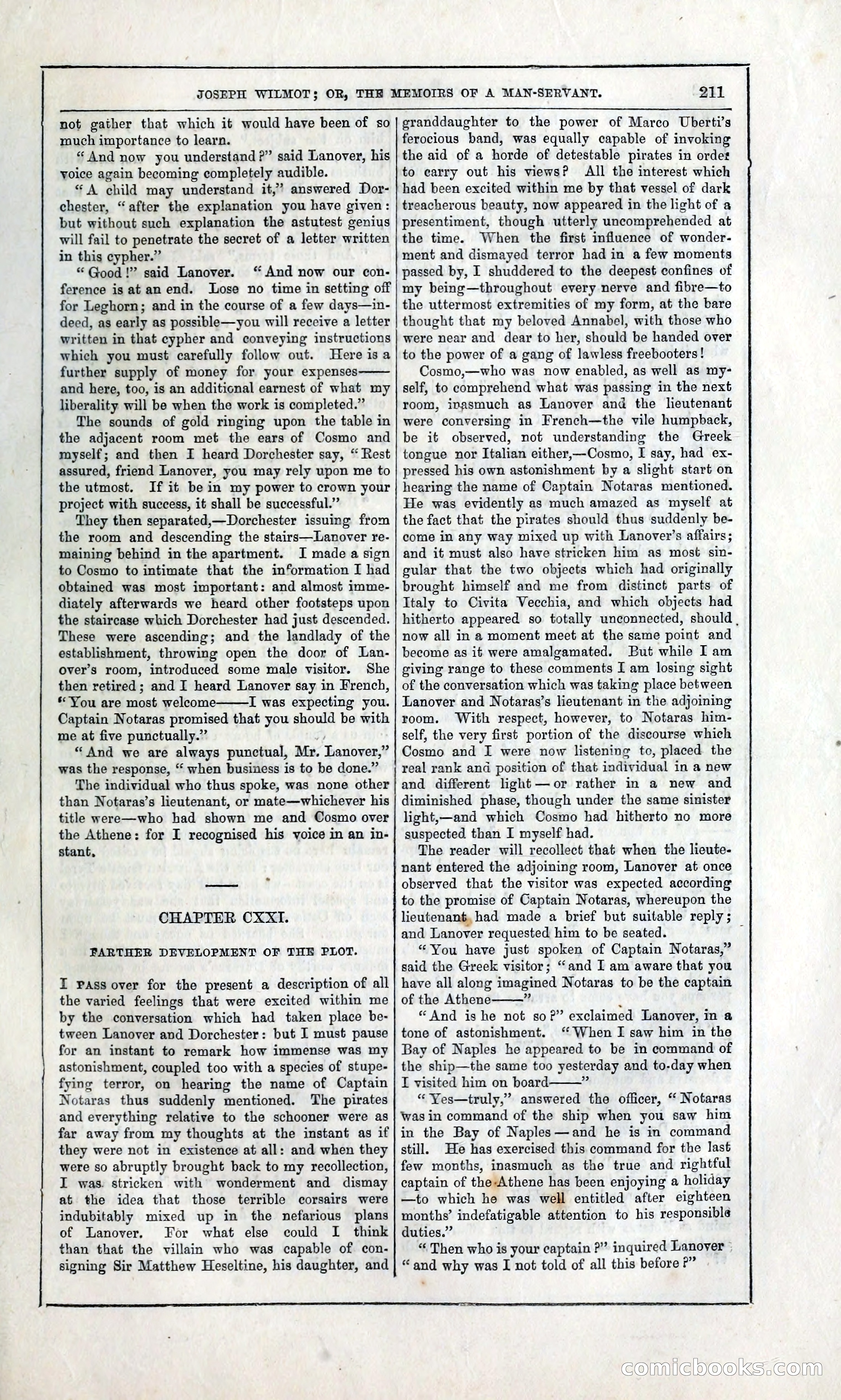
A restored page from Penny Dreadfuls, 1854. Page through the whole issue in the reader above.
📄 Transcribed text from this page (OCR, searchable)
Machine-transcribed from the original scan — historical spelling and the odd misread are preserved.
JOSEPH WILMOT; OR, THE MEMOIRS OF A MAN-SERVANT. not gather that which it would have been of so much importance to learn. “And now you understand ?” said Lanover, his yoice again becoming completely audible. “A child may understand it,’ answered Dor- chester, “after the explanation you have given: but without such explanation the astutest genius will fail to penetrate the secret of a letter written in this cypher.” “ Good!” said Lanover. “And now our con- ference is at anend. Lose no time in setting off for Leghorn; and in the course of a few days—in- deed, as early as possible—you will receive a letter written in that cypher and conveying instructions which you must carefully follow out. Here isa further supply of money for your expenses and here, too, is an additional earnest of what my liberality will be when the work is completed.” The sounds of gold ringing upon the table in the adjacent room met the ears of Cosmo and myself; and then I heard Dorchester say, “ Rest assured, friend Lanover, you may rely upon me to the utmost. If it bein my power to crown your project with success, it shall be successful.” They then separated,—Dorchester issuing from the room and descending the stairs—Lanover re- maining behind in the apartment. I made a sign to Cosmo to intimate that the information I had obtained was most important: and almost imme- diately afterwards we heard other footsteps upon the staircase which Dorchester had just descended. These were ascending; and the landlady of the establishment, throwing open the door of Lan- over’s room, introduced some male visitor. She then retired; and I heard Lanover say in French, ‘You are most welcome I was expecting you. Captain Notaras promised that you should be with me at five punctually.” “And we are always punctual, Mr. Lanover,” was the response, “ when business is to be done.” The individual who thus spoke, was none other than Notaras’s lieutenant, or mate—whichever his title were—who had shown me and Cosmo over the Athene: for I recognised his voice in an in- stant, CHAPTER CXXI. FARTHER DEVELOPMENT OF THE PLOT. I Pass over for the present a description of all the varied feelings that were excited within me by the conversation which had taken place be- tween Lanover and Dorchester: but 1 must pause for an instant to remark how immense was my astonishment, coupled too with a species of stupe- fying terror, on hearing the name of Captain Notaras thus suddenly mentioned. The pirates and everything relative to the schooner were as far away from my thoughts at the instant as if they were not in existence at all: and when they were so abruptly brought back to my recollection, I was. stricken with wonderment and dismay at the idea that those terrible corsairs were indubitably mixed up in the nefarious plans of Lanover. For what else could I think than that the villain who was capable of con- signing Sir Matthew Heseltine, his daughter, and 211 eranddaughter to the power of Marco Uberti’s ferocious band, was equally capable of invoking the aid of a horde of detestable pirates in ordet to carry out his viewsP All the interest which had been excited within me by that vessel of dark treacherous beauty, now appeared in the light of a presentiment, though utterly uncomprehended at the time. When the first influence of wonder- ment and dismayed terror had in a few moments passed by, I shuddered to the deepest confines of my being—throughout every nerve and fibre—to the uttermost extremities of my form, at the bare thought that my beloved Annabel, with those who were near and dear to her, should be handed over to the power of a gang of lawless freebooters! Cosmo,—who was now enabled, as well as my- self, to comprehend what was passing in the next room, inasmuch as Lanover and the leutenant were conversing in French—the vile humpback, be it observed, not understanding the Greek tongue nor Italian either,—Cosmo, I say, had ex- pressed his own astonishment by a slight start on hearing the name of Captain Notaras mentioned. He was evidently as much amazed as myself at the fact that the pirates should thus suddenly be- come in any way mixed up with Lanover’s affairs; and it must also have stricken him as most sin- gular that the two objects which had originally brought himself and me from distinct parts of Italy to Civita Vecchia, and which objects had hitherto appeared so totally unconnected, should . now all in a moment meet at the seme point and become as if were amalgamated. But while I am giving range to these comments I am losing sight of the conversation which was taking place between Lanover and Notaras’s lieutenant in the adjoining room. With respect, however, to Notaras him- self, the very first portion of the discourse which Cosmo and I were now listening te, placed the real rank ana position of that individual in a new and different light—or rather in @ new and diminished phase, though under the same sinister light,—and which Cosmo had hitherto no more suspected than I myself had. The reader will recollect that when the lieute- nant entered the adjoining room, Lanover at once observed that the visitor was expected according to the promise of Captain Notaras, whereupon the lieutenant, had made a brief but suitable reply; __ and Lanover requested him to be seated. “You have just spoken of Captain Notaras,” said the Greek visitor; “and I am aware that you have all along imagined Notaras to be the captain of the Athene * ! «“ And is he not so?” exclaimed Lanover, in a tone of astonishment. ‘ When I saw him in the Bay of Naples he appeared to be in command of the ship—the same too yesterday and to-day when I visited him on board A “ Yes—truly,” answered the officer, “ Notaras Was in command of the ship when you saw him in the Bay of Naples —and he is in command still. He has exercised this command for the last few months, inasmuch as the true and rightful captain of the-Athene has been enjoying a holiday —to which he was well entitled after eighteen months’ indefatigable attention to his responsible duties.” “Then who is your captain ?” inquired Lanover » “and why was I not told of all this before ?” eee eee rs ElN@QO) S (CO)