
Penny Dreadfuls, 1854 · page 225 of 399
Joseph Wilmot, or, The Memoirs of a Man-Servant — page 225: what you’re looking at
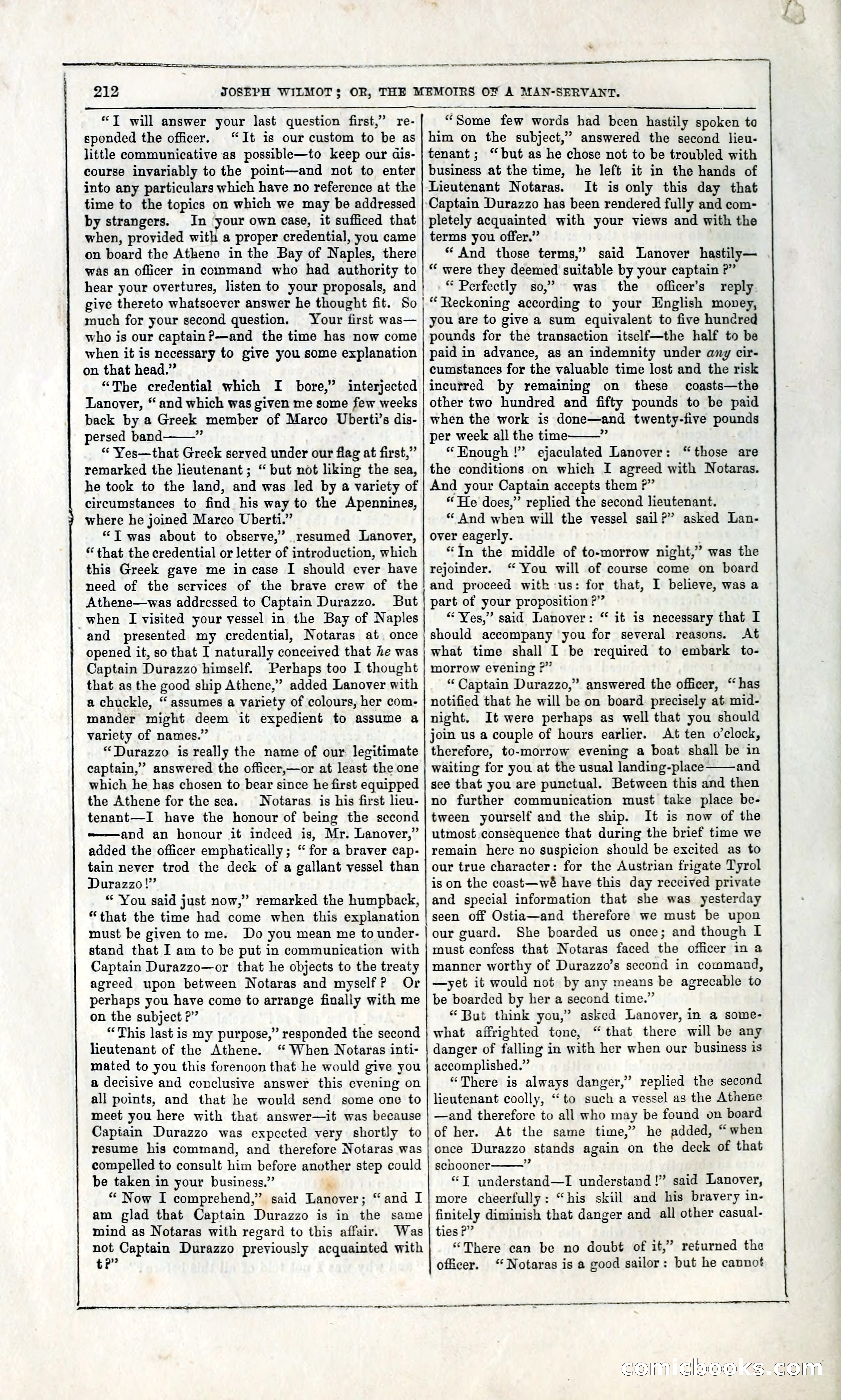
A restored page from Penny Dreadfuls, 1854. Page through the whole issue in the reader above.
📄 Transcribed text from this page (OCR, searchable)
Machine-transcribed from the original scan — historical spelling and the odd misread are preserved.
—ee eT = Seer ree eee ee 212 JOSEPH WILMOTs OR, THE MEMOIRS OF A MAN-SERVANT. “1 will answer your last question first,’ re- sponded the officer. “It is our custom to be as little communicative as possible—to keep our dis- course invariably to the point—and not to enter into any particulars which have no reference at the time to the topics on which we may be addressed by strangers. In your own case, it sufficed that when, provided with a proper credential, you came on board the Atheno in the Bay of N aples, there was an officer in command who had authority to hear your overtures, listen to your proposals, and give thereto whatsoever answer he thought fit. So much for your second question. Your first was— who is our captainP—and the time has now come when it is necessary to give you some explanation on that head.” “The credential which I bore,” interjected Lanover, “and which was given me some few weeks back by a Greek member of Marco Uberti’s dis- persed band “ Yes—that Greek served under our flag at first,” remarked the lieutenant; “ but not liking the sea, he took to the land, and was led by a variety of circumstances to find his way to the Apennines, where he joined Marco Uberti.” “JT was about to observe,’ resumed Lanover, “that the credential or letter of introduction, which this Greek gave me incase I should ever have need of the services of the brave crew of the Athene—was addressed to Captain Durazzo. But when I visited your vessel in the Bay of Naples -and presented my credential, Notaras at once opened it, so that I naturally conceived that he was Captain Durazzo himself. Perhaps too I thought that as the good ship Athene,” added Lanover with a chuckle, ‘“‘ assumes a variety of colours, her com- mander might deem it expedient to assume a variety of names.” “Durazzo is really the name of our legitimate captain,” answered the officer,—or at least the one which he has chosen to bear since he first equipped the Athene for the sea. Notaras is his first lieu- tenant—I have the honour of being the second and an honour it indeed is, Mr. Lanover,” added the officer emphatically; “ for a braver cap- tain never trod the deck of a gallant vessel than Durazzo!” “ You said just now,” remarked the humpback, “that the time had come when this explanation must be given to me. Do you mean me to under- stand that I am to be put in communication with Captain Durazzo—or that he objects to the treaty agreed upon between Notaras and myself? Or perhaps you have come to arrange finally with me on the subject ?” “This last is my purpose,” responded the second lieutenant of the Athene. ‘ When Notaras inti- mated to you this forenoon that he would give you a decisive and conclusive answer this evening on all points, and that he would send some one to meet you here with that answer—it was because Captain Durazzo was expected very shortly to resume his command, and therefore Notaras was compelled to consult him before another step could be taken in your business.” * Now I comprehend,” said Lanever: ; “and I am glad that Captain Durazzo is in the same mind as Notaras with regard to this affair. Was not Captain Durazzo previously acquainted with tP” eS A aC i ON I OE A AL CALA “Some few words had been hastily spoken ta him on the subject,” answered the second lieu- tenant; ‘but as he chose not to be troubled with business at the time, he left it in the hands of Lieutenant Notaras. It is only this day that Captain Durazzo has been rendered fully and com- pletely acquainted with your views and with the terms you offer.” “And those terms,’ said Lanover hastily— “‘ were they deemed suitable by your captain ?” “ Perfectly so,’ was the officer’s reply “Reckoning according to your English money, you are to give a sum equivalent to five huncred pounds for the transaction itself—the half to be paid in advance, as an indemnity under any cir- cumstances for the valuable time lost and the risk incutred by remaining on these coasts—the other two hundred and fifty pounds to be paid when the work is done—and twenty-five pounds per week all the time £ “Enough !” ejaculated Lanover: “those are the conditions on which I agreed with Notaras. And your Captain accepts them P” “He does,” replied the second lieutenant. * And when will the vessel sail?” asked Lan- over eagerly. “In the middle of to-morrow night,” was the rejoinder. ‘“ You will of course come on board and proceed with us: for that, I believe, was a part of your proposition ?” “Yes,” said Lanover: “ it is necessary that I should accompany you for several reasons. At what time shall I be required to embark to- morrow evening ?” “Captain Durazzo,” answered the officer, “has notified that he will be on board precisely at mid- night. It were perhaps as well that you should join us a couple of hours earlier. At ten o’clock, therefore, to-morrow evening a boat shall be in waiting for you at the usual landing-place and see that you are punctual. Between this and then no further communication must take place be- tween yourself and the ship. It is now of the utmost consequence that during the brief time we remain here no suspicion should be excited as to our true character: for the Austrian frigate Tyrol is on the coast—wé have this day received private and special information that she was yesterday seen off Ostia—and therefore we must be upon our guard. She boarded us once; and though I must confess that Notaras faced the officer in a manner worthy of Durazzo’s second in command, —yet it would not by any means be agreeable to be boarded by her a second time.” “But think you,” asked Lanover, in a some- what affrighted tone, “that there will be any danger of falling in with her when our business is accomplished.” “There is always danger,” replied the second lieutenant coolly, ‘to such a vessel as the Athene —and therefore to all who may be found on board of her. At the same time,” he added, “when once Durazzo stands again on the deck of that schooner ? “T understand—I understand!” said Lanover, more cheerfully: “his skill and his bravery in- finitely diminish that danger and all other casual- ties P” ‘There can be no doubt of it,” returned the officer. ‘ Notaras is a good sailor: but he cannot —————_———— OPO OR EE eS et et STE ELEC LAI I OOO) <S (C@)