
Penny Dreadfuls, 1854 · page 226 of 399
Joseph Wilmot, or, The Memoirs of a Man-Servant — page 226: what you’re looking at
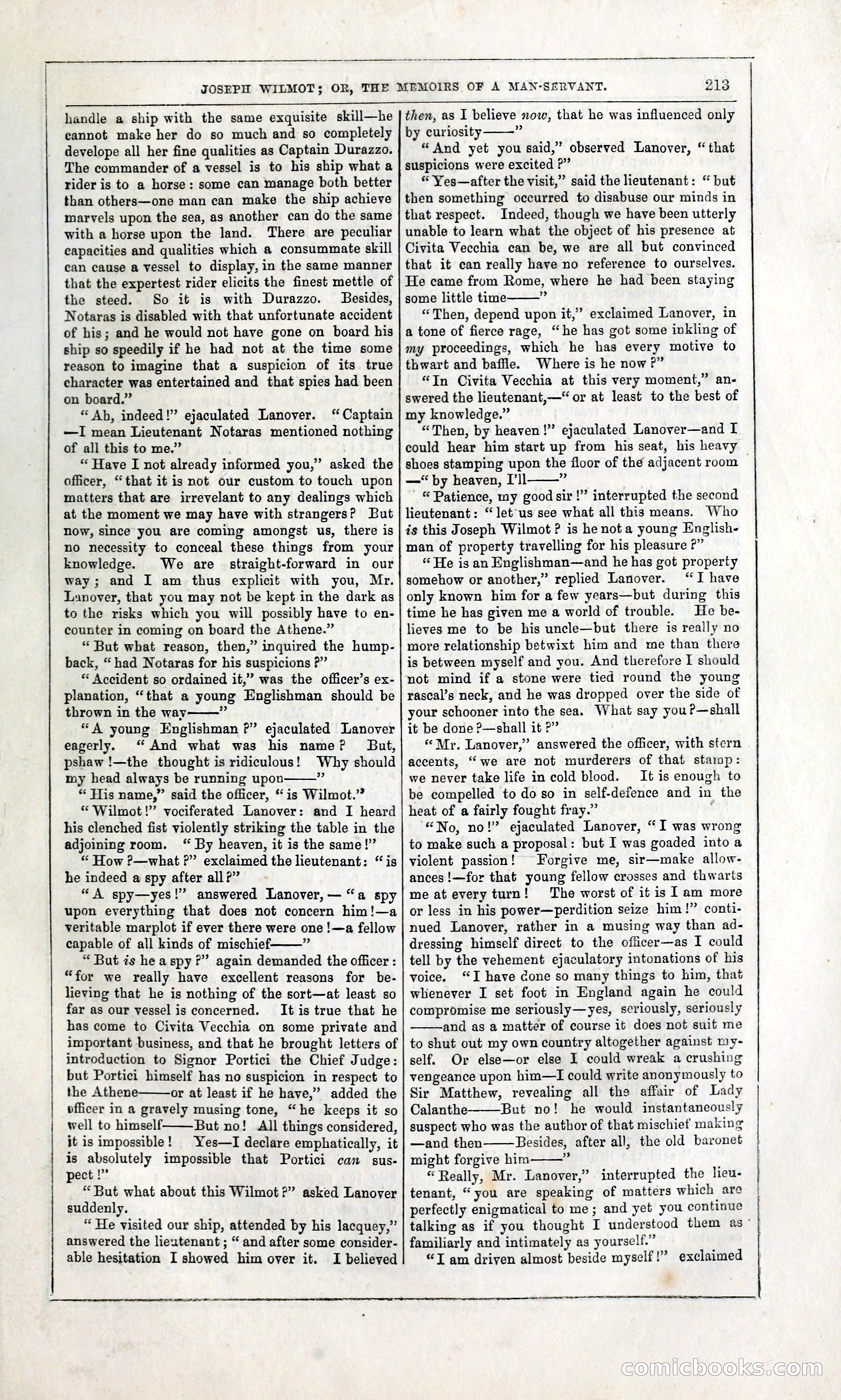
A restored page from Penny Dreadfuls, 1854. Page through the whole issue in the reader above.
📄 Transcribed text from this page (OCR, searchable)
Machine-transcribed from the original scan — historical spelling and the odd misread are preserved.
| | | handle a ship with the same exquisite skill—he cannot make her do so much and so completely develope all her fine qualities as Captain Durazzo. The commander of a vessel is to his ship what a rider is to a horse: some can manage both better than others—one man can make the ship achieve marvels upon the sea, as another can do the same with a horse upon the land. There are peculiar capacities and qualities which a consummate skill can cause a vessel to display, in the same manner that the expertest rider elicits the finest mettle of the steed. So it is with Durazzo. Besides, Notaras is disabled with that unfortunate accident of his; and he would not have gone on board his ship so speedily if he had not at the time some reason to imagine that a suspicion of its true character was entertained and that spies had been on board.” “ Ab, indeed!” ejaculated Lanover. ‘Captain —I mean Lieutenant Notaras mentioned nothing of all this to me.” “ Have I not already informed you,” asked the officer, “that it is not our custom to touch upon matters that are irrevelant to any dealings which at the moment we may have with strangers? But now, since you are coming amongst us, there is no necessity to conceal these things from your knowledge. We are straight-forward in our way; and I am thus explicit with you, Mr. Lanover, that you may not be kept in the dark as to the risks which you will possibly have to en- counter in coming on board the Athene.” “ But what reason, then,” inquired the hump- back, “had Notaras for his suspicions P” * Accident so ordained it,” was the officer’s ex- planation, “that a young Englishman should be thrown in the way 7 “A young Englishman ?” ejaculated Lanover eagerly. “And what was his name? But, pshaw !—the thought is ridiculous! Why should my head always be running upon 4 * Tis name,” said the officer, “is Wilmot.” * Wilmot!” vociferated Lanover: and I heard his clenched fist violently striking the table in the adjoining room. “ By heaven, it is the same!” “ How ?—what P” exclaimed the lieutenant: “is he indeed a spy after all?” “A spy—yes!” answered Lanover,— “a spy upon everything that does not concern him!—a veritable marplot if ever there were one !—a fellow capable of all kinds of mischie a “ But is he aspy ?” again demanded the officer : “for we really have excellent reasons for be- lieving that he is nothing of the sort—at least so far as our vessel is concerned. It is true that he has come to Civita Vecchia on some private and important business, and that he brought letters of introduction to Signor Portici the Chief Judge: but Portici himself has no suspicion in respect to the Athene or at least if he have,” added the officer in a gravely musing tone, “he keeps it so well to himself. But no! All things considered, it is impossible! | Yes—I declare emphatically, it is absolutely impossible that Portici can sus- pect !” “But what about this Wilmot?” asked Lanover suddenly. “ He visited our ship, attended by his lacquey,” answered the lieutenant; “ and after some consider- able hesitation I showed him over it. I believed JOSEPH WILMOT; OR, THE MEMOIRS OF A MAN-SERVANT. 213 then, as I believe now, that he was influenced only by curiosity i? “And yet you said,’ observed Lanover, “that suspicions were excited P” “ Yes—after the visit,” said the heutenant: “ but then something occurred to disabuse our minds in that respect. Indeed, though we have been utterly unable to learn what the object of his presence at Civita Vecchia can be, we are all but convinced that it can really have no reference to ourselves. He came from Rome, where he had been staying some little time a “Then, depend upon it,” exclaimed Lanover, in a tone of fierce rage, “he has got some inkling of my proceedings, which he has every motive to thwart and baffle. Where is he now P” “In Civita Vecchia at this very moment,” an- swered the lieutenant,—* or at least to the best of my knowledge.” “Then, by heaven!” ejaculated Lanover—and I git let cA TG OD could hear him start up from his seat, his heavy — shoes stamping upon the floor of the adjacent room —‘ by heaven, I'll a “ Patience, my good sir!” interrupted the second lieutenant: “let'us see what all this means. Who is this Joseph Wilmot ? is he nota young English- man of property travelling for his pleasure ?” “ He is an Englishman—and he has got property somehow or another,” replied Lanover. “I have only known him for a few years—but during this time he has given me a world of trouble. He be- lieves me to be his uncle—but there is really no more relationship betwixt him and me than there is between myself and you. And therefore I should not mind if a stone were tied round the young rascal’s neck, and he was dropped over the side of your schooner into the sea. What say you ?—shall it be done ?—shall it ?” «Mr. Lanover,” answered the officer, with stern accents, “we are not murderers of that stamp: we never take life in cold blood. It is enough to be compelled to do so in self-defence and in the heat of a fairly fought fray.” | “No, no!” ejaculated Lanover, “I was wrong to make such a proposal: but I was goaded into a violent passion! Forgive me, sir—make allow- ances !—for that young fellow crosses and thwarts me at every turn! The worst of it is lam more or less in his power—perdition seize him!” conti- nued Lanover, rather in a musing way than ad- dressing himself direct to the officer—as I could tell by the vehement ejaculatory intonations of his voice. “I have done so many things to him, that wlienever I set foot in England again he could compromise me seriously—yes, seriously, seriously and as a matter of course it does not suit me to shut out my own country altogether against my- self. Or else—or else I could wreak a crushing vengeance upon him—I could write anonymously to Sir Matthew, revealing all the affair of Lady Calanthe——But no! he would instantaneously suspect who was the author of that mischief making —and then Besides, after all, the old baronet might forgive him * “Really, Mr. Lanover,” interrupted the lieu- tenant, “you are speaking of matters which are perfectly enigmatical to me; and yet you continue talking as if you thought I understood them as’ familiarly and intimately as yourself.” “TJ am driven almost beside myself!” exclaimed Pt te Or a ee a a ea — CORNICE LOO@ S (CO) im