
Penny Dreadfuls, 1854 · page 276 of 399
Joseph Wilmot, or, The Memoirs of a Man-Servant — page 276: what you’re looking at
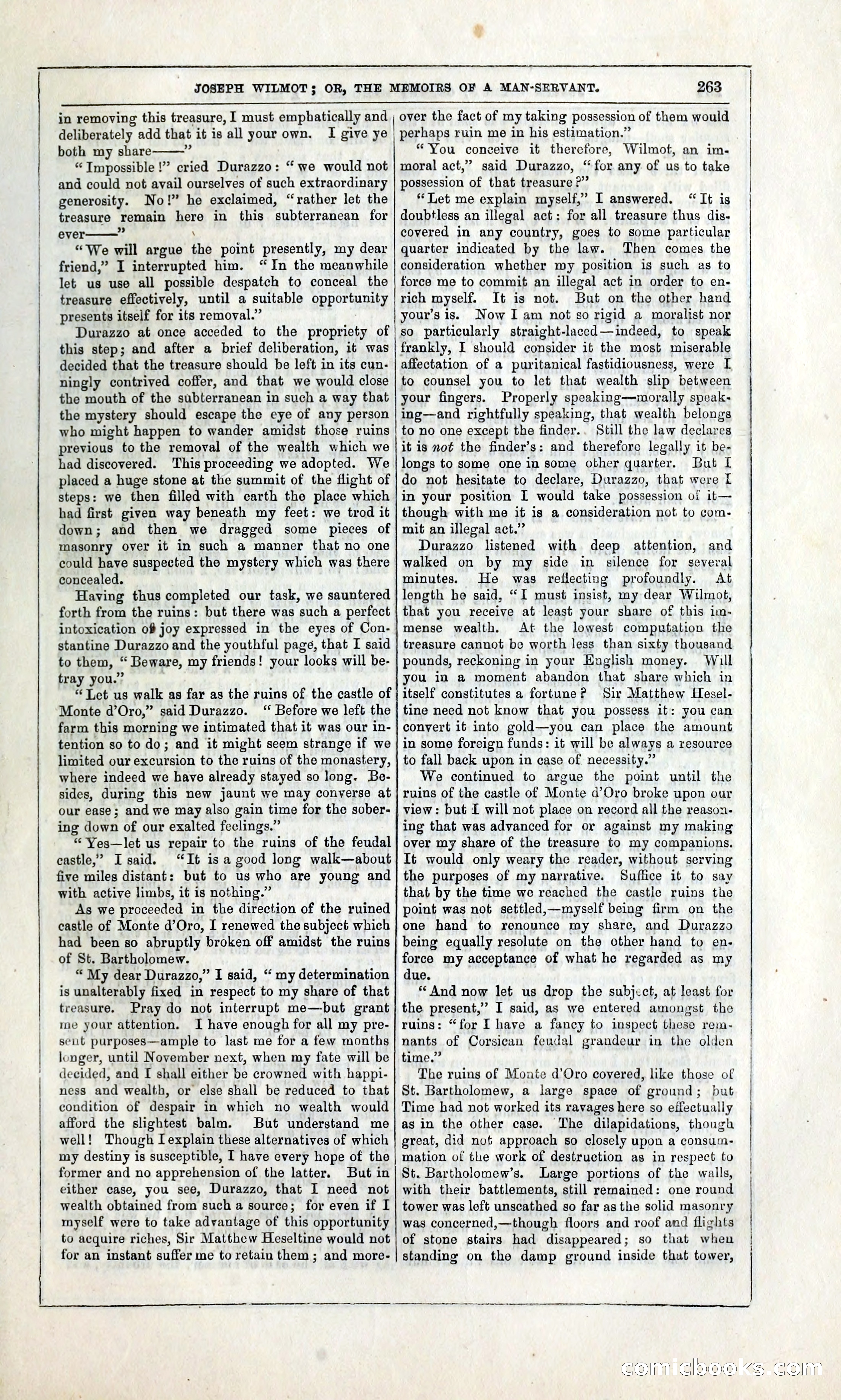
A restored page from Penny Dreadfuls, 1854. Page through the whole issue in the reader above.
📄 Transcribed text from this page (OCR, searchable)
Machine-transcribed from the original scan — historical spelling and the odd misread are preserved.
JOSEPH WILMOT; OR, THE MEMOIRS OF A MAN-SERVANT. 263 in removing this treasure, I must emphatically and deliberately add that it is all your own. I give ye both my share nf “ Tmpossible !” cried Durazzo: “ we would not and could not avail ourselves of such extraordinary generosity. No!” he exclaimed, “rather let the treasure remain here in this subterranean for ever 7 “We will argue the point presently, my dear friend,” I interrupted him. “In the meanwhile let us use all possible despatch to conceal the treasure effectively, until a suitable opportunity presents itself for its removal.” Durazzo at once acceded to the propriety of this step; and after a brief deliberation, it was decided that the treasure should be left in its cun- ningly contrived coffer, and that we would close the mouth of the subterranean in such a way that the mystery should escape the eye of any person who might happen to wander amidst those ruins previous to the removal of the wealth which we had discovered. This proceeding we adopted. We placed a huge stone at the summit of the flight of steps: we then filled with earth the place which had first given way beneath my feet: we trod it down; and then we dragged some pieces of masonry over it in such a manner that no one could have suspected the mystery which was there concealed. Having thus completed our task, we sauntered forth from the ruins: but there was such a perfect intoxication of joy expressed in the eyes of Con- stantine Durazzo and the youthful page, that I said to them, “ Beware, my friends! your looks will be- tray you.” “ Let us walk as far as the ruins of the castle of Monte d’Oro,” said Durazzo. ‘“ Before we left the farm this morning we intimated that it was our in- tention so to do; and it might seem strange if we limited our excursion to the ruins of the monastery, where indeed we have already stayed so long. Be- sides, during this new jaunt we may converse at our ease; and we may also gain time for the sober- ing down of our exalted feelings.” “ Yes—let us repair to the ruins of the feudal eastle,’ Isaid. “It isa good long walk—about five miles distant: but to us who are young and with active limbs, it is nothing.” As we proceeded in the direction of the ruined castle of Monte d’Oro, I renewed the subject which had been so abruptly broken off amidst the ruins of St. Bartholomew. “ My dear Durazzo,” I said, “ my determination is unalterably fixed in respect to my share of that treasure. Pray do not interrupt me—but grant me your attention. I have enough for all my pre- seit purposes—ample to last me for a few months longer, until November next, when my fate will be decided, and I shall either be crowned with happi- ness and wealth, or else shall be reduced to that condition of despair in which no wealth would afford the slightest balm. But understand me well! Though I explain these alternatives of which my destiny is susceptible, I have every hope of the former and no apprehension of the latter. But in either case, you see, Durazzo, that 1 need not wealth obtained from such a source; for even if I myself were to take advantage of this opportunity to acquire riches, Sir Matthew Heseltine would not for an instant suffer me to retain them; and more- \ over the fact of my taking possession of them would perhaps ruin me in his estimation.” * You conceive it therefore, Wilmot, an im. moral act,” said Durazzo, “for any of us to take possession of that treasure ?” **Let me explain myself,’ I answered. “It is doubtless an illegal act: for all treasure thus dis- covered in any country, goes to some particular quarter indicated by the law. Then comes the consideration whether my position is such as to force me to commit an illegal act in order to en- rich myself. It is not. But on the other hand your’s is. Now Iam not so rigid a moralist nor so particularly straight-laced—indeed, to speak frankly, I should consider it the most miserable affectation of a puritanical fastidiousness, were I to counsel you to let that wealth slip between your fingers. Properly speaking—morally speak- ing—and rightfully speaking, that wealth belongs to no one except the finder.. Still the law declares it is not the finder’s: and therefore legally it be- longs to some one in some other quarter. But I do not hesitate to declare, Durazzo, that were I in your position I would take possession of it— though with me it is a consideration not to com- mit an illegal act.” Durazzo listened with deep attention, and walked on by my side in silence for several minutes. He was reflecting profoundly. At length he said, “I must insist, my dear Wilmot, that you receive at least your share of this im- mense wealth. At the lowest computation the treasure cannot be worth less than sixty thousand pounds, reckoning in your English money. Will you in a moment abandon that share which in itself constitutes a fortune? Sir Matthew Hesel- tine need not know that you possess it: you can convert it into gold—you can place the amount in some foreign funds: it will be always a resource to fall back upon in case of necessity.” We continued to argue the point until the ruins of the castle of Monte d’Oro broke upon our view: but I will not place on record all the reason- ing that was advanced for or against my making over my share of the treasure to my companions. It would only weary the reader, without serving the purposes of my narrative. Suffice it to say that by the time we reached the castle ruins the point was not settled,—myself being firm on the one hand to renounce my share, and Durazzo being equally resolute on the other hand to en- force my acceptance of what he regarded as my due. And now let us drop the subject, at least for the present,” I said, as we entered amongst the ruins: “for I have a fancy to inspect these rem- nants of Corsican feudal grandeur in the olden time.” The ruins of Monte d’Oro covered, like those of St. Bartholomew, a large space of ground; but Time had not worked its ravages here so effectually as in the other case. The dilapidations, though great, did not approach so closely upon a consum- mation of the work of destruction as in respect to St. Bartholomew’s. Large portions of the walls, with their battlements, still remained: one round tower was left unscathed so far as the solid masonry was concerned,—though floors and roof and flights of stone stairs had disappeared; so that when standing on the damp ground inside that tower, ElO@QO) S (CO) im