
Penny Dreadfuls, 1854 · page 277 of 399
Joseph Wilmot, or, The Memoirs of a Man-Servant — page 277: what you’re looking at
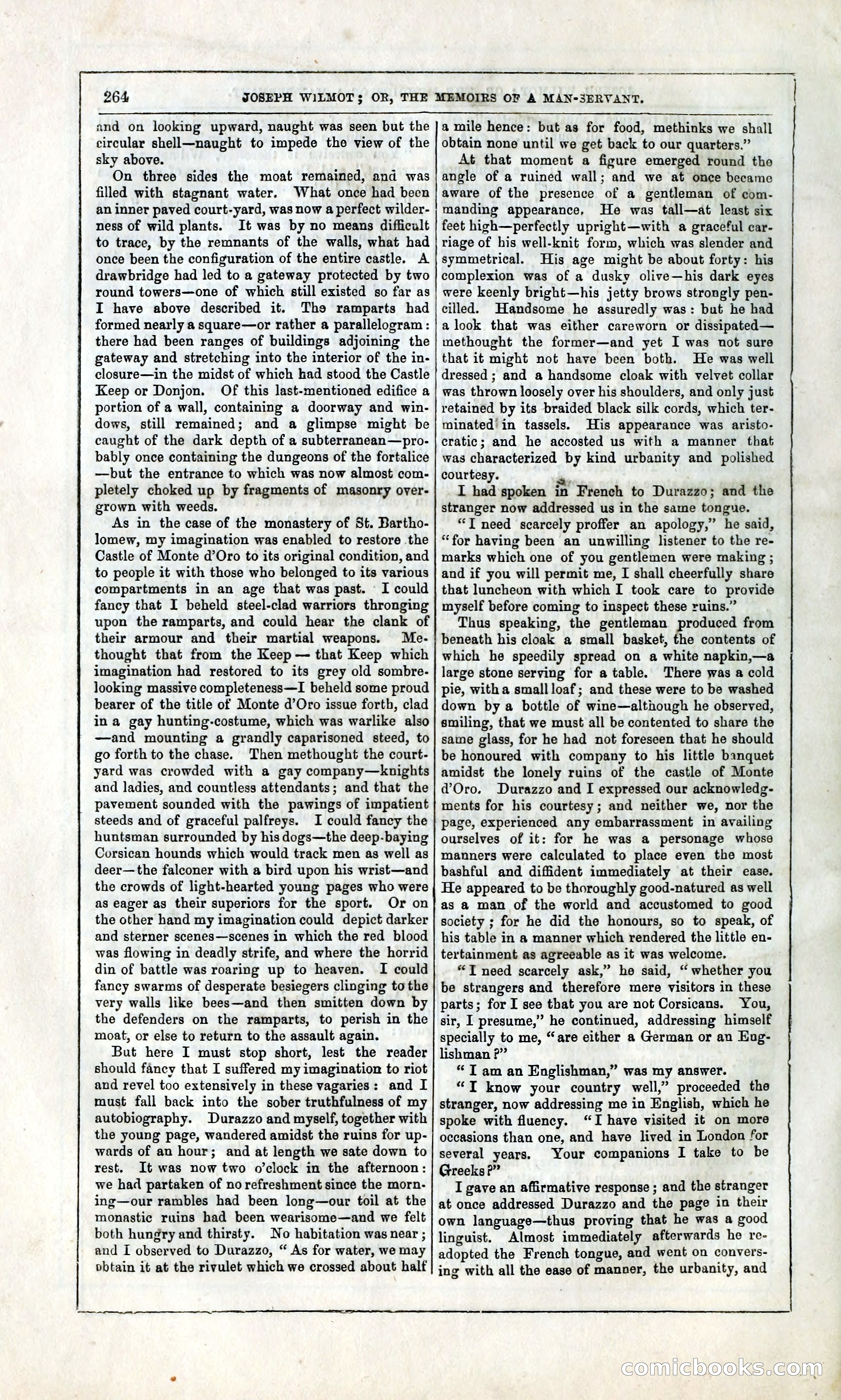
A restored page from Penny Dreadfuls, 1854. Page through the whole issue in the reader above.
📄 Transcribed text from this page (OCR, searchable)
Machine-transcribed from the original scan — historical spelling and the odd misread are preserved.
264 and on looking upward, naught was seen but the circular shell—naught to impede the view of the sky above. On three sides the moat remained, and was filled with stagnant water. What once had been an inner paved court-yard, was now a perfect wilder- ness of wild plants. It was by no means difficult to trace, by the remnants of the walls, what had once been the configuration of the entire castle. A drawbridge had led to a gateway protected by two round towers—one of which still existed so far as I have above described it. Tho ramparts had formed nearly a square—or rather a parallelogram: there had been ranges of buildings adjoining the gateway and stretching into the interior of the in- closure—in the midst of which had stood the Castle Keep or Donjon. Of this last-mentioned edifice a portion of a wall, containing a doorway and win- dows, still remained; and a glimpse might be caught of the dark depth of a subterranean—pro- bably once containing the dungeons of the fortalice —but the entrance to which was now almost com- pletely choked up by fragments of masonry over- grown with weeds. As in the case of the monastery of St. Bartho- lomew, my imagination was enabled to restore the Castle of Monte d’Oro to its original condition, and to people it with those who belonged to its various compartments in an age that was past. I could fancy that I beheld steel-clad warriors thronging upon the ramparts, and could hear the clank of their armour and their martial weapons. Me- thought that from the Keep — that Keep which imagination had restored to its grey old sombre- looking massive completeness—I beheld some proud bearer of the title of Monte d’Oro issue forth, clad ina gay hunting-costume, which was warlike also —and mounting a grandly caparisoned steed, to go forth to the chase. Then methought the court- yard was crowded with a gay company—knights and ladies, and countless attendants; and that the pavement sounded with the pawings of impatient steeds and of graceful palfreys. I could fancy the huntsman surrounded by his dogs—the deep-baying Corsican hounds which would track men as well as deer—the falconer with a bird upon his wrist—and the crowds of light-hearted young pages who were as eager as their superiors for the sport. Or on the other hand my imagination could depict darker and sterner scenes—scenes in which the red blood was flowing in deadly strife, and where the horrid din of battle was roaring up to heaven. I could fancy swarms of desperate besiegers clinging to the very walls like bees—and then smitten down by the defenders on the ramparts, to perish in the moat, or else to return to the assault again. But here I must stop short, lest the reader should fancy that I suffered my imagination to riot and revel too extensively in these vagaries: and I must fall back into the sober truthfulness of my autobiography. Durazzo and myself, together with the young page, wandered amidst the ruins for up- wards of an hour; and at length we sate down to rest. It was now two o’clock in the afternoon: we had partaken of no refreshment since the morn- ing—our rambles had been long—our toil at the monastic ruins had been wearisome—and we felt both hungry and thirsty. No habitation was near ; and I observed to Durazzo, “ As for water, we may obtain it at the rivulet which we crossed about half rn nee SS a eer oe JOSEPH WILMOTs$ OR, THE MEMOIRS OF A MAN-SERVANT. —_——_— -- — a mile hence: but as for food, methinks we shall obtain none until we get back to our quarters.” At that moment a figure emerged round the angle of a ruined wall; and we at once became aware of the presence of a gentleman of com- manding appearance, He was tall—at least six feet high—perfectly upright—with a graceful car- riage of his well-knit form, which was slender and symmetrical. His age might be about forty: his complexion was of a dusky olive—his dark eyes were keenly bright—his jetty brows strongly pen- cilled. Handsome he assuredly was: but he had a look that was either careworn or dissipated— methought the former—and yet I was not sure that it might not have been both. He was well dressed ; and a handsome cloak with velvet collar was thrown loosely over his shoulders, and only just retained by its braided black silk cords, which ter- minated'in tassels. His appearance was aristo- cratic; and he accosted us with a manner that was characterized by kind urbanity and polished courtesy. in I had spoken in French to Durazzo; and the stranger now addressed us in the same tongue. “JT need scarcely proffer an apology,” he said, “for having been an unwilling listener to the re- marks which one of you gentlemen were making ; and if you will permit me, I shall cheerfully share that luncheon with which I took care to provide myself before coming to inspect these ruins.” Thus speaking, the gentleman produced from beneath his cloak a small basket, the contents of which he speedily spread on a white napkin,—a large stone serving for a table. There was a cold pie, witha smallloaf; and these were to be washed down by a bottle of wine—although he observed, smiling, that we must all be contented to share the same glass, for he had not foreseen that he should be honoured with company to his little banquet amidst the lonely ruins of the castle of Monte d@’Oro. Durazzo and I expressed our acknowledg- ments for his courtesy; and neither we, nor the page, experienced any embarrassment in availing ourselves of it: for he was a personage whose manners were calculated to place even the most bashful and difiident immediately at their ease. He appeared to be thoroughly good-natured as well as a man of the world and accustomed to good society ; for he did the honours, so to speak, of his table in a manner which rendered the little en- tertainment as agreeable as it was welcome. *T need scarcely ask,” he said, “whether you be strangers and therefore mere visitors in these parts; for I see that you are not Corsicans. You, sir, I presume,” he continued, addressing himself specially to me, “are either a German or an Eng- lishman P” “ T am an Englishman,” was my answer. “T know your country well,” proceeded the stranger, now addressing me in English, which he spoke with fluency. “I have visited it on more occasions than one, and have lived in London for several years. Your companions I take to be Greeks P” I gave an affirmative response ; and the stranger at once addressed Durazzo and the page in their own language—thus proving that he was a good linguist. Almost immediately afterwards he re- adopted the French tongue, and went on convers- ing with all the ease of manner, the urbanity, aud MHICLOOoOkKS (C(O)