
Penny Dreadfuls, 1854 · page 28 of 399
Joseph Wilmot, or, The Memoirs of a Man-Servant — page 28: what you’re looking at
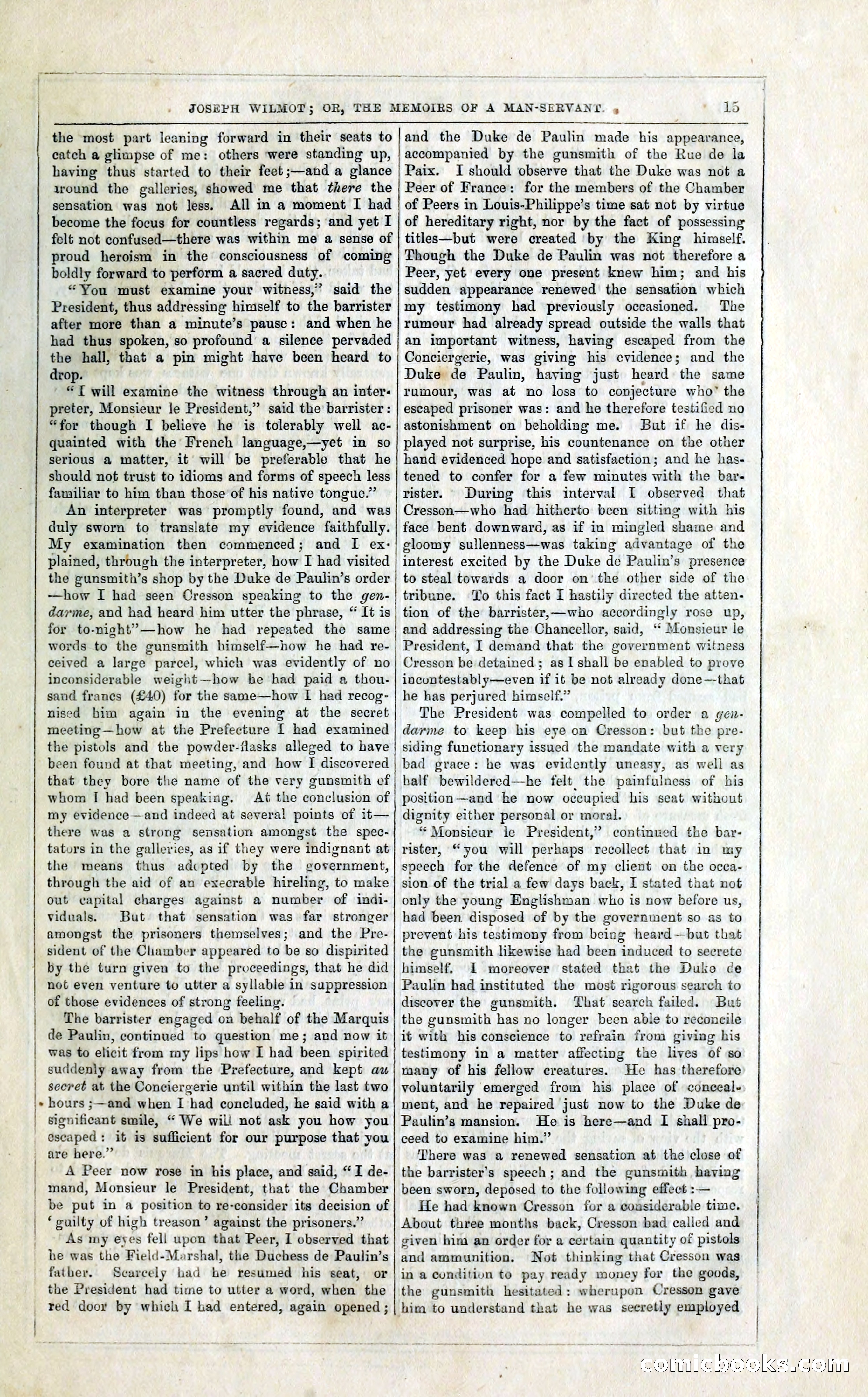
A restored page from Penny Dreadfuls, 1854. Page through the whole issue in the reader above.
📄 Transcribed text from this page (OCR, searchable)
Machine-transcribed from the original scan — historical spelling and the odd misread are preserved.
Ticuusaeeeiale — + + --—— - - ee JOSEPH WILMOT; OR, THE MEMOIRS OF A MAN-SERVANT. , the most part leaning forward in their seats to catch a glimpse of me: others ‘were standing up, having thus started to their feet;—and a glance wound the galleries, showed me that there the sensation was not less. All in a moment I had become the focus for countless regards; and yet I felt not confused—there was within me a sense of proud heroism in the consciousness of coming boldly forward to perform a sacred duty. “You must examine your witness,’ said the President, thus addressing himself to the barrister after more than a minute’s pause: and when he had thus spoken, so profound a silence pervaded the hall, that a pin might have been heard to drop. “T will examine the witness through an inter. preter, Monsieur le President,” said the barrister : “for though I believe he is tolerably well ac- quainted with the French language,—yet in so serious a matter, it will be preferable that he should not trust to idioms and forms of speech less familiar to him than those of his native tongue.” An interpreter was promptly found, and was duly sworn to translate my evidence faithfully. My examination then commenced; and I ex: plained, through the interpreter, how I had visited the gunsmith’s shop by the Duke de Paulin’s order —how I had seen Cresson speaking to the gen- darme, and had heard him utter the phrase, “ It is for to-night”—how he had repeated the same words to the gunsmith himself—how he had re- ceived a large parcel, which was evidently of no inconsiderable weight—how he had paid a thou- sand francs (£40) for the same—how I had recog- nised him again in the evening at the secret meeting—how at the Prefecture I had examined the pistols and the powder-flasks alleged to have been found at that meeting, and how I discovered that they bore the name of the very gunsmith of whom I had been speaking. At the conclusion of my evidence —and indeed at several points of i1t— there was a strong sensation amongst the spec- taturs in the galleries, as if they were indignant at the means thus adcpted by the government, through the aid of an execrable hireling, to make out capital charges against a number of indi- viduals. But that sensation was far stronger amongst the prisoners themselves; and the Pre- sident of the Clamber appeared to be so dispirited by the turn given to the proceedings, that he did not even venture to utter a syllable in suppression of those evidences of strong feeling. The barrister engaged on behalf of the Marquis de Paulin, continued to question me; and now it was to elicit from my lips how I had been spirited suddenly away from the Prefecture, and kept aw secret at the Conciergerie until within the last two » hours ;—and when I had concluded, he said with a significant smile, “ We will not ask you how you escaped: it is sufficient for our purpose that you | are here.” A Peer now rose in his place, and said, “I de- mand, Monsieur le President, that the Chamber _ be put in a position to re-consider its decision of ‘uilty of high treason’ against the prisoners.” As my eves fell upon that Peer, 1 observed that he was the Field-Marshal, the Duchess de Paulin’s father. Scarcely bad be resumed his seat, or the President had time to utter a word, when the red door by which I had entered, again opened ; j and the Duke de Paulin made his appearance, accompanied by the gunsmith of the Rue de la Paix. I should observe that the Duke was not a Peer of France: for the members of the Chamber of Peers in Louis-Philippe’s time sat not by virtue of hereditary right, nor by the fact of possessing titles—but were created by the King himeelf. Though the Duke de Paulin was not therefore a Peer, yet every one present knew him; and his sudden appearance renewed the sensation which my testimony had previously occasioned. The rumour had already spread outside the walls that an important witness, having escaped from the Conciergerie, was giving his evidence; and the Duke de Paulin, haying just heard the same rumour, was at no loss to conjecture who’ the escaped prisoner was: and he therefore testified no astonishment on beholding me. But if he dis- played not surprise, his countenance on the other hand evidenced hope and satisfaction; and he has- tened to confer for a few minutes with the bar- rister. During this interval I observed that Cresson—who had hitherto been sitting with his face bent downward, as if in mingled shame and gloomy sullenness~—was taking advantage of the interest excited by the Duke de Paulin’s presence to steal towards a door on the other side of the tribune. To this fact I hastily directed the atten- tion of the barrister,—who accordingly rose up, and addressing the Chancellor, said, ‘“ Monsieur le President, I demand that the government witness Cresson be detained; as I shall be enabled to prove incuntestably—even if it be not already done—that he has perjured himself.” The President was compelled to order a gew- darme to keep his eye on Cresson: but the pre- siding functionary issued the mandate with a very bad grace: he was evidently uneasy, as well as half bewildered—he felt the painfulness of his position—and he now occupied his seat without dignity either personal or moral. “ Monsieur le President,” continued the bar- rister, “you will perhaps recollect that in my speech for the defence of my client on the occa- sion of the trial a few days back, I stated that not only the young EKuglishman who is now before us, had been disposed of by the government so as to prevent his testimony from being heard-—but that the gunsmith likewise had been induced to secrete himself, I moreover stated that the Duke ce Paulin had instituted the most rigorous search to discover the gunsmith. That search failed. But the gunsmith has no longer been able tu reconcile it with his conscience to refrain from giving his testimony in a matter affecting the lives of so many of his fellow creatures. He has therefore voluntarily emerged from his place of conceal- ment, and he repaired just now to the Duke de Paulin’s mansion. He is here—and I shall pro- ceed to examine him.” There was a renewed sensation at the close of the barrister’s speech; and the gunsmith having been sworn, deposed to the following effect :— He had known Cresson for a considerable time. About three mouths back, Cresson bad called and given him an order for a certain quantity of pistols and ammunition. Not thinking that Cresson was | in a condition to pay ready money for the goods, the gunsmith hesitated: wherupon Cresson gave him to understand that he was secretly employed | ECONNICLOOO© 6S (C (0)