
Penny Dreadfuls, 1854 · page 29 of 399
Joseph Wilmot, or, The Memoirs of a Man-Servant — page 29: what you’re looking at
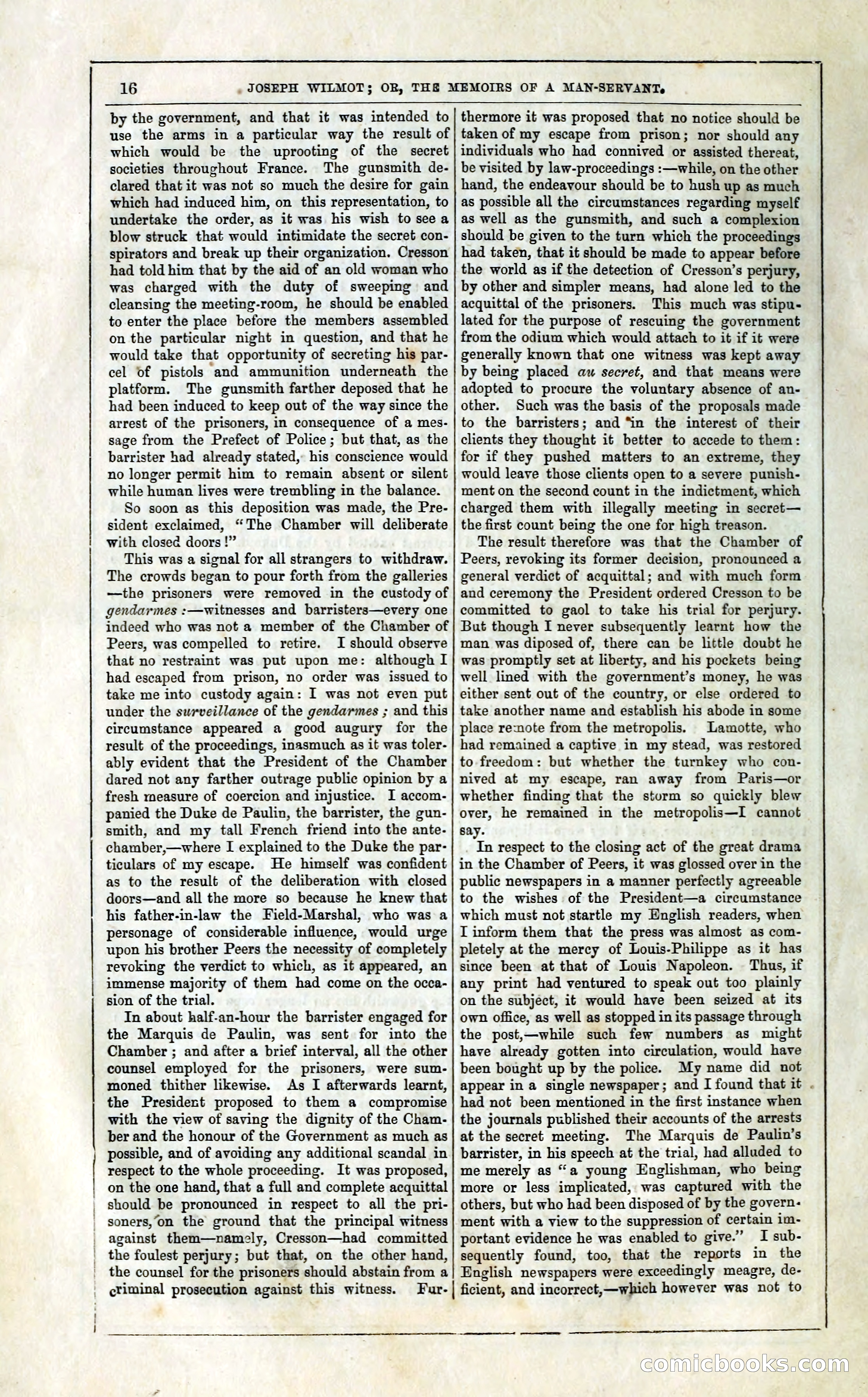
A restored page from Penny Dreadfuls, 1854. Page through the whole issue in the reader above.
📄 Transcribed text from this page (OCR, searchable)
Machine-transcribed from the original scan — historical spelling and the odd misread are preserved.
{ 16 by the government, and that it was intended to use the arms in a particular way the result of which would be the uprooting of the secret societies throughout France. The gunsmith de- clared that it was not so much the desire for gain which had induced him, on this representation, to undertake the order, as it was his wish to seea blow struck that would intimidate the secret con- spirators and break up their organization. Cresson had told him that by the aid of an old woman who was charged with the duty of sweeping and cleansing the meeting-room, he should be enabled to enter the place before the members assembled on the particular night in question, and that he would take that opportunity of secreting his par- cel of pistols and ammunition underneath the platform. The gunsmith farther deposed that he had been induced to keep out of the way since the arrest of the prisoners, in consequence of a mes- sage from the Prefect of Police; but that, as the barrister had already stated, his conscience would no longer permit him to remain absent or silent while human lives were trembling in the balance. So soon as this deposition was made, the Pre- sident exclaimed, “The Chamber will deliberate with closed doors !” This was a signal for all strangers to withdraw. The crowds began to pour forth from the galleries —the prisoners were removed in the custody of gendarmes :—witnesses and barristers—every one indeed who was not a member of the Chamber of Peers, was compelled to retire. I should observe that no restraint was put upon me: although I had escaped from prison, no order was issued to take me into custody again: I was not even put under the surveillance of the gendarmes ; and this circumstance appeared a good augury for the result of the proceedings, inasmuch as it was toler- ably evident that the President of the Chamber dared not any farther outrage public opinion by a fresh measure of coercion and injustice. I accom- panied the Duke de Paulin, the barrister, the gun- smith, and my tall French friend into the ante- chamber,—where I explained to the Duke the par- ticulars of my escape. He himself was confident as to the result of the deliberation with closed doors—and all the more so because he knew that his father-in-law the Field-Marshal, who was a personage of considerable influence, would urge upon his brother Peers the necessity of completely revoking the verdict to which, as it appeared, an immense majority of them had come on the occa- sion of the trial. In about half-an-hour the barrister engaged for the Marquis de Paulin, was sent for into the Chamber ; and after a brief interval, all the other counsel employed for the prisoners, were sum- moned thither likewise. As I afterwards learnt, the President proposed to them a compromise with the view of saving the dignity of the Cham- ber and the honour of the Government as much as possible, and of avoiding any additional scandal in respect to the whole proceeding. It was proposed, on the one hand, that a full and complete acquittal _ should be pronounced in respect to all the pri- _ soners,’on the ground that the principal witness against them—namely, Cresson—had committed _ the foulest perjury; but that, on the other hand, the counsel for the prisoners should abstain from a criminal prosecution against this witness. Fur- , JOSEPH WILMOT; OR, THE MEMOIRS OF A MAN-SERVANT, thermore it was proposed that no notice should be taken of my escape from prison; nor should any individuals who had connived or assisted thereat, be visited by law-proceedings :—while, on the other hand, the endeavour should be to hush up as much as possible all the circumstances regarding myself as well as the gunsmith, and such a complexion should be given to the turn which the proceedings had taken, that it should be made to appear before the world as if the detection of Cresson’s perjury, by other and simpler means, had alone led to the acquittal of the prisoners. This much was stipu- lated for the purpose of rescuing the government from the odium which would attach to it if it were generally known that one witness was kept away by being placed aw secret, and that means were adopted to procure the voluntary absence of an- other. Such was the basis of the proposals made to the barristers; and “in the interest of their clients they thought it better to accede to them: for if they pushed matters to an extreme, they would leave those clients open to a severe punish- ment on the second count in the indictment, which charged them with illegally meeting in secret— the first count being the one for high treason. The result therefore was that the Chamber of Peers, revoking its former decision, pronounced a general verdict of acquittal; and with much form and ceremony the President ordered Cresson to be committed to gaol to take his trial for perjury. But though I never subsequently learnt how the man was diposed of, there can be little doubt he was promptly set at liberty, and his pockets being well lined with the government’s money, he was either sent out of the country, or else ordered to take another name and establish his abode in some place rexnote from the metropolis. Lamotte, who had remained a captive in my stead, was restored to freedom: but whether the turnkey who con- nived at my escape, ran away from Paris—or whether finding that the storm so quickly blew over, he remained in the metropolis—I cannot say. In respect to the closing act of the great drama in the Chamber of Peers, it was glossed over in the public newspapers in a manner perfectly agreeable to the wishes of the President—a circumstance which must not startle my English readers, when I inform them that the press was almost as com- pletely at the mercy of Louis-Philippe as it has since been at that of Louis Napoleon. Thus, if any print had ventured to speak out too plainly on the subject, it would have been seized at its own office, as well as stopped in its passage through the post,—while such few numbers as might have already gotten into circulation, would have been bought up by the police. My name did not appear in a single newspaper; and I found that it . had not been mentioned in the first instance when the journals published their accounts of the arrests at the secret meeting. The Marquis de Paulin’s barrister, in his speech at the trial, had alluded to me merely as “a young Englishman, who being more or less implicated, was captured with the others, but who had been disposed of by the govern- ment with a view tothe suppression of certain im- portant evidence he was enabled to give.” I sub- sequently found, too, that the reports in the English newspapers were exceedingly meagre, de- | ficient, and incorrect,—which however was not to Gomicsdook (E©)