
Penny Dreadfuls, 1854 · page 378 of 399
Joseph Wilmot, or, The Memoirs of a Man-Servant — page 378: what you’re looking at
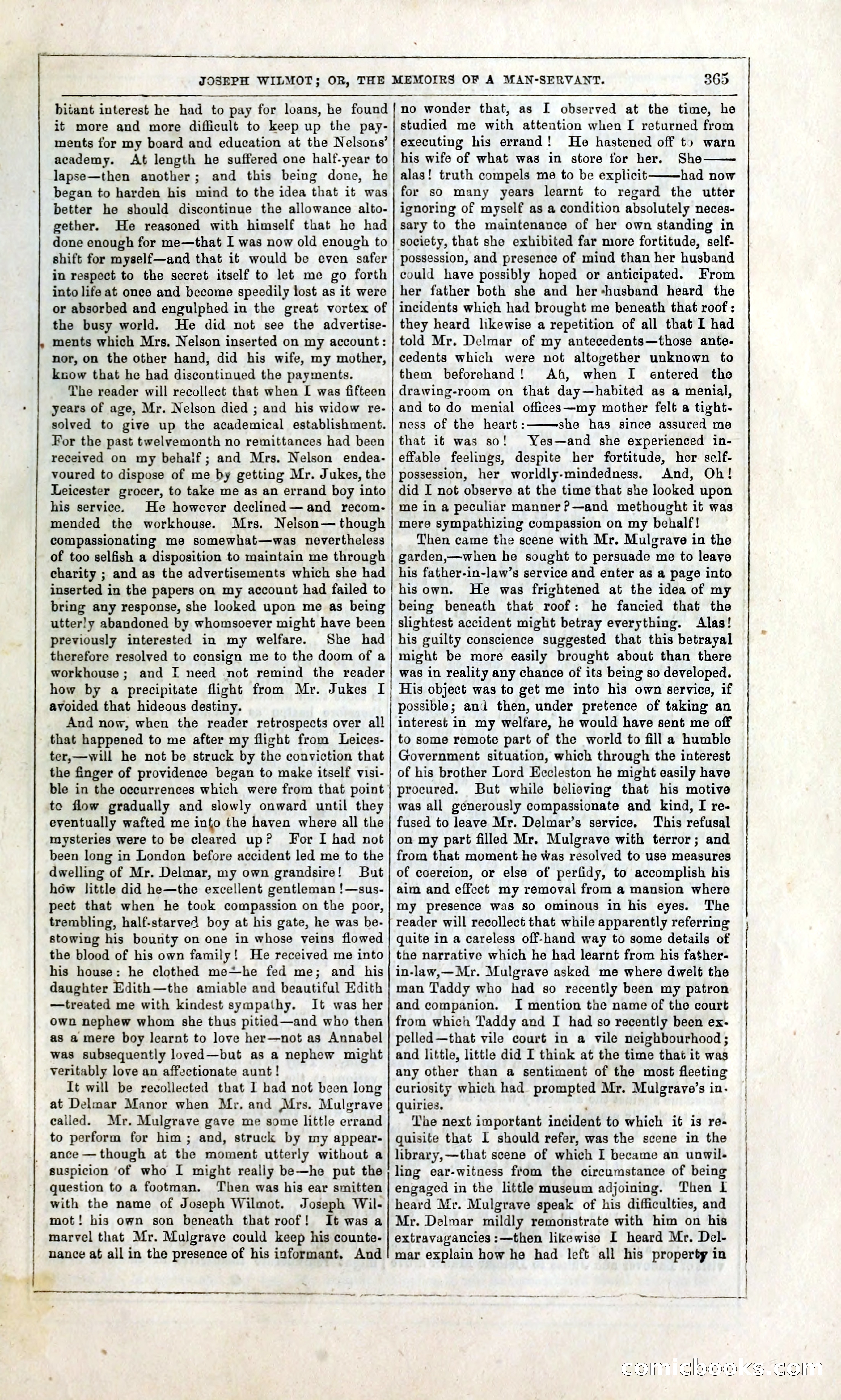
A restored page from Penny Dreadfuls, 1854. Page through the whole issue in the reader above.
📄 Transcribed text from this page (OCR, searchable)
Machine-transcribed from the original scan — historical spelling and the odd misread are preserved.
JOSEPH WILMOT; OR, THE MEMOIRS OF A MAN-SERVANT. bitant interest he had to pay for loans, he found it more and more diflicult to keep up the pay- ments for my board and education at the Nelsons’ academy. At length he suffered one half-year to lapse—then another; and this being done, he began to harden his mind to the idea that it was better he should discontinue the allowance alto- gether. He reasoned with himself that he had done enough for me—that I was now old enough to shift for myself—and that it would be even safer in respect to the secret itself to let me go forth into life at once and become speedily lost as it were or absorbed and engulphed in the great vortex of the busy world. He did not see the advertise- ments which Mrs. Nelson inserted on my account: nor, on the other hand, did his wife, my mother, know that he had discontinued the payments. The reader will recollect that when I was fifteen years of age, Mr. Nelson died ; and his widow re- solved to give up the academical establishment. For the past twelvemonth no remittances had been received on my behaif; and Mrs. Nelson endea- voured to dispose of me by getting Mr. Jukes, the Leicester grocer, to take me as an errand boy into his service. He however declined—and recom- mended the workhouse. Mrs. Nelson— though compassionating me somewhat—was nevertheless of too selfish a disposition to maintain me through charity ; and as the advertisements which she had inserted in the papers on my account had failed to bring any response, she looked upon me as being utterly abandoned by whomsoever might have been previously interested in my welfare. She had therefore resolved to consign me to the doom of a workhouse; and I need not remind the reader how by a precipitate flight from Mr. Jukes I avoided that hideous destiny. And now, when the reader retrospects over all that happened to me after my flight from Leices- ter,—will he not be struck by the conviction that the finger of providence began to make itself visi- ble in the occurrences which were from that point te flow gradually and slowly onward until they eventually wafted me into the haven where all the mysteries were to be cleared up? For I had not been long in London before accident led me to the dwelling of Mr. Delmar, my own grandsire! But how little did he—the excellent gentleman !—sus- pect that when he took compassion on the poor, trembling, half-starved boy at his gate, he was be- stowing his bounty on one in whose veins flowed the blood of his own family! He received me into his house: he clothed me~he fed me; and his daughter Edith—the amiable and beautiful Edith —treated me with kindest sympathy. It was her own nephew whom she thus pitied—and who then as a mere boy learnt to love her—not as Annabel was subsequently loved—but as a nephew might veritably love an affectionate aunt! It will be recollected that I had not been long at Delmar Manor when Mr, and Mrs. Mulgrave called. Mr. Mulgrave gave me some little errand to perform for him; and, struck by my appear- _ ance—though at the moment utterly without a suspicion of who I might really be—he put the question to a footman. Then was his ear smitten with the name of Joseph Wilmot. Joseph Wil- mot! his own son beneath that roof! It was a marvel that Mr. Mulgrave could keep his counte- nance af all in the presence of his informant. And —— —— pe eee 365 no wonder that, as I observed at the time, he studied me with attention when [ returned from executing his errand! He hastened off t> warn his wife of what was in store for her. She alas! truth compels me to be explicit had now for so many years learnt to regard the utter ignoring of myself as a condition absolutely neces- sary to the maintenance of her own standing in society, that she exhibited far more fortitude, self- possession, and presence of mind than her husband could have possibly hoped or anticipated. From her father both she and her-husband heard the incidents which had brought me beneath that roof : they heard likewise a repetition of all that I had told Mr. Delmar of my antecedents—those ante- eedents which were not altogether unknown to them beforehand! Ah, when I entered the drawing-room on that day—habited as a menial, and to do menial offices—my mother felt a tight- ness of the heart: she has since assured me that it was so! Yes—and she experienced in- effable feelings, despite her fortitude, her self- possession, her worldly-mindedness. And, Oh! did I not observe at the time that she looked upon me in a peculiar manner ?—and methought it was mere sympathizing compassion on my behalf! Then came the scene with Mr. Mulgrave in the garden,—when he sought to persuade me to leave his father-in-law’s service and enter as a page into his own. He was frightened at the idea of my being beneath that roof: he fancied that the slightest accident might betray everything. Alas! his guilty conscience suggested that this betrayal might be more easily brought about than there was in reality any chance of its being so developed. His object was to get me into his own service, if possible; and then, under pretence of taking an interest in my welfare, he would have sent me off to some remote part of the world to fill a humble Government situation, which through the interest of his brother Lord Eccleston he might easily have | procured. But while believing that his motive was all generously compassionate and kind, I re- fused to leave Mr. Delmar’s service. This refusal on my part filled Mr. Mulgrave with terror; and from that moment he was resolved to use measures of coercion, or else of perfidy, to accomplish his aim and effect my removal from a mansion where my presence was so ominous in his eyes. The reader will recollect that while apparently referring quite in a careless off-hand way to some details of the narrative which he had learnt from his father- in-law,—Mr. Mulgrave asked me where dwelt the man T'addy who had so recently been my patron and companion. I mention the name of the court from which Taddy and I had so recently been ex- pelled—that vile court in a vile neighbourhood; and little, little did I think at the time that it was any other than a sentiment of the most fleeting curiosity which had prompted Mr. Mulgrave’s in- quiries. , Tbe next important incident to which it is re- quisite that I should refer, was the scene in the library,—that scene of which I became an unwil- ling ear-witness from the circumstance of being engaged in the little museum adjoining. Then L heard Mr. Mulgrave speak of his difficulties, and Mr. Delmar mildly remonstrate with him on his extravagancies:—then likewise L heard Mr. Del- mar explain how he had left all his property in — —--—— | - - ee a ad - -- go —— Giyoo SS (CO iin