
Penny Dreadfuls, 1854 · page 379 of 399
Joseph Wilmot, or, The Memoirs of a Man-Servant — page 379: what you’re looking at
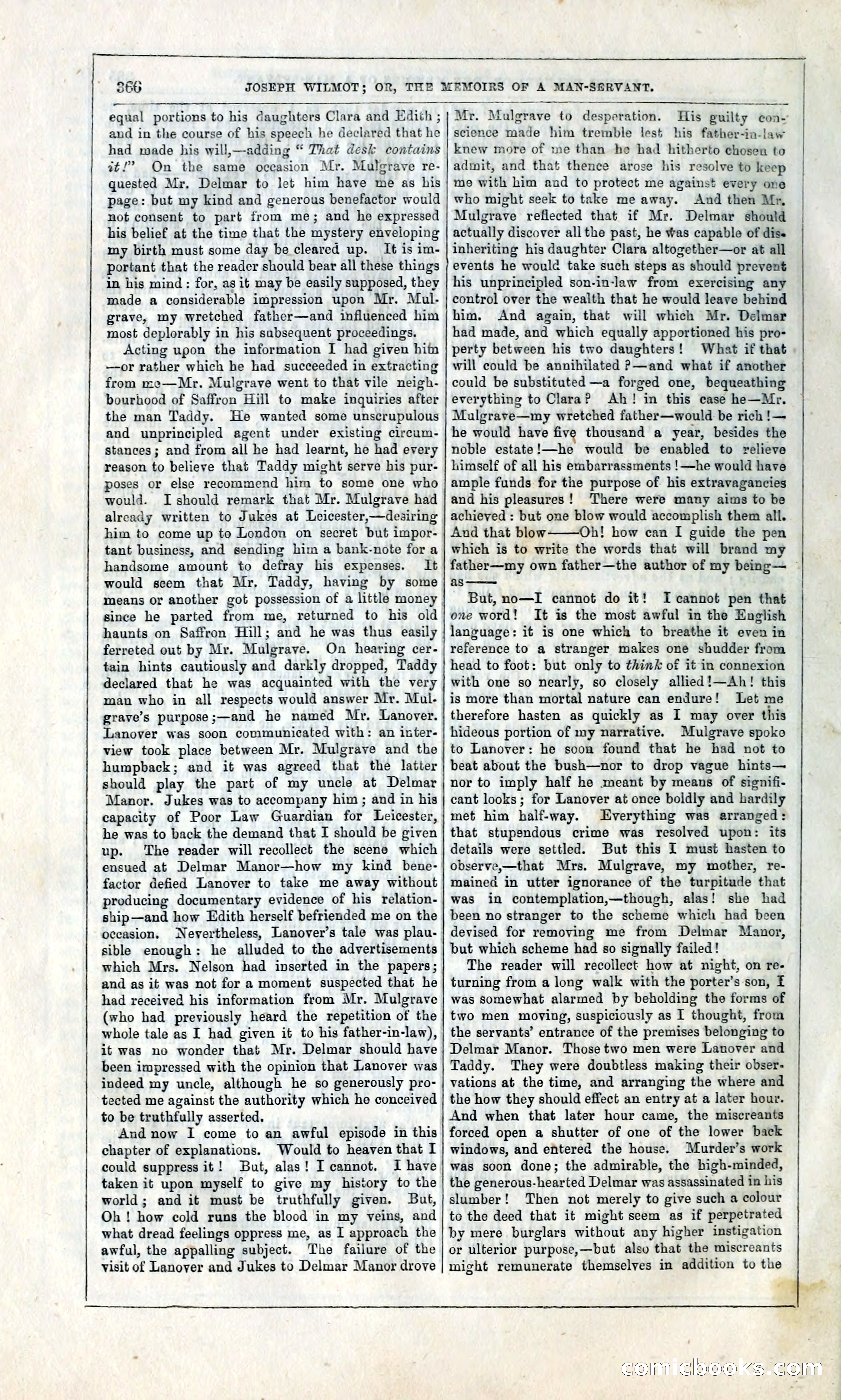
A restored page from Penny Dreadfuls, 1854. Page through the whole issue in the reader above.
📄 Transcribed text from this page (OCR, searchable)
Machine-transcribed from the original scan — historical spelling and the odd misread are preserved.
S66 egual portions to his daughters Clara and Edith ; and in the course of his speech he declared that he had made his will,—adding “ That desk contains it!’ On the same occasion Mr. Mulgrave re- quested Mr, Delmar to let him have me as his page: but my kind and generous benefactor would not consent to part from me; and he expressed his belief at the time that the mystery enveloping my birth must some day be cleared up. It is im- portant that the reader should bear all these things in his mind: for, as it may be easily supposed, they made a considerable impression upon Mr. Mul- grave, my wretched father—and influenced him most deplorably in his subsequent proceedings. Acting upon the information I had given him —or rather which he had succeeded in extracting from me—Mr. Mulgrave went to that vile neigh- bourhood of Saffron Hill to make inquiries after the man Taddy. He wanted some unscrupulous and unprincipled agent under existing circum- stances; and from all he had learnt, he had every reason to believe that Taddy might serve his pur- poses or else recommend him to some one who would. I should remark that Mr. Mulgrave had already written to Jukes at Leicester,—desiring him to come up to London on secret but impor- tant business, and sending him a bank-note for a handsome amount to defray his expenses. It would seem that Mr, Taddy, having by some means or another got possession of a little money | since he parted from me, returned to his old haunts on Saffron Hill; and he was thus easily ferreted out by Mr. Mulgrave. On hearing cer- tain hints cautiously and darkly dropped, Taddy declared that he was acquainted with the very man who in all respects would answer Mr. Mul- grave’s purpose;—and he named Mr. Lanover. Lanover was soon communicated with: an inter- view took place between Mr. Mulgrave and the humpback; and it was agreed that the latter should play the part of my uncle at Delmar Manor. Jukes was to accompany him; and in his capacity of Poor Law Guardian for Leicester, he was to back the demand that I should be given up. The reader will recollect the scene which ensued at Delmar Manor—how my kind bene- factor defied Lanover to take me away without producing documentary evidence of his relation- ship—and how Edith herself befriended me on the occasion. Nevertheless, Lanover’s tale was plau- sible enough: he alluded to the advertisements which Mrs. Nelson had inserted in the papers; and as it was not for a moment suspected that he had received his information from Mr. Mulgrave (who had previously heard the repetition of the whole tale as I had given it to his father-in-law), it was no wonder that Mr. Delmar should have been impressed with the opinion that Lanover was indeed my uncle, although he so generously pro- tected me against the authority which he conceived to be truthfully asserted. And now I come to an awful episode in this chapter of explanations. Would to heaven that I could suppress it! But, alas! I cannot. I have taken it upon myself to give my history to the world; and it must be truthfully given. But, Oh! how cold runs the blood in my veins, and what dread feelings oppress me, as I approach the awful, the appalling subject. The failure of the visit of Lanover and Jukes to Delmar Manor drove JOSEPH WILMOT; OR, THE MEMOIRS OF A MAN-SERVANT. Mr. Mulgrave to desperation. His puilty con- science made him tremble lest his father-in-law knew more of me than he had hitherto chosen to admit, and that thence arose his resolve to keep me with him and to protect me against every one who might seek to take me away. And then Mr, Mulgrave reflected that if Mr. Delmar should actually discover all the past, he was capable of diss inheriting his daughter Clara altogether—or at all events he woulc take such steps as should prevent his unprincipled son-in-law from exercising any control over the wealth that he would leave behind him. And again, that will which Mr. Delmar had made, and which equally apportioned his pro- perty between his two daughters! What if that will could be annihilated ?>—and what if another could be substituted —a forged one, bequeathing everything to ClaraP Ah! in this case he—Mr. Mulgrave—my wretched father—would be rich !— he would have five thousand a year, besides the noble estate!—he would be enabled to relieve himself of all his embarrassments !—he would have ample funds for the purpose of his extravagancies and his pleasures! There were many aims to be achieved : but one blow would accomplish them all. And that blow Oh! how can I guide the pen which is to write the words that will brand my father—my own father—the author of my being— as But, no—I cannot do it! Icannot pen that one word! It is the most awful in the Enelish language: it is one which to breathe it even in reference to a stranger makes one shudder from head to foot: but only to think of it in connexion with one so nearly, so closely allied!—Ah! this is more than mortal nature can endure! Let me therefore hasten as quickly as I may over this hideous portion of my narrative. Mulgrave spoke to Lanover: he soon found that he had not to beat about the bush—nor to drop vague hints— nor to imply half he meant by means of signifi- cant looks; for Lanover at once boldly and hardily met him half-way. Everything was arranged: that stupendous crime was resolved upon: its details were settled. But this I must hasten to observe,—that Mrs. Mulgrave, my mother, re- mained in utter ignorance of the turpitude that was in contemplation,—thougch, alas! she had been no stranger to the scheme which had been devised for removing me from Delmar Manor, but which scheme had so signally failed! The reader will recollect how at night, on re- turning from a long walk with the porter’s son, f was somewhat alarmed by beholding the forms of two men moving, suspiciously as I thought, from the servants’ entrance of the premises belonging to Delmar Manor. Those two men were Lanover and Taddy. They were doubtless making their obser- vations at the time, and arranging the where and the how they should effect an entry at a later hour. And when that later hour came, the miscreants forced open a shutter of one of the lower back windows, and entered the house. Murder’s work was soon done; the admirable, the high-minded, the generous-hearted Delmar was assassinated in his slumber! Then not merely to give such a colour to the deed that it might seem as if perpetrated by mere burglars without any higher instigation or ulterior purpose,—but also that the miscreants might remunerate themselves in addition to the ‘éT Giook a ET Ce eee SEP ee PA PGS Ly ee On ete ea eee 8 co S|