
Penny Dreadfuls, 1854 · page 380 of 399
Joseph Wilmot, or, The Memoirs of a Man-Servant — page 380: what you’re looking at
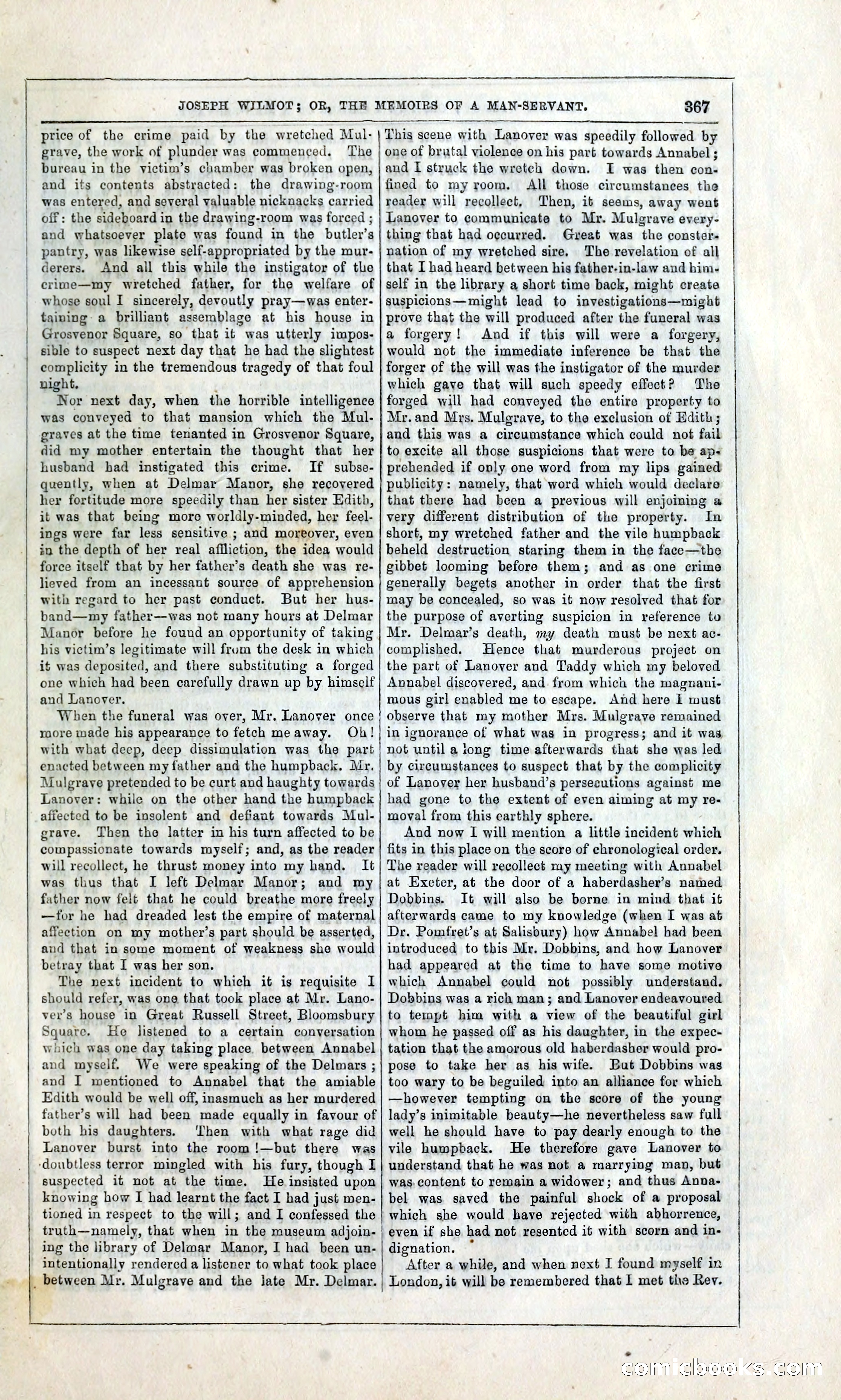
A restored page from Penny Dreadfuls, 1854. Page through the whole issue in the reader above.
📄 Transcribed text from this page (OCR, searchable)
Machine-transcribed from the original scan — historical spelling and the odd misread are preserved.
et JOSEPH WILMOT; OR, THE MEMOIRS OF A MAN-SERVANT. price of the crime paid by the wretched Mul- grave, the work of plunder was commenced. The bureau in the yictim’s chamber was broken open, and its contents abstracted: the drawing-room was entered, and several valuable nicknacks carried off: the sideboard in the drawing-room was forced ; and whatsoever plate was found in the butler’s pantry, was likewise self-appropriated by the mur- derers. And all this while the instigator of the crime—my wretched father, for the welfare of whose soul I sincerely, devoutly pray—was enter- taining: a brilliant assemblage at his house in Grosvenor Square, so that it was utterly impos- sible to suspect next day that he had the slightest complicity in the tremendous tragedy of that foul night. Nor next day, when the horrible intelligence was conveyed to that mansion which the Mul. graves at the time tenanted in Grosvenor Square, did my mother entertain the thought that her husband had instigated this crime. If subse- quently, when at Delmar Manor, she recovered her fortitude more speedily than her sister Edith, it was that being more worldly-minded, her feel- ings were far less sensitive ; and moreover, even in the depth of her real affliction, the idea would force itself that by her father’s death she was re- lieved from an incessant source of apprehension with regard to her past conduct. But her hus- band—my father—was not many hours at Delmar Manor before he found an opportunity of taking his victim’s legitimate will frum the desk in which if was deposited, and there substituting a forged one which had been carefully drawn up by himself and Lanover. When the funeral was over, Mr. Lanover once more made his appearance to fetch meaway. Ob! with what deep, deep dissimulation was the part enacted between my father and the humpback. Mr. Mulgrave pretended to be curt and haughty towards Lanover: while on the other hand the humpback affected to be insolent and defiant towards Mul- grave. Then the latter in his turn affected to be compassionate towards myself; and, as the reader will recollect, he thrust money into my hand. It was thus that I left Delmar Manor; and my father now felt that he could breathe more freely —for he had dreaded lest the empire of maternal affection on my mother’s part should be asserted, and that in some moment of weakness she would betray that [ was her son. The next incident to which it is requisite I should refer, was one that took place at Mr. Lano- ver’s house in Great Russell Street, Bloomsbury Square. He listened to a certain conversation which was one day taking place. between Annabel and myself. We were speaking of the Delmars ; and I mentioned to Annabel that the amiable Edith would be well off, inasmuch as her murdered father’s will had been made equally in favour of both his daughters. ‘Then with what rage did Lanover burst into the room!—but there was ‘doubtless terror mingled with his fury, though I suspected it not at the time. He insisted upon knowing how I had learnt the fact I had just men- tioned in respect to the will; and I confessed the truth—namely, that when in the museum adjoin- ing the library of Delmar Manor, I had been un- intentionally rendered a listener to what took place . between Mr. Mulgrave and the late Mr. Delmar. 367 This scene with Lanover was speedily followed by one of brutal violence on his part towards Annabel; and I struck the wretch down. I was then con- fined to my room. All those circumstances the reader will recollect, Then, it seams, away went Lanover to communicate to Mr. Mulgrave every- thing that had o¢curred. Guyeat was the conster. nation of my wretched sire, The revelation of all that I had heard between his father-in-law aud him- self in the library a short time back, might create suspicions—might lead to investigations—might prove that the will produced after the funeral was a forgery! And if this will were a forgery, would not the immediate inference be that the forger of the will was the instigator of the murder which gaye that will such speedy effect? The forged will had conveyed the entire property to Mr. and Mrs. Mulgrave, to the exclusion of Edith ; and this was a circumstance which could not fail to excite all those suspicions that were to be ap. prehended if only one word from my lips gained publicity: namely, that word which would declare that there had been a previous will enjoming a very different distribution of the property. In short, my wretched father and the vile humpback beheld destruction staring them in the face—the gibbet looming before them; and as one crime generally begets another in order that the first may be concealed, so was it now resolved that for the purpose of averting suspicion in reference to Mr. Delmar’s death, my death must be next ac- complished. Hence that murderous project on the part of Lanover and Taddy which my beloved Annabel discovered, and. from which the magnani- mous girl enabled me to escape. And here I must observe that my mother Mrs. Mulgrave remained in ignorance of what was in progress; and it was not until a iong time afterwards that she was led by circumstances to suspect that by the complicity of Lanoyer her husband’s persecutions against me had gone to the extent of even aiming at my re- moval from this earthly sphere. And now I will mention a little incident which fits in this place on the score of chronological order. The reader will recollect my meeting with Annabel at Exeter, at the door of a haberdasher’s named Dobbins. It will also be borne in mind that if afterwards came to my knowledge (when I was at Dr. Pomfret’s at Salisbury) how Annabel had been introduced to this Mr. Dobbins, and how Lanover had appeared at the time to have some motive which Annabel could not possibly understand. Dobbins was a rich man; and Lanover endeavoured to tempt him with a view of the beautiful girl whom he passed off as his daughter, in the expec- tation that the amorous old haberdasher would pro- pose to take her as his wife. But Dobbins was too wary to be beguiled into an alliance for which —however tempting on the score of the young lady’s inimitable beauty—he nevertheless saw full well he should have to pay dearly enough to the vile humpback. He therefore gave Lanover to understand that he was not a marrying man, but was. content to remain a widower; and thus Anna- bel was saved the painful shock of a proposal which she would have rejected with abhorrence, even if she had not resented it with scorn and in- dignation. ~ After a while, and when next I found myself in London, it will be remembered that I met the Rev. Giook (EO)