
Penny Dreadfuls, 1854 · page 63 of 399
Joseph Wilmot, or, The Memoirs of a Man-Servant — page 63: what you’re looking at
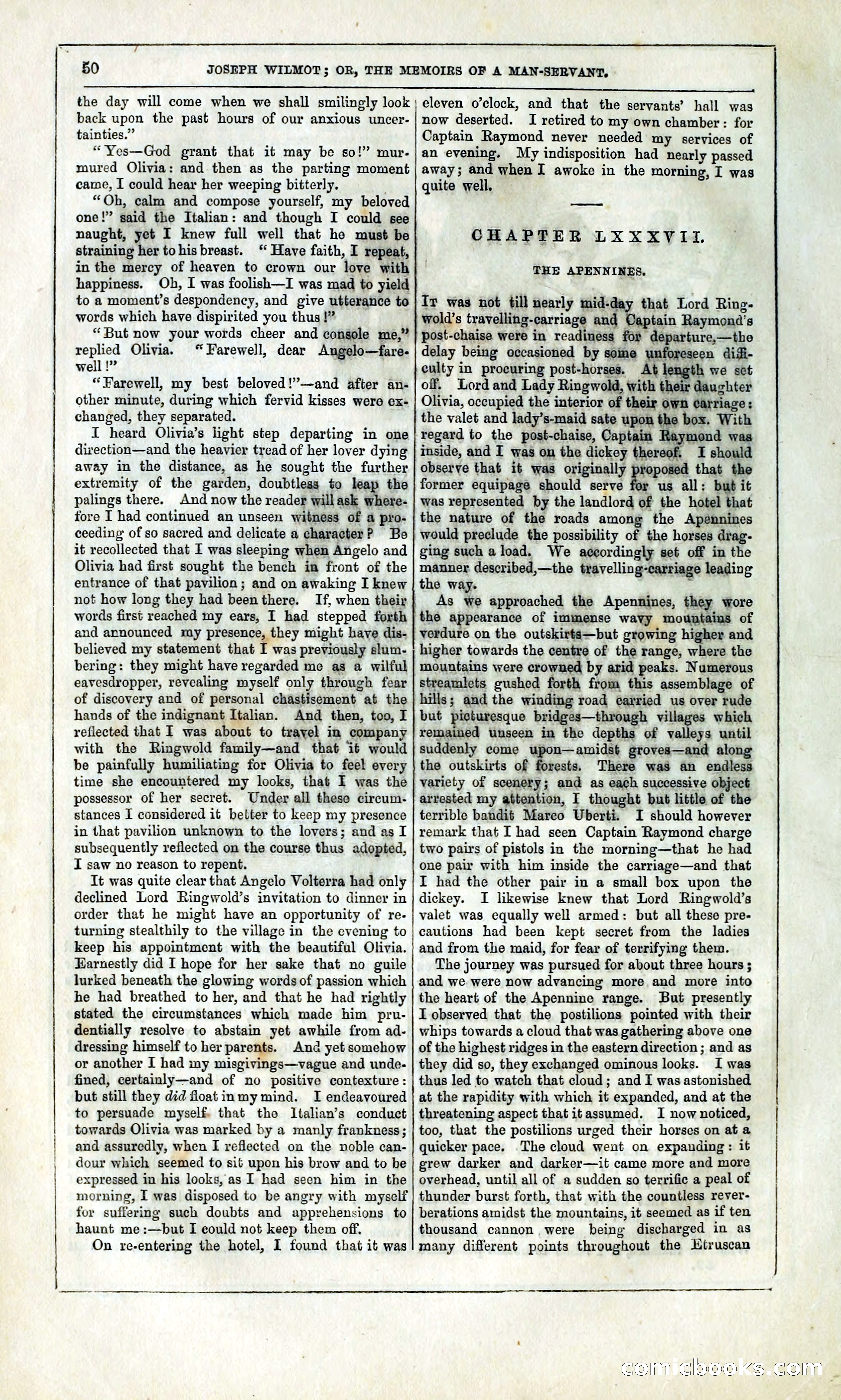
A restored page from Penny Dreadfuls, 1854. Page through the whole issue in the reader above.
📄 Transcribed text from this page (OCR, searchable)
Machine-transcribed from the original scan — historical spelling and the odd misread are preserved.
50 JOSEPH WILMOT; OR, THE MEMOIRS OF A MAN-SERVANT, SR Wg Ss ea ca aT TA I a NR rE ee oe een ee eee Tee Ee eee the day will come when we shall smilingly look back upon the past hours of our anxious uncer- tainties.” “Yes—God grant that it may be so!” mur- mured Olivia: and then as the parting moment came, I could hear her weeping bitterly. “Oh, calm and compose yourself, my beloved one!” said the Italian: and though I could see naught, yet I knew full well that he must be straining her tohisbreast. ‘ Have faith, I repeat, in the mercy of heaven to crown our love with happiness. Oh, I was foolish—I was mad to yield to a moment’s despondency, and give utterance to words which have dispirited you thus !” “But now your words cheer and console me,” replied Olivia. “Farewell, dear Augelo—fare- well !” | “Farewell, my best beloved!”—and after an- other minute, during which fervid kisses were ex- changed, they separated. I heard Olivia’s light step departing in one direction—and the heavier tread of her lover dying away in the distance, as he sought the further extremity of the garden, doubtless to leap the palings there. And now the reader willask where- fore I had continued an unseen witness of a pro- ceeding of so sacred and delicate a character? Be it recollected that I was sleeping when Angelo and Olivia had first sought the bench in front of the entrance of that pavilion; and on awaking I knew not how long they had beenthere. If, when their words first reached my ears, I had stepped forth and announced my presence, they might have dis- believed my statement that I was previously slum- bering: they might have regarded me as a wilful eavesdropper, revealing myself only through fear of discovery and of personal chastisement at the hands of the indignant Italian. And then, too, I reflected that I was about to trayel in company with the Ringwold family—and that it would be painfully humiliating for Olivia to feel every time she encountered my looks, that I was the possessor of her secret. Under all these circum- stances I considered it better to keep my presence in that pavilion unknown to the lovers; and as I subsequently reflected on the course thus adopted, I saw no reason to repent. Tt was quite clear that Angelo Volterra had only declined Lord Ringwold’s invitation to dinner in order that he might have an opportunity of re- turning stealthily to the village in the evening to keep his appointment with the beautiful Olivia. Harnestly did I hope for her sake that no guile lurked beneath the glowing words of passion which he had breathed to her, and that he had rightly stated the circumstances which made him pru- dentially resolve to abstain yet awhile from ad- dressing himself to her parents. And yet somehow or another I had my misgivings—vague and unde- fined, certainly—and of no positive contexture : but still they did float inmy mind. I endeavoured to persuade myself, that the Italian’s conduct towards Olivia was marked by a manly frankness; and assuredly, when I reflected on the noble can- dour which seemed to sit upon his brow and to be expressed in his looks, as I had seen him in the morning, I was disposed to be angry with myself for suffering such doubts and apprehensions to haunt me:—but I eould not keep them off. On re-entering the hotel, I found that it was eleven o’clock, and that the servants’ hall was now deserted. I retired to my own chamber: for Captain Raymond never needed my services of an evening, My indisposition had nearly passed away; and when I awoke in the morning, I was quite well. CHAPTER LXXXVII. THE APENNINES. Tr was not till nearly mid-day that Lord Ring- wold’s travelling-carriage and Captain Raymond's post-chaise were in readiness for departure,—the delay being occasioned by soine ynforeseen difi- culty in procuring post-horses. At length we sct off. Lord and Lady Ringwold, with their daughter Olivia, occupied the interior of their own carriage : the valet and lady’s-maid sate upon the box. With regard to the post-chaise, Captain Raymond was inside, and I was on the dickey thereof. I should observe that it was originally Proposed that the former equipage should serve us all: but it was represented by the landlord of the hotel that the nature of the roads among the Apénnines would preclude the possibility of the horses drag- ging such a load. We accordingly set off in the manner described,—the travelling-carriage leading the way. ; As we approached the Apennines, they wore the appearance of immense wavy mountains of verdure on the outskirts—but growing higher and higher towards the centre of the range, where the mountains were crowned by arid peaks. Numerous streamlets gushed forth from this assemblage of hills; and the winding road carried us over rude but picturesque bridges—through villages which remained unseen in the depths of valleys until suddenly come upon—amidst groves—and along the outskirts of forests. There was an endless variety of scenery; and as each successive object arrested my attention, I thought but little of the terrible bandit Mareo Uberti. I should however remark that I had seen Captain Raymond charge two pairs of pistols in the morning—that he had one pair with him inside the carriage—and that I had the other pair in a small box upon the dickey. I likewise knew that Lord Ringwold’s valet was equally well armed: but all these pre- cautions had been kept secret from the ladies and from the maid, for fear of terrifying them. The journey was pursued for about three hours ; and we were now advancing more and more into the heart of the Apennine range. But presently I observed that the postilions pointed with their whips towards a cloud that was gathering above one of the highest ridges in the eastern direction ; and as they did so, they exchanged ominous looks. I was thus led to watch that cloud; and I was astonished at the rapidity with which it expanded, and at the threatening aspect thatitassumed. I now noticed, too, that the postilions urged their horses on at a quicker pace, The cloud went on expanding: it grew darker and darker—it came more and more overhead, until all of a sudden so terrific a peal of thunder burst forth, that with the countless rever- berations amidst the mountains, it seemed as if ten thousand cannon were being discharged in as many different points throughout the Ktruscan CoOmicaoolks (C@)