
Penny Dreadfuls, 1854 · page 64 of 399
Joseph Wilmot, or, The Memoirs of a Man-Servant — page 64: what you’re looking at
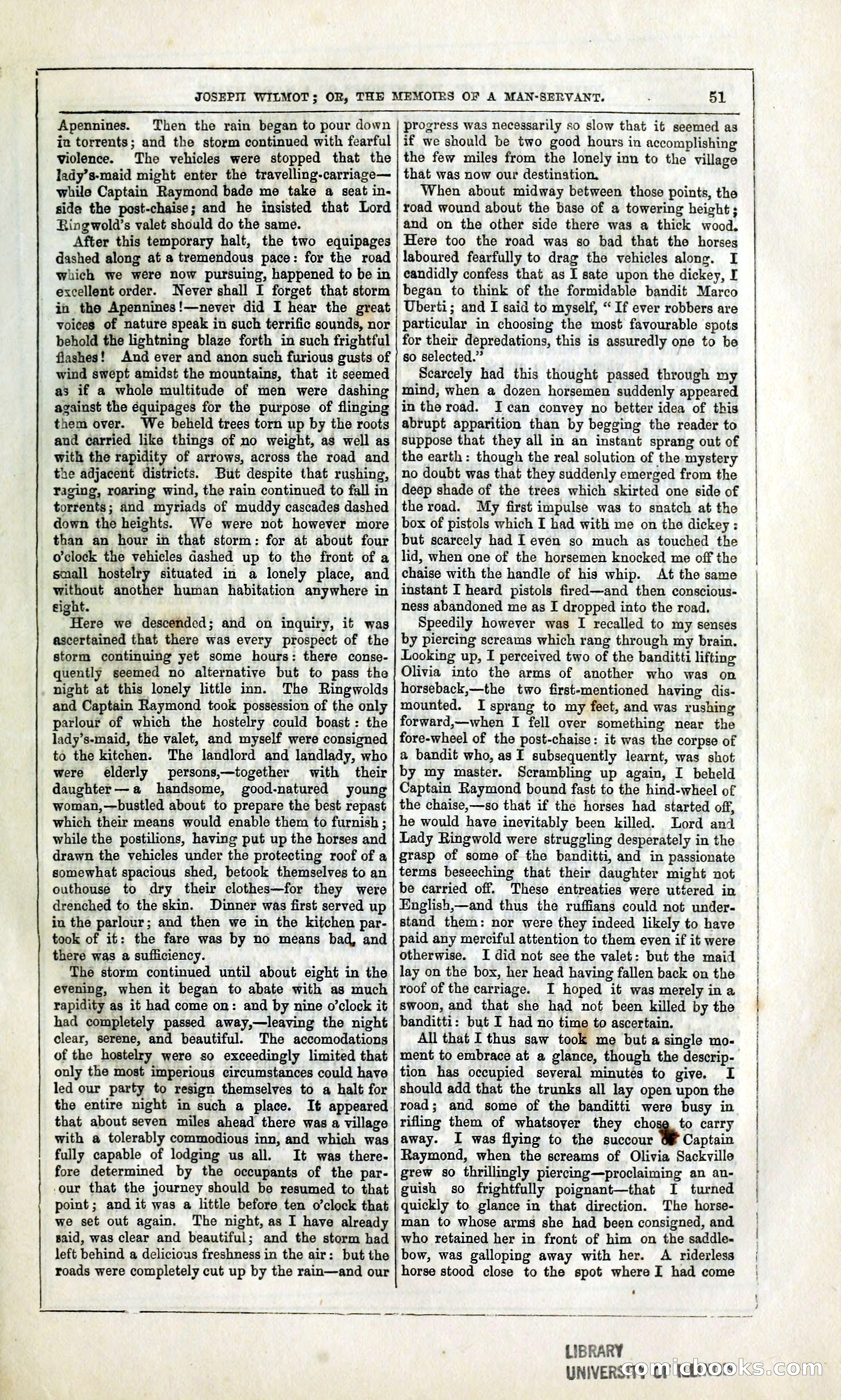
A restored page from Penny Dreadfuls, 1854. Page through the whole issue in the reader above.
📄 Transcribed text from this page (OCR, searchable)
Machine-transcribed from the original scan — historical spelling and the odd misread are preserved.
JOSEPIE WILMOT; OR, THE MEMOIRS OF A MAN-SERVANT. 51 Apennines. Then the rain began to pour down in torrents; and the storm continued with fearful violence. The vehicles were stopped that the lady’s-maid might enter the travelling-carriage— while Captain Raymond bade me take a seat in- side the post-chaise; and he insisted that Lord Ringwold’s valet should do the same. After this temporary halt, the two equipages dashed along at a tremendous pace: for the road which we were now pursuing, happened to be in excellent order. Never shall I forget that storm in the Apennines!—never did I hear the great voices of nature speak in such terrific sounds, nor behold the lightning blaze forth in such frightful flashes! And ever and anon such furious gusts of wind swept amidst the mountains, that it seemed as if a whole multitude of men were dashing against the équipages for the purpose of flinging them over. We beheld trees torn up by the roots and carried like things of no weight, as well as with the rapidity of arrows, across the road and the adjacent districts. But despite that rushing, raging, roaring wind, the rain continued to fall in torrents; and myriads of muddy cascades dashed down the heights. We were not however more than an hour in that storm: for at about four o’clock the vehicles dashed up to the front of a small hostelry situated in a lonely place, and without another human habitation anywhere in eight. Here we descended; and on inquiry, it was ascertained that there was every prospect of the storm continuing yet some hours: there conse- quently seemed no alternative but to pass the night at this lonely little inn. The Ringwolds and Captain Raymond took possession of the only parlour of which the hostelry could boast: the lady’s-maid, the valet, and myself were consigned to the kitchen. The landlord and landlady, who were elderly persons,—together with their daughter—a handsome, good-natured young woman,—bustled about to prepare the best repast which their means would enable them to furnish ; while the postilions, having put up the horses and drawn the vehicles under the protecting roof of a somewhat spacious shed, betook themselves to an outhouse to dry their clothes—for they were drenched to the skin. Dinner was first served up in the parlour; and then we in the kitchen par- took of it: the fare was by no means bad, and there was a sufficiency. The storm continued until about eight in the evening, when it began to abate with as much rapidity as it had come on: and by nine o’clock it had completely passed away,—leaving the night clear, serene, and beautiful. The accomodations of the hostelry were so exceedingly limited that only the most imperious circumstances could have led our party to resign themselves to a halt for the entire night in such a place. It appeared that about seven miles ahead there was a village with a tolerably commodious inn, and which was fully capable of lodging us all. It was there. fore determined by the occupants of the par- our that the journey should be resumed to that point; and it was a little before ten o’clock that we set out again. The night, as I have already said, was clear and beautiful; and the storm had left behind a delicious freshness in the air: but the roads were completely cut up by the rain—and our progress was necessarily so slow that it seemed as if we should be two good hours in accomplishing the few miles from the lonely inn to the village that was now our destination, When about midway between those points, the road wound about the base of a towering height; and on the other side there was a thick wood. Here too the road was so bad that the horses laboured fearfully to drag the vehicles along. I candidly confess that as I sate upon the dickey, I began to think of the formidable bandit Marco Uberti; and I said to myself, “ If ever robbers are particular in choosing the most favourable spots for their depredations, this is assuredly one to be so selected.” Scarcely had this thought passed through my mind, when a dozen horsemen suddenly appeared in the road. Ican convey no better idea of this abrupt apparition than by begging the reader to suppose that they all in an instant sprang out of the earth: though the real solution of the mystery no doubt was that they suddenly emerged from the deep shade of the trees which skirted one side of the road. My first impulse was to snatch at the box of pistols which I had with me on the dickey : but scarcely had L even so much as touched the lid, when one of the horsemen knocked me off the chaise with the handle of his whip. At the same instant I heard pistols fired—and then conscious- ness abandoned me as I dropped into the road. Speedily however was I recalled to my senses by piercing screams which rang through my brain. Looking up, I perceived two of the banditti lifting Olivia into the arms of another who was on horseback,—the two firstementioned haying dis- mounted. Isprang to my feet, and was rushing forward,—when I fell over something near the fore-wheel of the post-chaise: it was the corpse of a bandit who, as I subsequently learnt, was shot by my master. Scrambling up again, I beheld Captain Raymond bound fast to the hind-wheel of the chaise,—so that if the horses had started off, he would have inevitably been killed. Lord and Lady Ringwold were struggling desperately in the grasp of some of the banditti, and in passionate terms beseeching that their daughter might not be carried off. These entreaties were uttered in English,—and thus the ruffians could not under- stand them: nor were they indeed likely to have paid any merciful attention to them even if it were otherwise. I did not see the valet: but the maid lay on the box, her head having fallen back on the roof of the carriage. I hoped it was merely ina swoon, and that she had not been killed by the banditti: but I had no time to ascertain. All that I thus saw took me but a single mo- ment to embrace at a glance, though the descrip- tion has occupied several minutes to give. I should add that the trunks all lay open upon the road; and some of the banditti were busy in rifling them of whatsoyer they chosg to carry away. I was flying to the succour Wt Captain Raymond, when the screams of Olivia Sackville grew so thrillingly piercing—proclaiming an an- guish so frightfully poignant—that I turned quickly to glance in that direction. The horse- man to whose arms she had been consigned, and who retained her in front of him on the saddle- bow, was galloping away with her. A riderless horse stood close to the spot where I had come a a er ee ee es Ce LIBRARY UNIVERST® 01) FAO SS (C@)