
Penny Dreadfuls, 1849 · page 365 of 394
The Mysteries of the Court of London — page 365: what you’re looking at
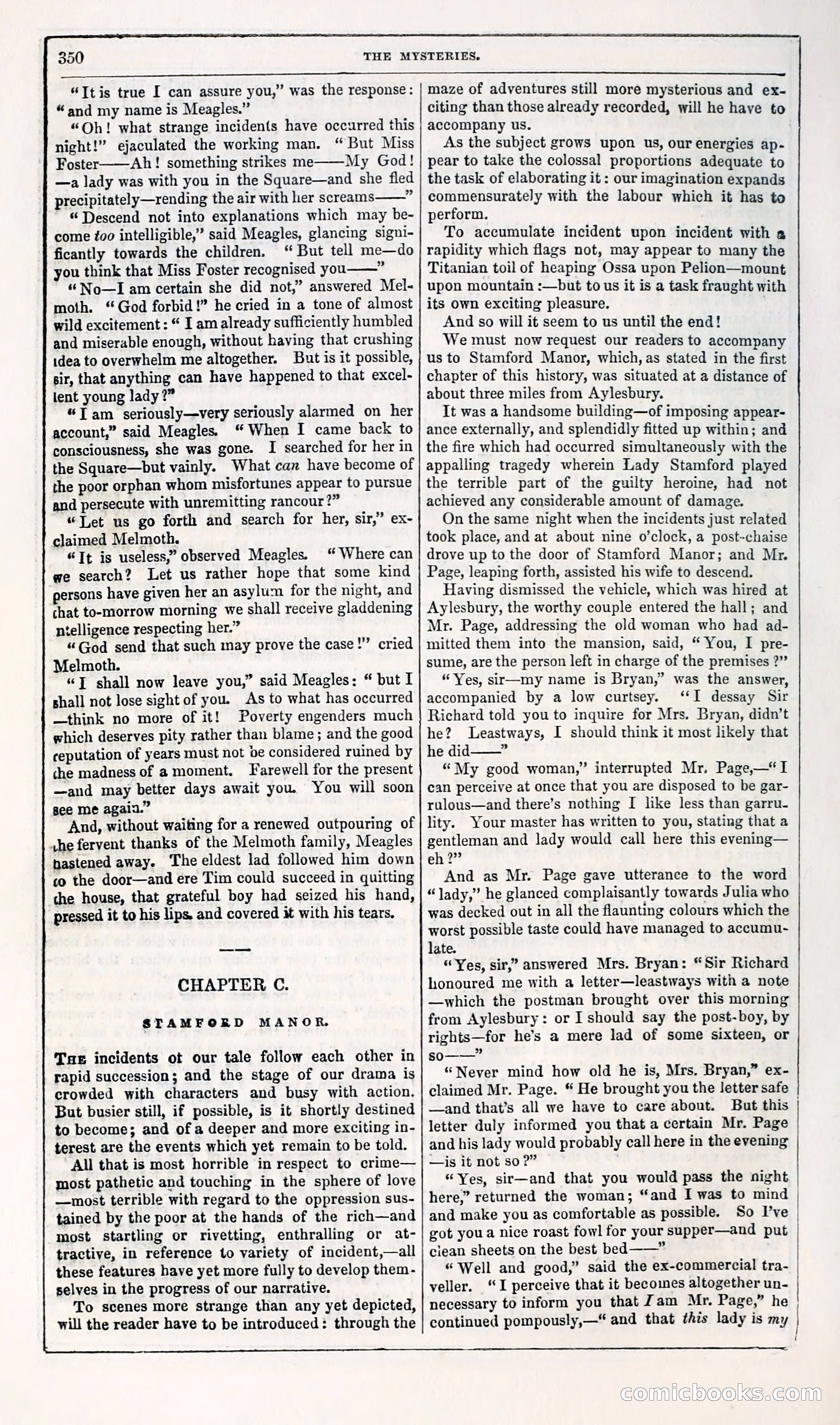
A restored page from Penny Dreadfuls, 1849. Page through the whole issue in the reader above.
📄 Transcribed text from this page (OCR, searchable)
Machine-transcribed from the original scan — historical spelling and the odd misread are preserved.
300 THE MYSTERIES. 8 a TF SO LE a ea ae ee a ee “TItis true [ can assure you,” was the response: “and my name is Meagles.” “Oh! what strange incidents have occurred this night!” ejaculated the working man. “ But Miss Foster——Ah! something strikes me——My God! —a lady was with you in the Square—and she fled precipitately—rending the air with her screams——” “ Descend not into explanations which may be- come too intelligible,” said Meagles, glancing signi- ficantly towards the children. ‘“ But tell me—do you think that Miss Foster recognised you——” ‘‘ No—I am cettain she did not,” answered Mel- moth. “God forbid!” he cried in a tone of almost wild excitement: “ I am already sufficiently humbled and miserable enough, without having that crushing idea to overwhelm me altogether. But is it possible, sir, that anything can have happened to that excel- lent young lady 2” “Tam seriously—very seriously alarmed on her account,” said Meagles. ‘“ When I came back to consciousness, she was gone. I searched for her in the Square—but vainly. What can have become of the poor orphan whom misfortunes appear to pursue and persecute with unremitting rancour?” “Let us go forth and search for her, sir,” ex- claimed Melmoth. “Tt is useless,” observed Meagles. “ Where can we search? Let us rather hope that some kind persons have given her an asylum for the night, and chat to-morrow morning we shall receive gladdening telligence respecting her.” “God send that such may prove the case!” cried Melmoth. “J shall now leave you,” said Meagles: “ but I shall not lose sight of you. As to what has occurred —think no more of it! Poverty engenders much which deserves pity rather than blame; and the good ceputation of years must not ve considered ruined by che madness of a moment. Farewell for the present —and may better days await you. You will soon gee me agaia.” And, without waiting for a renewed outpouring of she fervent thanks of the Melmoth family, Meagles hastened away. The eldest lad followed him down co the door—and ere Tim could succeed in quitting the house, that grateful boy had seized his hand, pressed it to his lips, and covered it with his tears. CHAPTER C. STAMFORD MANOR. Tue incidents ot our tale follow each other in rapid succession; and the stage of our drama is crowded with characters and busy with action. But busier still, if possible, is it shortly destined to become; and ofa deeper and more exciting in- terest are the events which yet remain to be told. All that is most horrible in respect to crime— most pathetic and touching in the sphere of love —most terrible with regard to the oppression sus- tained by the poor at the hands of the rich—and most startling or rivetting, enthralling or at- tractive, in reference to variety of incident,—all these features have yet more fully to develop them- selves in the progress of our narrative. To scenes more strange than any yet depicted, will the reader have to be introduced: through the maze of adventures still more mysterious and ex- citing than those already recorded, will he have to accompany us. As the subject grows upon us, our energies ap- pear to take the colossal proportions adequate to the task of elaborating it : our imagination expands commensurately with the labour which it has to perform. To accumulate incident upon incident with a rapidity which flags not, may appear to many the Titanian toil of heaping Ossa upon Pelion—mount upon mountain :—but to us it is a task fraught with its own exciting pleasure. And so will it seem to us until the end! We must now request our readers to accompany us to Stamford Manor, which, as stated in the first chapter of this history, was situated at a distance of about three miles from Aylesbury. It was a handsome building—of imposing appear- ance externally, and splendidly fitted up within; and the fire which had occurred simultaneously with the appalling tragedy wherein Lady Stamford played the terrible part of the guilty heroine, had not achieved any considerable amount of damage. On the same night when the incidents just related took place, and at about nine o’clock, a post-chaise drove up to the door of Stamford Manor; and Mr. Page, leaping forth, assisted his wife to descend. Having dismissed the vehicle, which was hired at Aylesbury, the worthy couple entered the hall; and Mr. Page, addressing the old woman who had ad- mitted them into the mansion, said, “ You, I pre- sume, are the person left in charge of the premises ?” “Yes, sir—my name is Bryan,” was the answer, accompanied by a low curtsey. “I dessay Sir Richard told you to inquire for Mrs. Bryan, didn’t he? lLeastways, I should think it most likely that he did——” “My good woman,” interrupted Mr, Page,—* I can perceive at once that you are disposed to be gar- rulous—and there’s nothing I like less than garru- lity. Your master has written to you, stating that a gentleman and lady would call here this evening— eh 2” And as Mr. Page gave utterance to the word “lady,” he glanced complaisantly towards Julia who was decked out in all the flaunting colours which the worst possible taste could have managed to accumu-~ late. “Yes, sir,” answered Mrs. Bryan: “Sir Richard honoured me with a letter—leastways with a note —which the postman brought over this morning from Aylesbury: or I should say the post-boy, by rights—for he’s a mere lad of some sixteen, or s0——— “Never mind how old he is, Mrs. Bryan,” ex- claimed Mr. Page. “ He brought you the letter safe —and that’s all we have to care about. But this letter duly informed you that a certain Mr. Page and his lady would probably call here in the evening —is it not so ?” “Yes, sir—and that you would pass the night here,” returned the woman; “and I was to mind and make you as comfortable as possible. So I’ve got you a nice roast fowl for your supper—and put clean sheets on the best bed ——” “Well and good,” said the ex-commercial tra- veller. “I perceive that it becomes altogether un- necessary to inform you that Jam Mr. Page,” he continued pompously,—* and that this lady is my eee | | | O)(©Y6) (C(O) SCO