
Penny Dreadfuls, 1849 · page 366 of 394
The Mysteries of the Court of London — page 366: what you’re looking at
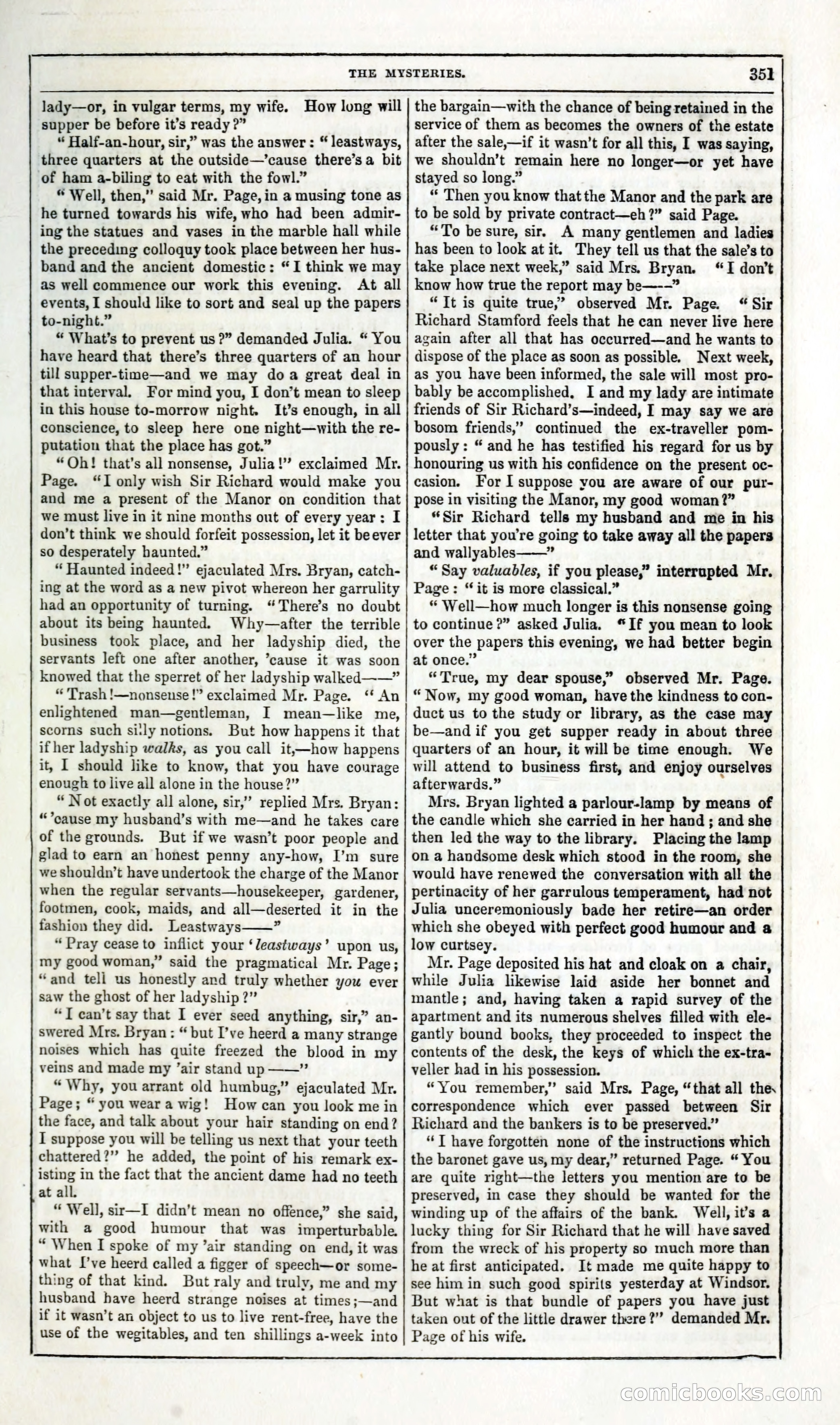
A restored page from Penny Dreadfuls, 1849. Page through the whole issue in the reader above.
📄 Transcribed text from this page (OCR, searchable)
Machine-transcribed from the original scan — historical spelling and the odd misread are preserved.
THE MYSTERIES. 351 lady—or, in vulgar terms, my wife. How long will supper be before it’s ready ?” “ Half-an-hour, sir,” was the answer: “ leastways, three quarters at the outside—’cause there’s a bit of ham a-biling to eat with the fowl.” * Well, then,” said Mr. Page, in a musing tone as he turned towards his wife, who had been admir- ing the statues and vases in the marble hall while the preceding colloquy took place between her hus- band and the ancient domestic: “I think we may as well commence our work this evening. At all events, I should like to sort and seal up the papers to-night.” “ What’s to prevent us ?” demanded Julia. “ You have heard that there’s three quarters of an hour till supper-time—and we may doa great deal in that interval. For mind you, I don’t mean to sleep in this house to-morrow night. It’s enough, in all conscience, to sleep here one night—with the re- putation that the place has got.” “Oh! that’s all nonsense, Julia!’ exclaimed Mr. Page. “I only wish Sir Richard would make you and me a present of the Manor on condition that we must live in it nine months out of every year; I don’t think we should forfeit possession, let it be ever so desperately haunted.” “ Haunted indeed!” ejaculated Mrs. Bryan, catch- ing at the word as a new pivot whereon her garrulity had an opportunity of turning. “There’s no doubt about its being haunted. Why—after the terrible business took place, and her ladyship died, the servants left one after another, ’cause it was soon knowed that the sperret of her ladyship walked —~—” “Trash !—nonsense!” exclaimed Mr. Page. ‘‘ An enlightened man—gentleman, I mean—like me, scorns such si:ly notions. But how happens it that if her ladyship walks, as you call it,—how happens it, I should like to know, that you have courage enough to live all alone in the house?” “ Not exactly all alone, sir,” replied Mrs. Bryan: “’cause my husband’s with me—and he takes care of the grounds. But if we wasn’t poor people and glad to earn an honest penny any-how, I’m sure we Shouldn’t have undertook the charge of the Manor when the regular servants—housekeeper, gardener, footmen, cook, maids, and all—deserted it in the fashion they did. Leastways——” “ Pray cease to inflict your ‘leastways’ upon us, my good woman,” said the pragmatical Mr. Page; “and tell us honestly and truly whether you ever saw the ghost of her ladyship ?” “I can’t say that I ever seed anything, sir,” an- swered Mrs. Bryan: “ but I’ve heerd a many strange noises which has quite freezed the blood in my veins and made my ’air stand up ——” “Why, you arrant old humbug,” ejaculated Mr. Page; “ you weara wig! How can you look me in the face, and talk about your hair standing on end? I suppose you will be telling us next that your teeth chattered?”” he added, the point of his remark ex- isting in the fact that the ancient dame had no teeth {at all. “ Well, sir—I didn’t mean no offence,” she said, with a good humour that was imperturbable. “ When I spoke of my ’air standing on end, it was what I’ve heerd called a figger of speech—or some- thing of that kind. But raly and truly, me and my husband have heerd strange noises at times;—and if it wasn’t an object to us to live rent-free, have the use of the wegitables, and ten shillings a-week into the bargain—with the chance of being retained in the service of them as becomes the owners of the estate after the sale,—if it wasn’t for all this, I was saying, we shouldn’t remain here no longer—or yet have stayed so long.” “ Then you know thatthe Manor and the park are to be sold by private contract—eh?” said Page. “To be sure, sir. A many gentlemen and ladies has been to look at it. They tell us that the sale’s to take place next week,” said Mrs. Bryan. “I don’t know how true the report may be—--” “It is quite true,” observed Mr. Page “Sir Richard Stamford feels that he can never live here again after all that has occurred—and he wants to dispose of the place as soon as possible. Next week, as you have been informed, the sale will most pro- bably be accomplished, I and my lady are intimate friends of Sir Richard’s—indeed, I may say we are bosom friends,” continued the ex-traveller pom- pously: “ and he has testified his regard for us by honouring us with his confidence on the present oc- casion. For ] suppose you are aware of our pur- pose in visiting the Manor, my good woman 2” “Sir Richard tells my husband and me in his letter that you're going to take away all the papers and wallyables——” “ Say valuables, if you please,” interrupted Mr. Page: ‘it is more classical,” * Well—how much longer is this nonsense going to continue ?” asked Julia. “If you mean to look over the papers this evening, we had better begin at once.” “True, my dear spouse,” observed Mr. Page. “ Now, my good woman, have the kindness to con- duct us to the study or library, as the case may be—and if you get supper ready in about three quarters of an hour, it will be time enough. We will attend to business first, and enjoy ourselves afterwards.” Mrs. Bryan lighted a parlour-lamp by means of the candle which she carried in her hand ; and she then led the way to the library. Placing the lamp on a handsome desk which stood in the room, she would have renewed the conversation with all the pertinacity of her garrulous temperament, had not Julia unceremoniously bade her retire—an order which she obeyed with perfect good humour and a low curtsey. Mr. Page deposited his hat and cloak on a chair, while Julia likewise laid aside her bonnet and mantle; and, having taken a rapid survey of the apartment and its numerous shelves filled with ele- gantly bound books, they proceeded to inspect the contents of the desk, the keys of whicli the ex-tra- veller had in his possession. “You remember,” said Mrs. Page, “that all the, correspondence which ever passed between Sir Richard and the bankers is to be preserved.” “T have forgotten none of the instructions which the baronet gave us, my dear,” returned Page. “ You are quite right—the letters you mention are to be preserved, in case they should be wanted for the winding up of the affairs of the bank. Well, it’s a lucky thing for Sir Richard that he will have saved from the wreck of his property so much more than he at first anticipated. It made me quite happy to see him in such good spirits yesterday at Windsor. But what is that bundle of papers you have just taken out of the little drawer there ?”” demanded Mr. Page of his wife. LDOO a © = Q) Ho (CO)