
Penny Dreadfuls, 1849 · page 397 of 394
The Mysteries of the Court of London — page 397: what you’re looking at
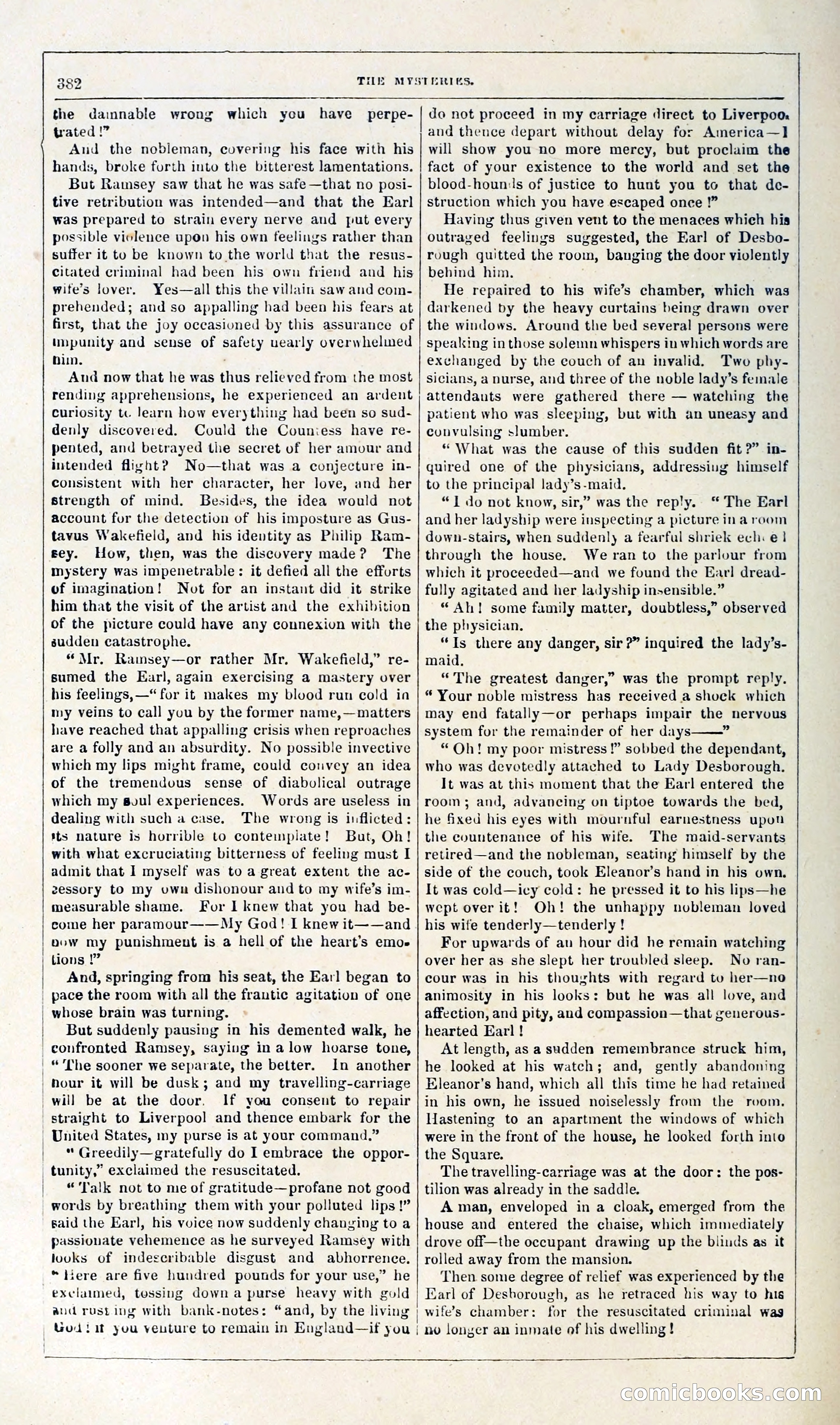
A restored page from Penny Dreadfuls, 1849. Page through the whole issue in the reader above.
📄 Transcribed text from this page (OCR, searchable)
Machine-transcribed from the original scan — historical spelling and the odd misread are preserved.
382 the dainnable wrong which you have _ perpe- trated !” Aud the nobleman, covering his face with his hands, broke forth into the bitterest lamentations. But Ramsey saw that he was safe —that no posi- tive retribution was intended—and that the Earl was prepared to strain every nerve and put every possible violence upon his own feelings rather than suffer it to be known to the world that the resus- citated criminal had been his own friend and his wife’s lover. Yes—all this the villain saw and com- prehended; and so appalling had been his fears at first, that the joy occasioned by this assurance of ubpunity and sense of safety uearly overwhelined bin. And now that he was thus relieved from the most rendivg apprehensions, he experienced an ardent curiosity tc learn how everything had been so sud- denly discovered. Could the Couniess have re- pented, and betrayed the secret of her amour and intended flight? No—that was a conjecture in- consistent with her character, her love, and her strength of mind. Besides, the idea would not account fur the detection of his imposture as Gus- tavus Wakefield, and his identity as Philip Ram- geey. How, then, was the discovery made? The mystery was impenetrable: it defied all the effurts of imagination! Not for an instant did it strike him that the visit of the artist and the exhibition of the picture could have any connexivun with the sudden catastrophe. “Mr. Ramsey—or rather Mr. Wakefield,” re- sumed the Earl, again exercising a mastery over his feelings, —“for it makes my blood run cold in my veins to call you by the former name,—matters have reached that appalling crisis when reproaches are a folly and an absurdity. No possible invective which my lips might frame, could convey an idea of the tremendous sense of diabolical outrage which my soul experiences. Words are useless in dealing with such a case. The wrong is iiflicted: tts nature is horrible to contemplate! But, Oh! with what excruciating bitterness of feeling must I admit that I myself was to a great extent the ac- zessory to my own dishonour and to my wife’s im- measurable shame. For I knew that you had be- come her paramour——My God! I knew it——and bow my punishment is a hell of the heart’s emos lions !” And, springing from his seat, the Earl began to pace the room with all the frantic agitation of one whose brain was turning. But suddenly pausing in his demented walk, he confronted Ramsey, saying in alow hoarse tone, | will “The sooner we separate, the better. In another nour it will be dusk; and my travelling-carriage be at the door. If you consent to repair straight to Liverpool and thence embark for the United States, my purse is at your command.” “ Greedily—gratefully do I embrace the oppor- tunity,” exclaimed the resuscitated. “Talk not to me of gratitude—profane not good words by breathing them with your polluted lips !” paid the Earl, his voice now suddenly changing to a passionate vehemence as he surveyed Ramsey with looks of indescribable disgust and abhorrence, “iiere are five hundred pounds for your use,” he exclaimed, tossing down a purse heavy with gold and rusting with bank-notes: “and, by the living Guilit yuu veuture to remain in England—if you —<—.e. TIE MYSTERIES. | do not proceed in my carriage direct to Liverpoo. and thence depart without delay for America—] will show you no more mercy, but proclaim the fact of your existence to the world and set the blood-houn:ls of justice to hunt you to that de- struction which you have escaped once !” Having thus given vent to the menaces which his outraged feelings suggested, the Earl of Desbo- rough quitted the room, banging the door violently behind him. He repaired to his wife’s chamber, which was darkened by the heavy curtains being drawn over the windows. Around the bed several persons were speaking in those solemn whispers in which words are exchanged by the couch of an invalid. Two phy- sicians, a nurse, and three of the noble lady’s female attendants were gathered there — watching the patient who was sleeping, but with an uneasy and convulsing slumber. * What was the cause of this sudden fit ?” in- quired one of the physicians, addressiug himself to the principal lady’s-maid. “I do not know, sir,” was the reply. “ The Earl and her ladyship were inspecting a picture ina room down-stairs, when suddenly a fearful shriek ech: e | through the house. Weran to the parlour from which it proceeded—and we found the Earl dread- fully agitated and her ladyship insensible.” “Ah! some family matter, doubtless,” observed the physician. “Is there any danger, sir?” inquired the lady’s- maid. “The greatest danger,” was the prompt reply. “ Your noble mistress has received a shock which may end fatally—or perhaps impair the nervous system for the remainder of her days vs “ Oh! my poor mistress!” sobbed the dependant, who was devotedly attached to Lady Desborough. It was at this moment that the Earl entered the room; and, advancing on tiptoe towards the bed, he Sxed his eyes with mournful earnestness upon the countenance of his wife. The maid-servants retired—and the nobleman, seating himself by the side of the couch, took Eleanor’s hand in his own. It was cold—icy cold: he pressed it to his lips—he wept over it! Oh! the unhappy nobleman loved his wife tenderly—tenderly ! For upwards of au hour did he remain watching over her as she slept her troubled sleep. No ran- cour was in his thoughts with regard tou her—no animosity in his looks: but he was all love, and affection, and pity, and compassion—that generous- hearted Earl ! At length, as a sudden remembrance struck him, he looked at his watch; and, gently abandoning Eleanor’s hand, which all this time he had retained in his own, he issued noiselessly from the room. Hastening to an apartment the windows of which were in the front of the house, he looked forth into the Square. The travelling-carriage was at the door: the pos- tilion was already in the saddle. A man, enveloped in a cloak, emerged from the house and entered the chaise, which immediately drove off—tbe occupant drawing up the blinds as it rolled away from the mansion. Then some degree of relief was experienced by the Earl of Deshorough, as he retraced his way to his | wife’s chamber: for the resuscitated criminal wag i nv longer an inmate of his dwelling! (@ 6)(0)() im (C(O) Ha l(EO)