
Penny Dreadfuls, 1849 · page 398 of 394
The Mysteries of the Court of London — page 398: what you’re looking at
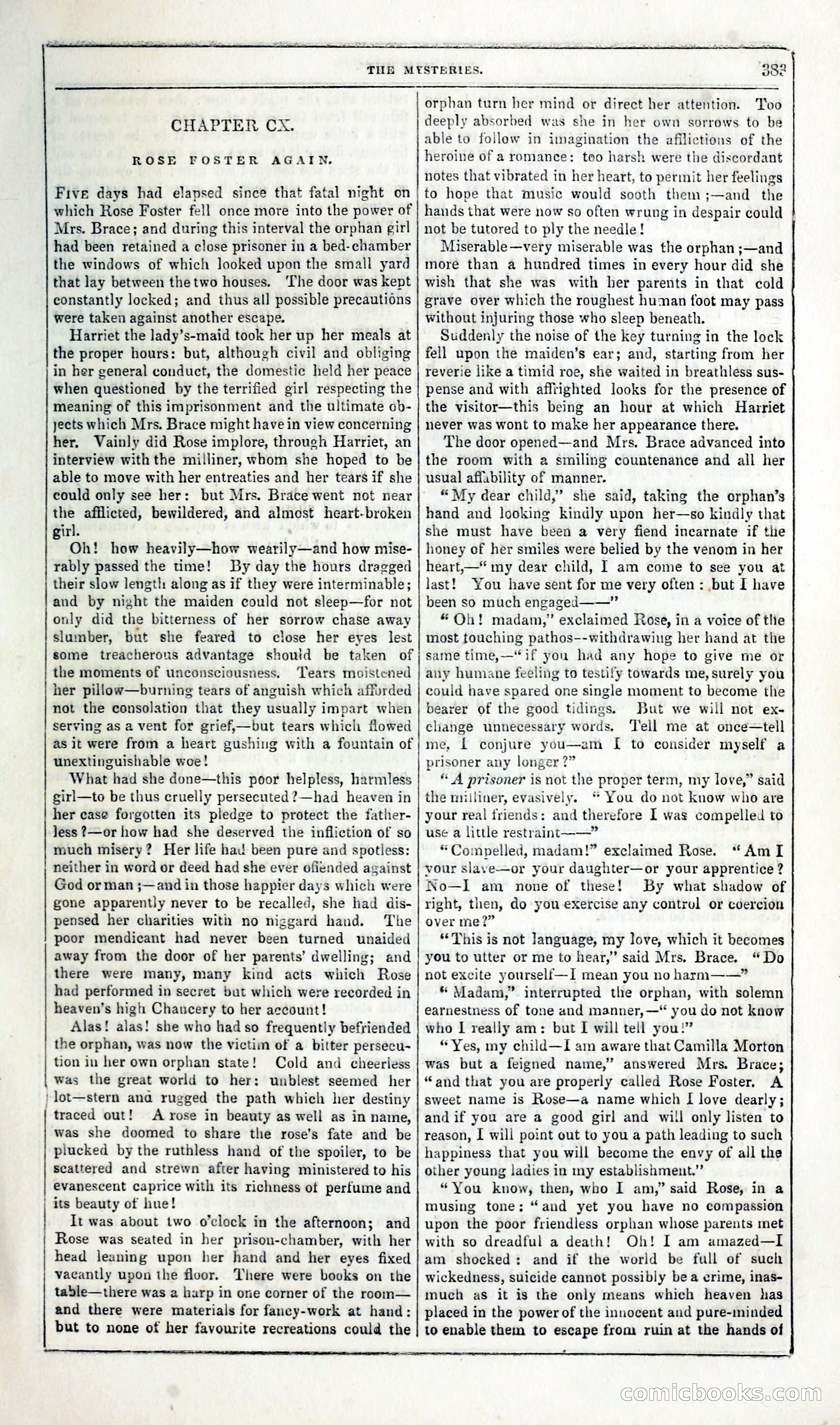
A restored page from Penny Dreadfuls, 1849. Page through the whole issue in the reader above.
📄 Transcribed text from this page (OCR, searchable)
Machine-transcribed from the original scan — historical spelling and the odd misread are preserved.
a Ce ees THE MYSTERIES. CHAPTER Cx. ROSE FOSTER AGAIN, Five days had elapsed since that fatal night on which Rose Foster fell once more into the power of Mrs. Brace; and during this interval the orphan girl had been retained a close prisoner in a bed-chamber the windows of which looked upon the small yard that lay between thetwo houses. ‘The door was kept constantly locked; and thus all possible precautions were taken against another escape. Harriet the lady’s-maid took her up her meals at the proper hours: but, although civil and obliging in her general conduct, the domestic held her peace when questioned by the terrified girl respecting the meaning of this imprisonment and the ultimate ob- jects which Mrs. Brace might have in view concerning her. Vainly did Rose implore, throuch Harriet, an interview with the milliner, whom she hoped to be able to move with her entreaties and her tears if she could only see her: but Mrs. Brace went not near the afflicted, bewildered, and almost heart-broken girl. Oh! how heavily—how wearily—and how mise- rably passed the ume! [By day the hours dragged their slow length along as if they were interminable; and by night the maiden could not sleep—for not only did the bitterness of her sorrow chase away slumber, but she feared to close her eyes lest some treacherons advantage shouid be taken of the moments of unconsciousness. Tears moistened her pillow—burning tears of anguish which afforded not the consolation that they usually impart when serving as a vent for grief,—but tears which flowed as it were from a heart gushing with a fountain of unextinguishable woe! What had she done—this poor helpless, harmless girl—to be thus cruelly persecuted ?—had heaven in her case forgotten its pledge to protect the father- Jess ?—or how had she deserved the infliction of so much misery? Her life had been pure and spotless: neither in word or deed had she ever ofiended against God or man ;— and in those happier days which were gone apparently never to be recalled, she had dis- pensed her charities with no niggard hand. The poor mendicant had never been turned unaided away from the door of her parents’ dwelling; and there were many, many kind acts which Rose had performed in secret but which were recorded in heaven’s high Chancery to her account! Alas! alas! she who had so frequently befriended the orphan, was now the victim of a bitter persecu- tion in her own orphan state! Cold and cheeriess was the great world to her: unblest seemed her lot—stern ana rugged the path which her destiny traced out! A rose in beauty as well as in name, was she doomed to share the rose’s fate and be plucked by the ruthless hand of the spoiler, to be scattered and strewn after having ministered to his evanescent caprice with its richness of perfume and its beauty of hue! It was about two o’clock in the afternoon; and Rose was seated in her prison-chamber, with her head leaning upon her hand and her eyes fixed vacantly upon the floor. There were books on the table—there was a harp in one corner of the roon— and there were materials for fancy-work at hand: but to none of her favourite recreations could the orphan turn her mind or direct her attention. Too deeply absorbed was she in her own sorrows to be able to follow in imagination the afilictions of the heroine of a romance: too harsh were the discordant notes that vibrated in her heart, to permit her feelings to hope that music would sooth them ;—and the hands that were now so often wrung in despair could not be tutored to ply the needle! Miserable—very miserable was the orphan ;—and more than a hundred times in every hour did she wish that she was with her parents in that cold grave over which the roughest human foot may pass without injuring those who sleep beneath. Suddenly the noise of the key turning in the lock fell upon the maiden’s ear; and, starting from her reverie like a timid roe, she waited in breathless sus- pense and with affrighted looks for the presence of the visitor—this being an hour at which Harriet never was wont to make her appearance there. The door opened—and Mrs. Brace advanced into the room with a smiling countenance and all her usual affability of manner. “My dear child,” she said, taking the orphan’s hand and looking kindly upon her—so kindly that she must have been a very fiend incarnate if tiie honey of her smiles were belied by the venom in her heart,—* my dear child, I am come to see you at last! You have sent for me very often: but I have been so much engaged——” * Oh! madam,’ exclaimed Rose, in a voice of tlie most touching pathos--withdrawiug her hand at the same time,—“if you had any hope to give me or any humane feeling to testify towards me, surely you could have spared one single moment to become the bearer of the good tidings. But we will not ex- change unnecessary words. Tell me at once—tell me, £ conjure you—am [ to consider myself a prisoner any longer 2?” “ A prisoner is not the proper term, my love,” said the milliner, evasively. * You do not know who are your real friends: and therefore I was compelled to use a little restraint——” “*Compelled, madam!” exclaimed Rose. “Am I vour slave—or your daughter—or your apprentice ? No—I am none of these! By what shadow of right, then, do you exercise any control or coercion over me?” “This is not language, my love, which it becomes you to utter or me to hear,” said Mrs. Brace. “Do not excite yourself—I mean you no harm——” * Madam,” interrupted the orphan, with solemn earnestness of tone and manner,—“ you do not know who I really am: but I will tell you!” “Yes, my child—I am aware that Camilla Morton was but a feigned name,” answered Mrs. Brace; “and that you are properly called Rose Foster, A sweet name is Rose—a name which | love dearly; andif you are a good girl and will only listen to reason, I will point out to you a path leading to such happiness that you will become the envy of all the other young ladies in my establishment.” “You know, then, who I am,’ said Rose, in a musing tone: “and yet you have no compassion upon the poor friendless orphan whose parents met with so dreadful a death! Oh! I am amazed—l am shocked: and if the world be full of such wickedness, suicide cannot possibly bea crime, inas- much as it is the only means which heaven has placed in the power of the innocent and pure-minded to enable them to escape from ruin at the hands of COMIC OOO So (C(©)