
Penny Dreadfuls, 1849 · page 111 of 394
The Mysteries of the Court of London — page 111: what you’re looking at
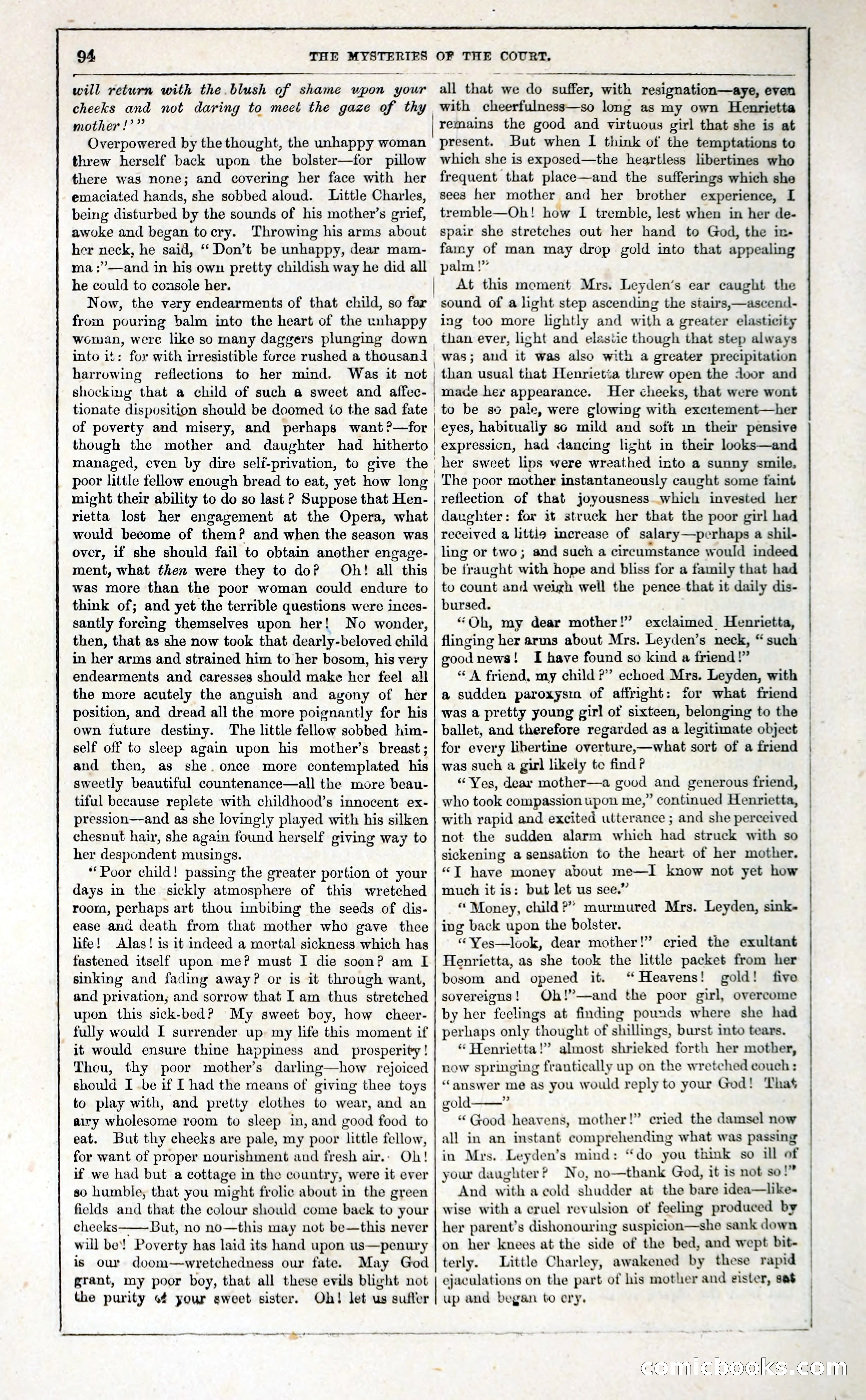
A restored page from Penny Dreadfuls, 1849. Page through the whole issue in the reader above.
📄 Transcribed text from this page (OCR, searchable)
Machine-transcribed from the original scan — historical spelling and the odd misread are preserved.
94 THE MYSTERIES OF THE COURT, will return with the blush of shame wpon your all that we do suffer, with resignation—aye, even cheeks and not daring to meet the gaze of thy with cheerfulness+60 long as my own Henrietta mother !’” Overpowered by the thought, the unhappy woman threw herself back upon the bolster—for pillow there was none; and covering her face with her emaciated hands, she sobbed aloud. Little Charles, being disturbed by the sounds of his mother’s grief, awoke and began tocry. Throwing his arms about her neck, he said, ‘‘ Don’t be unhappy, dear mam- ma :”—and in his own pretty childish way he did all he could to coasole her. Now, the very endearments of that child, so far from pouring balm into the heart of the unhappy woman, were like so many daggers plunging down | into it: for with irresistible furce rushed a thousani- harrowing reflections to her mind. remains the good and virtuous girl that she is at present. But when I think of the temptations to which she is exposed—the heartless libertines who frequent that place—and the sufferings which she sees her mother and her brother experience, I tremble—Oh! how I tremble, lest when in her de- spair she stretches out her hand to God, the in- fairy of man may drop gold into that appealing palm !”’ At this moment Mrs. Leyden’s ear caught the sound of a light step ascending the stairs,—ascend- ing too more lightly and with a greater elasticity than ever, light and elastic though that step always was; aud it was also with a greater precipitation Was it not | than usual that Henrietia threw open the door and shocking that a child of such a sweet and affec- | mace her appearance. Her cheeks, that were wont tionate disposition should be doomed to the sad fate of poverty and misery, and perhaps want ?—for though the mother and daughter had hitherto | | to be so pale, were glowing with excitement—her eyes, habitually so mild and soft in their pensive expressicn, had dancing light in their looks—and managed, even by dire self-privation, to give the her sweet lips were wreathed into a sunny smile, poor little fellow enough bread to eat, yet how long might their ability to do so last ? Suppose that Hen- rietta lost her engagement at the Opera, what would become of them? and when the season was over, if she should fail to obtain another engage- ment, what then were they to do? Oh! all this was more than the poor woman could endure to think of; and yet the terrible questions were inces- santly forcing themselves upon her! No wonder, then, that as she now took that dearly-beloved child in her arms and strained him to her bosom, his very endearments and caresses should make her feel all the more acutely the anguish and agony of her position, and dread all the more poignantly for his own future destiny. The little fellow sobbed him- self off to sleep again upon his mother’s breast; and then, as she.once more contemplated his sweetly beautiful countenance—all the more beau- tiful because replete with childhood’s innocent ex- pression—and as she lovingly played with his silken chesnut hair, she again found herself giving way to her despondent musings. “Poor child! passing the greater portion ot your days in the sickly atmosphere of this wretched room, perhaps art thou imbibing the seeds of dis- ease ana death from that mother who gave thee life! Alas! is it indeed a mortal sickness which has fastened itself upon me? must I die soon? am I sinking and fading away? or is it through want, and privation,; and sorrow that I am thus stretched upon this sick-bed? My sweet boy, how cheer- fully would I surrender up: my life this moment if it would ensure thine happimess and _ prosperity! Thou, thy poor mother’s darling—how rejoiced should 1 .be if I had the means of giving thee toys to play with, and pretty clothes to wear, and an airy wholesome room to sleep in, and good food to eat. But thy cheeks are pale, my poor little fellow, for want of proper nourishment and fresh air.- Oh! if we had but a cottage in the country, were it ever so humble, that you might frolic about in the green fields and that the colour should come back to your checks But, no no—this may not be—this never will be! Pover ty has laid its hand upon us—penury is our doom—wretchedness our fate. May God grant, my poor boy, that all these evils blight not the purity of your sweet sister. tes ee The poor mother instantaneously caught some faint reflection of that joyousness which invested her daughter: for it struck her that the poor girl had received a little increase of salary—perhaps a shil- ling or two; and such a circumstance would indeed be fr aucht with hope and bliss for a family that had to ccnshit and weigh well the pence that it daily dis- bursed. “Oh, my dear mother!” exclaimed Henrietta, flinging her arms about Mrs. Leyden’s neck, “such good news! I have found so kind a friend!” “A friend, my child ?” echoed Mrs. Leyden, with a sudden paroxysin of affright: was a pretty young girl of sixteen, belonging to the ballet, and therefore regarded as a legitimate object for every libertine overture,—what sort of a friend was such a girl likely tc find? “Yes, dear mother—a good and generous friend, who took compassion ipon me,” continued Henrietta, with rapid and excited utterance ; and she perceived not the sudden alarm which had struck with so sickening a sensation to the heart of her mother, “T have money about me—I know not yet how much it is: but let us see.” “ Money, child?’ murmured Mrs. Leyden, sink- ing back upon the bolster. “Yes—look, dear mother!” cried the exultant Henrietta, as she took the little packet from her bosom and opened it. “Heavens! gold! five sovereigns! Oh!”—and the poor girl, overcome by her feelings at finding pounds where she had perhaps only thought of shillings, burst into tears. “ Henrietta!” almost shrieked forth her mother, now springing frantically up on the wretched couch : “answer me as you would reply to your God! That gold “ Good heavens, mother!” cried the damsel now all in an instant comprehending what was passing in Mrs. Leyden’s mind: “do you think so ill of your daughter? No, no—thank God, it is not so!” And with acold shudder at the bare idea—like- wise with a cruel revulsion of feeling produced by her parent’s dishonouring suspicion—she sank down on her knees at the side of the bed, and wept bit- terly. Little Charley, awakened by these rapid ejaculations on the part of his mother and sister, sat Ob! let us suffer | up and began to ery, ee ee ee << sm tt ttl LC CC CT lll nn tt, for what friend | oe eens ee ee ow ECORNICLOOO <=) (E©)