
Penny Dreadfuls, 1849 · page 112 of 394
The Mysteries of the Court of London — page 112: what you’re looking at
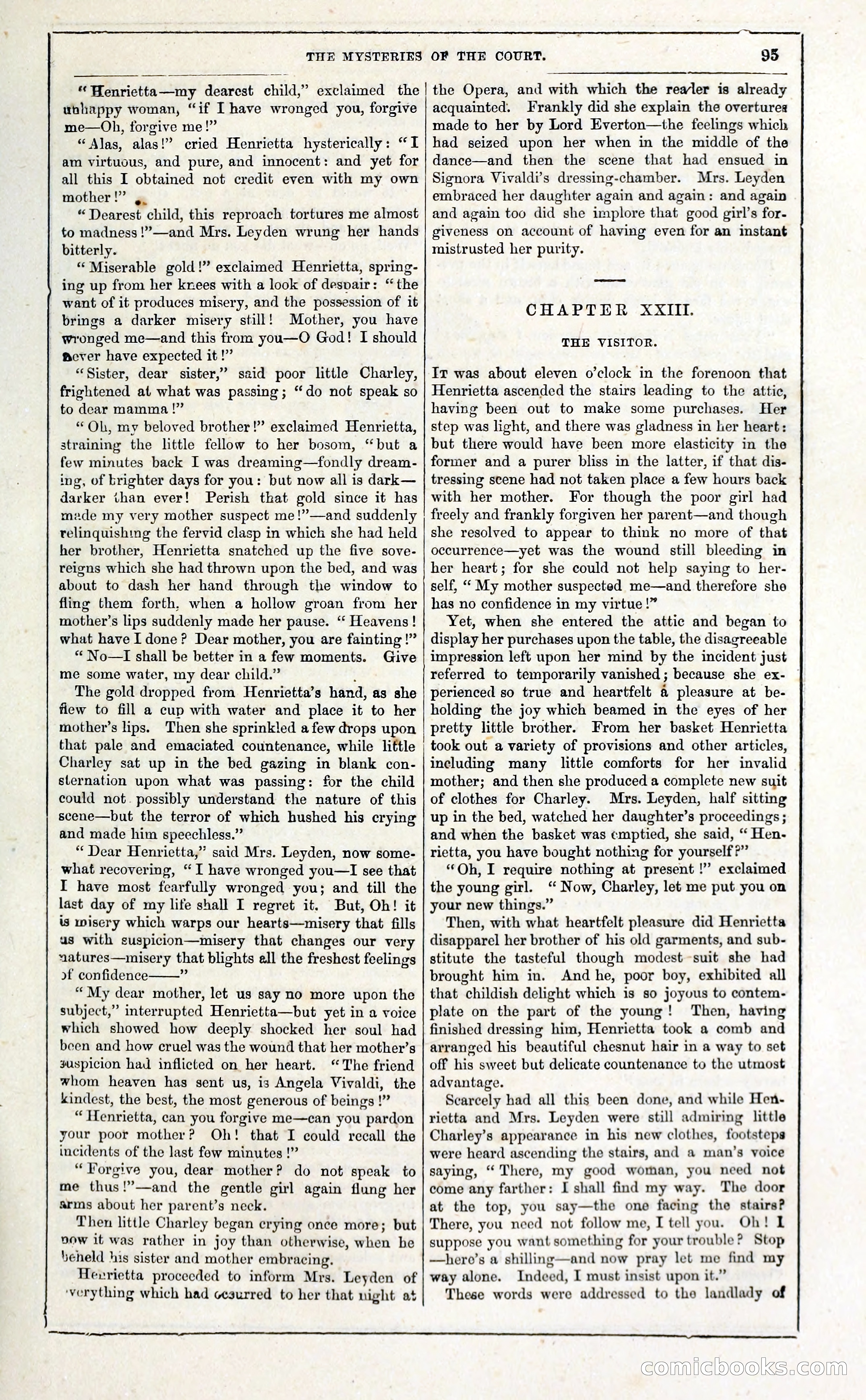
A restored page from Penny Dreadfuls, 1849. Page through the whole issue in the reader above.
📄 Transcribed text from this page (OCR, searchable)
Machine-transcribed from the original scan — historical spelling and the odd misread are preserved.
TH MYSTERIES —_—S——_ ——————_——_—___ —. “ Henrietta—my dearest child,” exclaimed the whhappy woman, “if I have wronged you, forgive me—Oh, forgive me!” “Alas, alas!” cried Henrietta hysterically: “1 am virtuous, and pure, and innocent: and yet for all this I obtained not credit even with my own mother!” ,. “ Dearest child, this reproach tortures me almost to madness !”—and Mrs. Leyden wrung her hands bitterly. ‘Miserable gold!” exclaimed Henrietta, spring- ing up from her knees with a look of despair: “the want of it produces misery, and the possession of it brings a darker misery still! Mother, you have wronged me—and this from you—O God! I should @cver have expected it!” “Sister, dear sister,” said poor little Charley, frightened at what was passing; “do not speak so to dear mamma!” “Ol, my beloved brother!” exclaimed Henrietta, straining the little fellow to her bosom, “but a few minutes back I was dreaming—fondly dream- ing, of brighter days for you: but now all is dark— darker than ever! Perish that gold since it has mede my very mother suspect me!”—and suddenly relinquishing the fervid clasp in which she had held her brother, Henrietta snatched up the five sove- reigns which she had thrown upon the bed, and was about to dash her hand through the window to fling them forth, when a hollow groan from her mother’s lips suddenly made her pause. “ Heavens! what have I done? Dear mother, you are fainting !” “* No—TI shall be better in a few moments. Give me some water, my dear child.” The gold dropped from Henrietta’s hand, as she fiew to fill a cup with water and place it to her mother’s lips. Then she sprinkled a few drops upon that pale and emaciated countenance, while little Charley sat up in the bed gazing in blank con- sternation upon what was passing: for the child could not. possibly understand the nature of this scene—but the terror of which hushed his crying and made him speechless.” ‘Dear Henrietta,” said Mrs. Leyden, now some- what recovering, “ I have wronged you—I see that I have most fearfully wronged you; and till the last day of my life shall I regret it. But, Oh! it is wisery which warps our hearts—misery that fills us with suspicion—misery that changes our very uatures—aiisery that blights all the freshest feelings af confidence sf “My dear mother, let us say no more upon the subject,” interrupted Henrietta—but yet in a voice which showed how deeply shocked her soul had been and how cruel was the wound that her mother’s suspicion had inflicted on her heart. “The friend whom heaven has sent us, is Angela Vivaldi, the kindest, the best, the most generous of beings !” “ Henrietta, can you forgive me—can you pardon your poor mother? Oh! that I could recall the incidents of the last few minutes !” “Forgive you, dear mother? do not speak to me thus!’—and the gentle girl again flung her arms about her parent’s neck. Then little Charley began erying once more; but pow it was rather in joy than otherwise, when be beheld his sister and mother embracing. Henrietta proceeded to inform Mrs. Leyden of ‘verything which had cesurred to her that night at OF THE COURT. 95 the Opera, and with which the rewler is already acquainted. Frankly did she explain the overtures made to her by Lord Everton—the feelings which had seized upon her when in the middle of the dance—and then the scene that had ensued in Signora Vivaldi’s dressing-chamber. Mrs. Leyden embraced her daughter again and again: and again and again too did she implore that good girl’s for- giveness on account of having even for an imstant mistrusted her purity. CHAPTER XXIII. THE VISITOR. Ir was about eleven o’clock in the forenoon that Henrietta ascended the stairs leading to the attic, having been out to make some purchases. Her step was light, and there was gladness in her heart: but there would have been more elasticity in the former and a purer bliss in the latter, if that dis- tressing scene had not taken place a few hours back with her mother. For though the poor girl had freely and frankly forgiven her parent—and though she resolved to appear to think no more of that occurrence—yet was the wound still bleeding in her heart; for she could not help saying to her- self, “My mother suspected me—and therefore she has no confidence in my virtue !” Yet, when she entered the attic and began to display her purchases upon the table, the disagreeable impression left upon her mind by the incident just referred to temporarily vanished ; because she ex- perienced so true and heartfelt & pleasure at be- holding the joy which beamed in the eyes of her pretty little brother. From her basket Henrietta took out a variety of provisions and other articles, including many little comforts for her invalid mother; and then she produced a complete new suit of clothes for Charley. Mrs. Leyden, half sitting up in the bed, watched her daughter’s proceedings ; and when the basket was emptied, she said, “ Hen- rietta, you have bought nothing for yourself?” “Oh, I require nothing at present !” exclaimed the young girl. ‘“ Now, Charley, let me put you on your new things.” Then, with what heartfelt pleasure did Henrietta disapparel her brother of his old garments, and sub- stitute the tasteful though modest suit she had brought him in. And he, poor boy, exhibited all that childish delight which is so joyuus to contem- plate on the part of the young! Then, having finished dressing him, Henrietta took a comb and arranged his beautiful chesnut hair in a way to set off his sweet but delicate countenance to the utmost advantage. Scarcely had all this been done, and while Hen- rietta and Mrs. Leyden were still admiring little Charley’s appearance in his new clothes, footsteps were heard ascending the stairs, and a man’s voice saying, “ There, my good woman, you need not come any farther: I shall find my way. The door at the top, you say—the one facing the stairs? There, you need not follow me, I tell you. Oh! 1 suppose you want something for your trouble? Stop —hero’s a shilling—and now pray let me find my way alone. Indeed, I must insist upon it.” These words were addressed to the landlady of a a a Se mn ECOMmMiclboooks (CO)