
Penny Dreadfuls, 1849 · page 116 of 394
The Mysteries of the Court of London — page 116: what you’re looking at
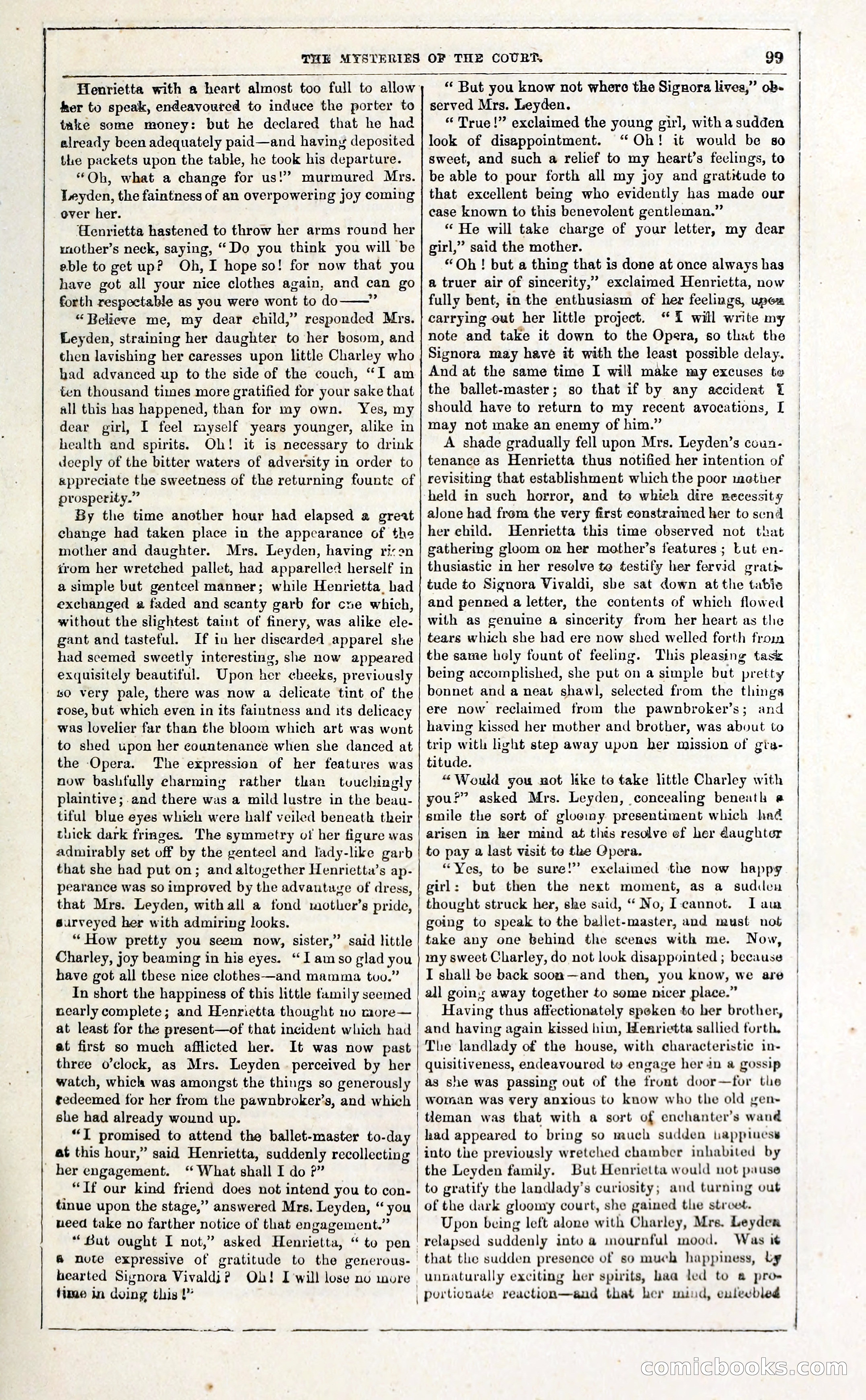
A restored page from Penny Dreadfuls, 1849. Page through the whole issue in the reader above.
📄 Transcribed text from this page (OCR, searchable)
Machine-transcribed from the original scan — historical spelling and the odd misread are preserved.
THE MYSTERIES OF THE COURT. Henrietta with a heart almost too full to allow fer to speak, endeavoured to induce the porter to tuke some money: but he declared that he had elready been adequately paid—and having deposited the packets upon the table, he took his departure. “Ob, what a change for us!” murmured Mrs. Leyden, the faintness of an overpowering joy coming over her. Genrietta hastened to throw her arms round her mother’s neck, saying, “Do you think you will be eble to get up? Oh, I hope so! for now that you have got all your nice clothes again, and can go forth respectable as you were wont to do——” “Believe me, my dear ehild,” responded Mrs. Leyden, straining her daughter to her bosom, and then lavishing her caresses upon little Charley who had advanced up to the side of the couch, “I am ten thousand times more gratified for your sake that rll this has happened, than for my own. Yes, my dear girl, I feel myself years younger, alike in health and spirits. Oh! it is necessary to drink deeply of the bitter waters of adversity in order to gppreciate the sweetness of the returning founte of prosperity.” By the time another hour had elapsed a great ehange had taken place in the appearance of the mother and daughter. Mrs. Leyden, having ri: on irom her wretched pallet, had apparelled herself in a simple but gentcel manner; while Henrietta, bad exchanged a faded and scanty garb for cue which, without the slightest taint of finery, was alike ele- gant and tasteful. If in her discarded apparel she had seemed sweetly interesting, she now appeared exquisitely beautiful. Upon her ebeeks, previously 60 very pale, there was now a delicate tint of the rose, but which even in its faintness and its delicacy was lovelier far than the bloom which art was wont to shed upon her countenance when she danced at the Opera. The expression of her features was now bashfully eharming rather than tuuchingly plaintive; and there was a mild lustre in the beau- tiful blue eyes which were half veiled beneath their thick dark fringes. The symmetry ot her figure was admirably set off by the gentecl and lady-like garb that she had put on; and altogether Henrietta’s ap- pearance was so improved by the advautuve of dress, that Mrs. Leyden, withall a fond mother’s pride, gurveyed her with admiring looks. “How pretty you seem now, sister,” said little Charley, joy beaming in his eyes. “Iam so glad you have got all these nice clothes—and mamma two.” In short the happiness of this little family seemed nearly complete; and Henrietta thought uo raore— at least for the present—of that incident which had at first so much afflicted her. It was now past three o’clock, as Mrs. Leyden . perceived by her watch, which was amongst the things so generously redeemed for her from the pawnbroker’s, and which she had already wound up. “I promised to attend the ballet-master to-day at this hour,” said Henrietta, suddenly recollecting her engagement. ‘ What shall I do ?” “If our kind friend does not intend you to con- tinue upon the stage,” answered Mrs. Leyden, “you need take no farther notice of that engagement.” “But ought I not,” asked Henrietta, “to pen | @® note expressive of gratitude to the generous- hearted Signora Vivaldj? Ob! Iwill lose no wore ftme In doing this ” — — 99 “ But you know not where the Signora lives,” ob- served Mrs. Leyden. : “ True!” exclaimed the young girl, with a sudden look of disappointment. “Oh! it would be so sweet, and such a relief to my heart’s feclings, to be able to pour forth all my joy and gratitude to that excellent being who evidently has made our case known to this benevolent gentleman.” * He will take charge of your letter, my dear girl,” said the mother. “Oh ! but a thing that is done at once always has a truer air of sincerity,’ exclaimed Henrietta, now fully bent, in the enthusiasm of her feelings, upoa carrying out her little project. “41 will write my note and take it down to the Opera, so that the Signora may have it with the least possible delay. And at the same time I will make my excuses te the ballet-master; so that if by any accident 1 should have to return to my recent avocations, [ may not make an enemy of him.” A shade gradually fell upon Mrs. Leyden’s coun- tenance as Henrietta thus notified her intention of revisiting that establishment which the poor iether held in such horror, and to whieh dire necessity alone had from the very first eonstraimed her to send her child. Henrietta this time observed not that gathering gloom on her mother’s features ; Lut en- thusiastic in her resolve te testify her fervid gratr tude to Signora Vivaldi, she sat down at the tabie and penned a letter, the contents of which flowed with as genuine a sincerity from her heart as the tears which she had ere now shed welled forth from the same holy fount of feeling. This pleasing task being accomplished, she put on a simple but pretty bonnet and a neat shawl, selected from the things ere now reclaimed from the pawnbroker’s; and having kissed her mother and brother, was about to trip with light step away upon ber mission of gra- titude. , “Would you not like te take little Charley with you?” asked Mrs. Leyden, concealing beneath @ smile the sort of gloomy presentiment which had arisen in her mand at thts resolve ef her daughter to pay a last visit to the Opera. “Yes, to be sure!” exclaimed the now happy girl: but then the next moment, as a sudden thought struck her, she said, “ No, I-cannot. Taw going to speak to the ballet-master, and must not take any one behind the scenes with me. Now, my sweet Charley, do not look disappointed ; because I shall be back soon—and then, you know, we are all goin away together to some nicer place.” Having thus affectionately speken to her brother, and having again kissed him, Henrietta sallied forth, The landlady of the house, with characteristic in- quisitiveness, endeavoured te engage her in a gossip as she was passing out of the front door—tor the woman was very anxious to know who the old gen- tleman was that with a sort of enchanter’s wand had appeared to bring so much sudden Lappiuess into the previously wretched chamber inhabited by the Leyden family. But Henrietta would not pause to gratify the landlady’s curiosity; and turning out of the dark gloomy court, she gained the stroet. Upon being left alone with Charley, Mrs. Leyden relapsed suddenly into a mournful mood. Was it that the sudden presence of so much happiness, by unnaturally exciting her spirits, haa led to a pro- _ portionate reaction—anud that her mind, enlevbled —_ —---- ---—_——— — —— -_—_- — - Go JOO SS (CO)