
Penny Dreadfuls, 1849 · page 117 of 394
The Mysteries of the Court of London — page 117: what you’re looking at
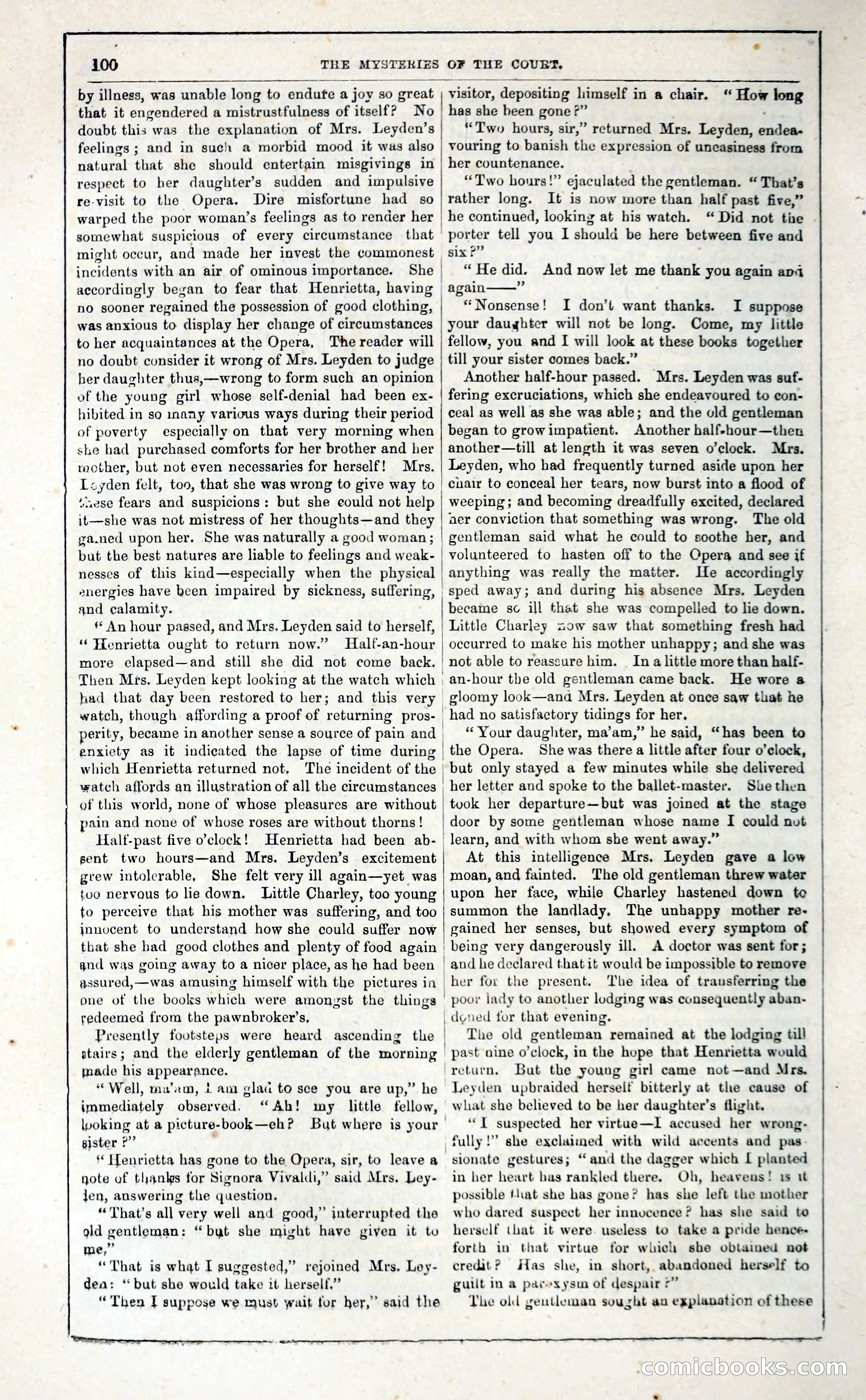
A restored page from Penny Dreadfuls, 1849. Page through the whole issue in the reader above.
📄 Transcribed text from this page (OCR, searchable)
Machine-transcribed from the original scan — historical spelling and the odd misread are preserved.
100 THE MYSTERIES OF TILE COURT, by illness, was unable long to endufe a joy so great that it engendered a mistrustfulness of itself? No | doubt this was the explanation of Mrs. Leyden’s feelings ; and in such a morbid mood it was also natural that she should entertain misgivings in respect to her daughter’s sudden and impulsive re-visit to the Opera. Dire misfortune had so warped the poor woman’s feelings as to render her somewhat suspicious of every circumstance that might occur, and made her invest the commonest incidents with an air of ominous importance. She accordingly beyan to fear that Henrietta, having no sooner regained the possession of good clothing, was anxious to display her change of circumstances to her acquaintances at the Opera, The reader will no doubt consider it wrong of Mrs. Leyden to judge her daughter thus,—wrong to form such an opinion of the young girl whose self-denial had been ex- hibited in so inany various ways during their period of poverty especially on that very morning when ste had purchased comforts for her brother and her mother, but not even necessaries for herself! Mrs. Lzyzden felt, too, that she was wrong to give way to 4ese fears and suspicions: but she eould not help it—she was not mistress of her thoughts—and they ga.ned upon her. She was naturally a good woman; but the best natures are liable to feelings and weak- nesses of this kind—especially when the physical energies have been impaired by sickness, suffering, | and calamity. f* An hour passed, and Mrs. Leyden said to herself, ‘‘ Hienrietta ought to return now.” Half-an-hour more elapsed—and still she did not come back. Then Mrs. Leyden kept looking at the watch which | jiad that day been restored to her; and this very watch, though affording a proof of returning pros- perity, became in another sense a source of pain and | enxiety as it indicated the lapse of time during which Henrietta returned not, The incident of the watch affords an illustration of all the circumstances | of this world, none of whose pleasures are without pain and none of whose roses are without thorns! Half-past five o’clock! Henrietta had been ab- sent two hours—and Mrs. Leyden’s excitement grew intolerable, She felt very ill again—yet was tuo nervous to lie down. Little Charley, too young to perceive that his mother was suffering, and too jnnocent to understand how she could suffer now that she had good clothes and plenty of food again and was going away to a nicer place, as he had been assured,—was amusing himself with the pictures in one ot the books which were amongst the things redeemed from the pawnbroker’s, Presently footsteps were heard ascending the atairs; and the elderly gentleman of the morning ynade his appearance. “ Well, ma’am, i am glad to sce you are up,” he immediately observed. “Ah! my little fellow, woking at a picture-book—eh ? sister ?” fTenrietta has gone to the Opera, sir, to leave a note of thanks for Signora Vivaldi,” said Mrs, Ley- Jen, answering the question, “That's all very well and goad,” old gentleman: me,” “That is what I suggested,” rejoined Mrs. Ley- dea: ‘but she would take it herself.” ‘Then I suppose we must wait for her,” said the interrupted the “but she might have given it tu tt ee But where is your | visitor, depositing limself in a chair. “ How long has she been gone ?” * Two hours, sir,” returned Mrs. Leyden, wee vouring to banish the expression of uneasiness from her countenance. “Two hours!” ejaculated the gentleman. “ That’s rather long. It is now more than half past five,” he continued, looking at his watch. “ Did not the . porter tell you I should be here between five and six ?” “ He did. And now let me thank you again apa again——” “Nonsense! I don’t want thanks. I suppose your daughter will not be long. Come, my little fellow, you and I will look at these books together till your sister comes back.” Another half-hour passed. Mrs. Leyden was suf- fering excruciations, which she endeavoured to con- ceal as well as she was able; and the old gentleman began to growimpatient. Another half-hour—then another—till at length it was seven o’clock. Mrs. Leyden, who had frequently turned aside upon her cnair to conceal her tears, now burst into a flood of weeping; and becoming dreadfully excited, declared aer conviction that something was wrong. The old gentleman said what he could to soothe her, and volunteered to hasten off to the Opera and see if anything was really the matter. Me accordingly sped away; and during his absence Mrs, Leyden became sc ill that she was compelled to lie down. Little Charley sow saw that something fresh had occurred to make his mother unhappy; and she was not able to reassure him. In a little more than half- an-hour the old gentleman came back. He wore a gloomy look—ana Mrs. Leyden at once saw that he had no satisfactory tidings for her. “ Your daughter, ma’am,” he said, “has been to the Opera. She was there a little after four o’clock, | but only stayed a few minutes while she delivered her letter and spoke to the ballet-master. She then tuok her departure—but was joined at the stage door by some gentleman whose name I could not learn, and with whom she went away.” At this intelligence Mrs. Leyden gave a low moan, and fainted. The old gentleman threw water upon her face, while Charley hastened down te summon the landlady, The unhappy mother re- gained her senses, but showed every symptom of being very dangerously ill. A doctor was sent for; and he declared thatit would be impossible to remove her for the present. The idea of trausferring the poor lady to another lodging was consequently aban- dened tor that evening. The old gentleman remained at the lodging till past aine o’clock, in the hope that Henrietta would return. But the young girl came not—and Mrs. Leyden upbraided herself bitterly at the cause of what she believed to be her daughter’s flight. ‘“I suspected her virtue—I accused her wrong- fully! she exclaimed with wild accents and pas. sionate gestures; “and the dagger which [ planted in her heart has rankled there. “Oh, heavens! us ul possible that she has gone? has she left the mother who dared suspect her innucenece? has she said to herself (hat it were. useless to take a pride hence- forth in that virtue for which sbe obtained not credit? dias she, in short, abandoned herself to guilt In a parexysm of despair r” The old gentleman souzht aa explanation of these —— A — GO 0)(0)(0) <=) (E©)