
Penny Dreadfuls, 1849 · page 161 of 394
The Mysteries of the Court of London — page 161: what you’re looking at
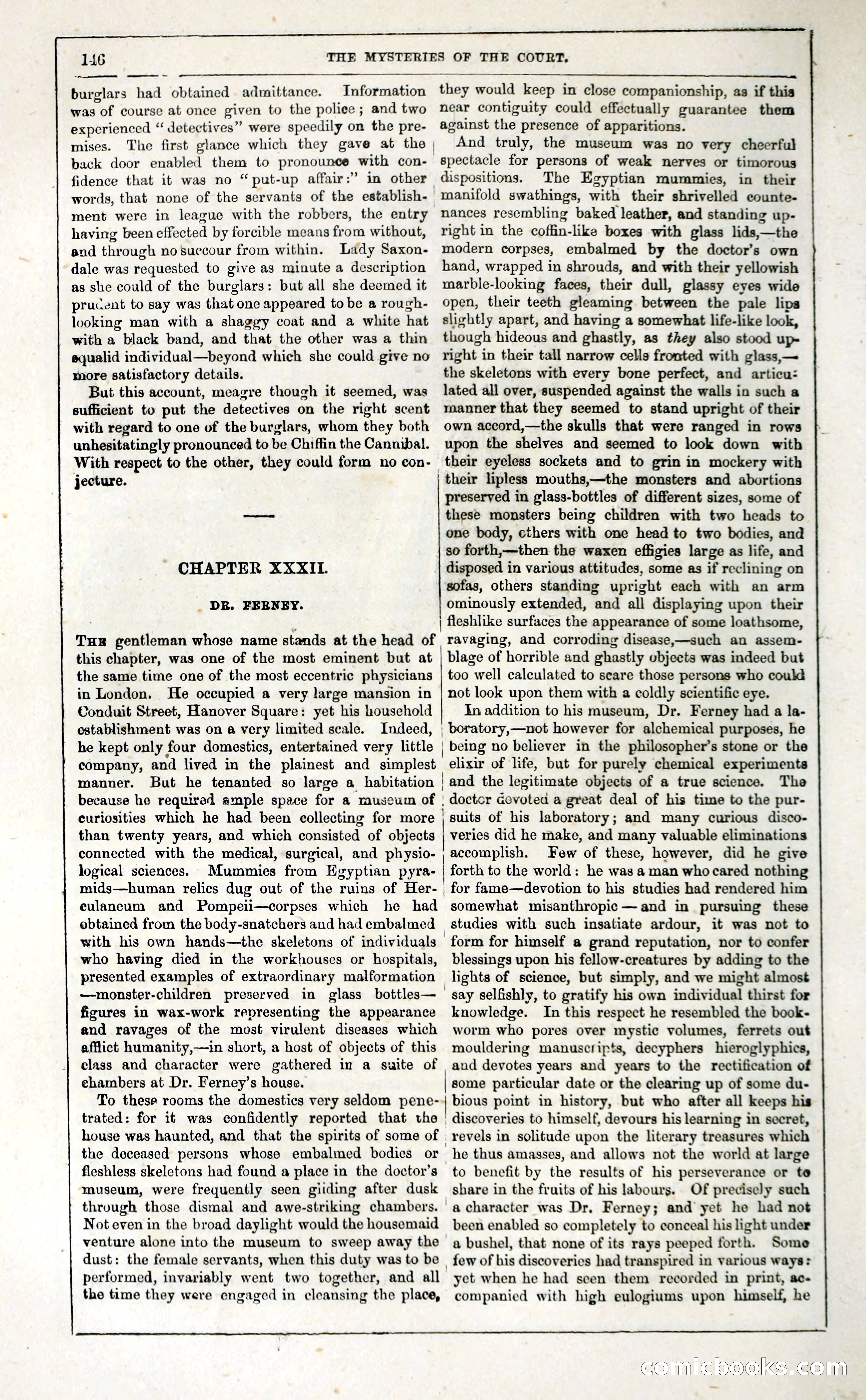
A restored page from Penny Dreadfuls, 1849. Page through the whole issue in the reader above.
📄 Transcribed text from this page (OCR, searchable)
Machine-transcribed from the original scan — historical spelling and the odd misread are preserved.
116 plans had obtained admittance. was of course at once given to the poliee; and two experienced “ detectives” were speedily on the pre- mises. The first glance which they gave at the fidence that it was no “put-up affair:” in other words, that none of the servants of the establish- ment were in league with the robbers, the entry having been effected by forcible means from without, and through nosuccour from within. Lady Saxon- dale was requested to give as minute a description as she could of the burglars: but all she deemed it prucent to say was that one appeared to be a rouch- looking man with a shaggy coat and a white hat with a black band, and that the other was a thin squalid individual—beyond which she could give no more satisfactory details. But this account, meagre though it seemed, was sufficient to put the detectives on the right scent with regard to one of the burglars, whom they both unhesitatingly pronounced to be Chiffin the Cannibal. With respect to the other, they could form no con- jecture. - CHAPTER XXXIL _ DR. FERNEY. this chapter, was one of the most eminent but at the same time one of the most eccentric physicians in London. He occupied a very large mansion in Conduit Street, Hanover Square: yet his household establishment was on a very limited scale. Indeed, he kept only four domestics, entertained very little manner. But he tenanted so large a habitation curiosities which he had been collecting for more than twenty years, and which consisted of objects connected with the medical, surgical, and physio- logical sciences. Mummies from Egyptian pyra- obtained from the body-snatchers and had embalmed with his own hands—the skeletons of individuals who having died in the workhouses or hospitals, presented examples of extraordinary malformation —monster-children preserved in glass bottles— firures in wax-work representing the appearance and ravages of the most virulent diseases which afflict humanity,—in short, a host of objects of this class and character were gathered in a suite of ehambers at Dr. Ferney’s house. To these rooms the domestics very seldom pene- trated: for it was confidently reported that the | the deceased persons whose embalmed bodies or museum, were frequently seen giiding after dusk through those dismal and awe-striking chambers. Not even in the broad daylight would the housemaid | venture alone into the museum to sweep away the | dust: the female servants, when this duty was to be performed, invariably went two together, and all the time they were engaged in cleansing the place, NEE Nee renee eee ——E ew back door enabled them to pronounce with con- THE MYSTERIES OF THE COURT, Information they would keep in close companionship, as if this near contiguity could effectually guarantee them against the presence of apparitions. “And truly, the museum was no very cheerful spectacle for persons of weak nerves or timorous dispositions. The Egyptian mummies, in their manifold swathings, with their shrivelled counte- fleshless skeletons had found a place in the doctor’s — nances resembling baked leather, and standing up- right in the coffin-like boxes with glass lids,—the modern corpses, embalmed by the doctor’s own hand, wrapped in shrouds, and with their yellowish marble-looking faces, their dull, glassy eyes wide open, their teeth gleaming between the pale lips slightly apart, and having a somewhat life-like look, though hideous and ghastly, as they also stood up- right in their tall narrow cells fronted with glass,— the skeletons with every bone perfect, and articu: lated all over, suspended against the walls in such a manner that they seemed to stand upright of their own accord,—the skulls that were ranged in rows upon the shelves and seemed to look down with their eyeless sockets and to grin in mockery with | their lipless mouths,—the monsters and abortions preserved in glass-bottles of different sizes, some of these monsters being children with two heads to one body, cthers with one head to two bodies, and so forth,—then the waxen effigies large as life, and disposed in various attitudes, some as if reclining on sofas, others standing upright each with an arm ominously extended, and all displaying upon their | fleshlike surfaces the appearance of some loathsome, Tas gentleman whose name stamds at the head of ravaging, and corroding disease,—such an assem- blage of horrible and ghastly ubjects was indeed but too well calculated to seare those persons who could not look upon them with a coldly scientific eye. In addition to his museum, Dr. Ferney had a la- | boratory,—not however for alchemical purposes, he | | being no believer in the philosopher’s stone or the company, and lived in the plainest and simplest. elixir of life, but for purely chemical experiments | and the legitimate objects of a true science. The because he required ample space for @ mauseum of | doctcr Gevoted a great deal of his time to the pur- ‘ suits of his laboratory; and many curious disco- veries did he make, and many valuable eliminations accomplish. Few of these, however, did he give forth to the world: he was a man who cared nothing mids—human relics dug out of the ruins of Her- , for fame—devotion to his studies had rendered him eulaneum and Pompeii—corpses which he had somewhat misanthropic —and in pursuing these studies with such insatiate ardour, it was not to form for himself a grand reputation, nor to confer blessings upon his fellow-creatures by adding to the lights of science, but simply, and we might almost say selfishly, to gratify his own individual thirst for knowledge. In this respect he resembled the book- worm who pores over mystic volumes, ferrets out mouldering manuscripts, decyphers hieroglyphics, and devotes years and years to the rectification of some particular date or the clearing up of some du- | bious point in history, but who after all keeps his discoveries to himself, devours his learning in secret, house was haunted, and that the spirits of some of revels in solitude upon the literary treasures which he thus amasses, and allows not the world at large to benefit by the results of his perseverance or te share in the fruits of his labours. Of precisely such a character was Dr, Ferney; and yet he had not been enabled so completely to conceal his light under a bushel, that none of its rays peeped forth. Some _ few of his discoveries had transpired in various ways: yet when he had seen them recorded in print, ac- companied with high eulogiums upon himself, he ECORNICLOO G SoC