
Penny Dreadfuls, 1849 · page 162 of 394
The Mysteries of the Court of London — page 162: what you’re looking at
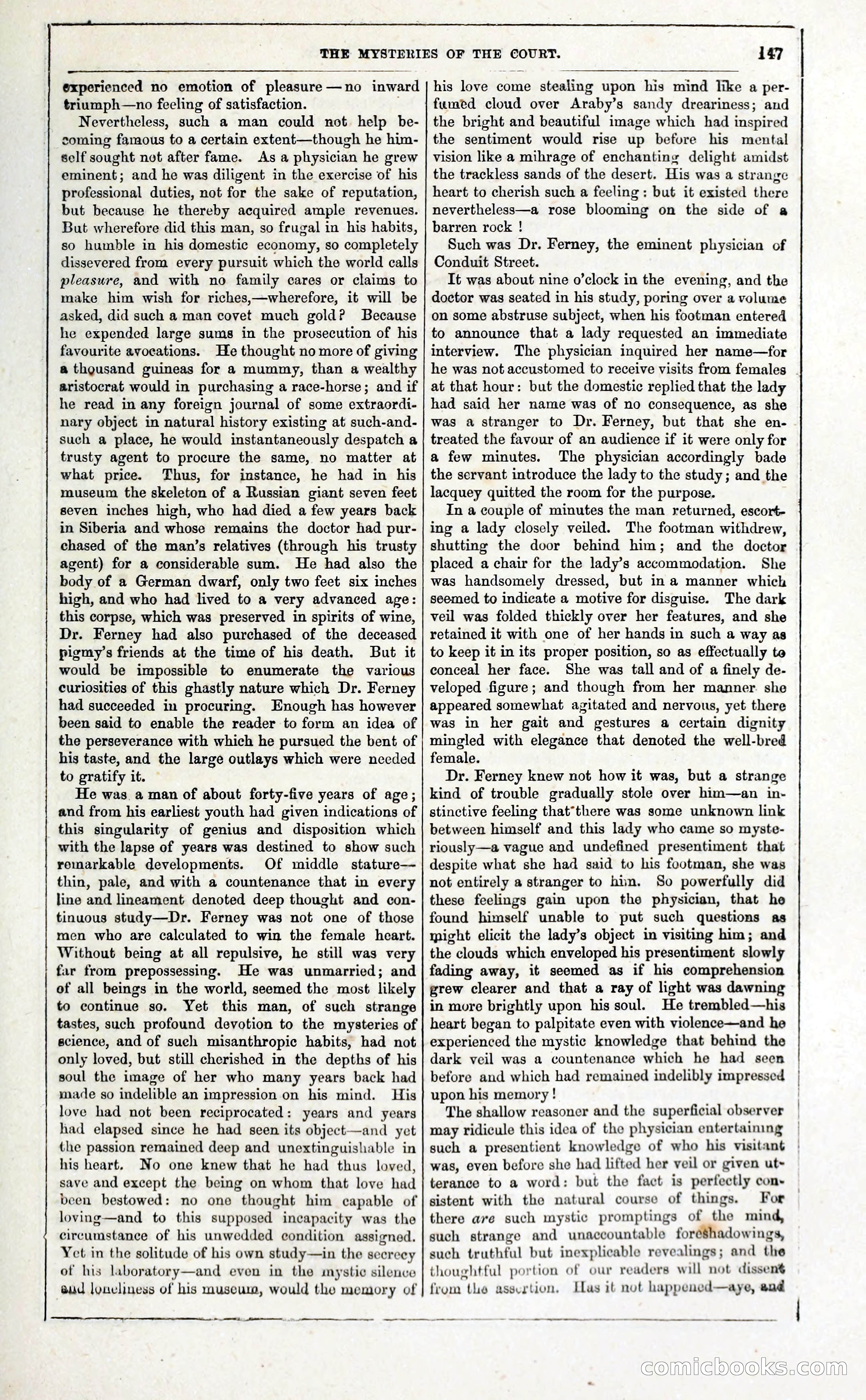
A restored page from Penny Dreadfuls, 1849. Page through the whole issue in the reader above.
📄 Transcribed text from this page (OCR, searchable)
Machine-transcribed from the original scan — historical spelling and the odd misread are preserved.
THE MYSTERIES OF THE COURT. experienced no emotion of pleasure —no inward triumph—no feeling of satisfaction. : Nevertheless, such a man could not help be- coming famous to a certain extent—though he him- self sought not after fame. As a physician he grew eminent; and he was diligent in the exercise of his professional duties, not for the sake of reputation, but because he thereby acquired ample revenues. But wherefore did this man, so frugal in his habits, so humble in his domestic economy, so completely dissevered from every pursuit which the world calls pleasure, and with no family cares or claims to make him wish for riches,—wherefore, it will be asked, did such a man covet much gold? Because he expended large sums in the prosecution of his favourite avocations. He thought no more of giving a thousand guineas for a mummy, than a wealthy aristocrat would in purchasing a race-horse; and if he read in any foreign journal of some extraordi- nary object in natural history existing at such-and- such a place, he would instantaneously despatch a trusty agent to procure the same, no matter at what price. Thus, for instance, he had in his museum the skeleton of a Russian giant seven feet seven inches high, who had died a few years back in Siberia and whose remains the doctor had pur- chased of the man’s relatives (through his trusty agent) for a considerable sum. He had also the body of a German dwarf, only two feet six inches high, and who had lived to a very advanced age: this corpse, which was preserved in spirits of wine, Dr. Ferney had also purchased of the deceased plgmy’s friends at the time of his death. But it would be impossible to enumerate the various curiosities of this ghastly nature which Dr. Ferney had succeeded in procuring. Enough has however been said to enable the reader to form an idea of the perseverance with which he pursued the bent of his taste, and the large outlays which were needed to gratify it. He was aman of about forty-five years of age; and from his earliest youth had given indications of this singularity of genius and disposition which with the lapse of years was destined to show such remarkable developments. Of middle stature— thin, pale, and with a countenance that in every line and lineament denoted deep thought and con- tinuous study—Dr. Ferney was not one of those men who are calculated to win the female heart. Without being at all repulsive, he still was very far from prepossessing. He was unmarried; and of all beings in the world, seemed the most likely to continue so. Yet this man, of such strange tastes, such profound devotion to the mysteries of science, and of such misanthropic habits, had not only loved, but still cherished in the depths of his soul the image of her who many years back had made so indelible an impression on his mind. His love had not been reciprocated: years and years had elapsed since he had seen its object—and yet the passion remained deep and unextinguishable in his heart. No one knew that he had thus loved, save and except the being on whom that love had been bestowed: no one thought him capable of loving—and to this supposed incapacity was the circumstance of his unwedded condition assigned. Yet in the solitude of his own study—in the secreey of his laboratory—and even in the mystic silence aud loneliness of his museum, would the memory of ee el << a — =~ = —_—_ - — ~ — 147 his love come stealing upon his mind like a per- fumed cloud over Araby’s sandy dreariness; and the bright and beautiful image which had inspired the sentiment would rise up befure his mental vision like a mihrage of enchanting delight amidst the trackless sands of the desert. His was a strange heart to cherish such a feeling: but it existed there nevertheless—a rose blooming on the side of a barren rock ! Such was Dr. Ferney, the eminent physician of Conduit Street. It was about nine o’clock in the evening, and the doctor was seated in his study, poring over a volume on some abstruse subject, when his footman entered to announce that a lady requested an immediate interview. The physician inquired her name—for he was not accustomed to receive visits from females - at that hour: but the domestic replied that the lady had said her name was of no consequence, as she was a stranger to Dr. Ferney, but that she en- treated the favour of an audience if it were only for a few minutes. The physician accordingly bade the servant introduce the lady to the study; and the lacquey quitted the room for the purpose. In a couple of minutes the man returned, escort- ing a lady closely veiled. The footman withdrew, shutting the door behind him; and the doctor placed a chair for the lady’s accommodation. She was handsomely dressed, but in a manner which seemed to indicate a motive for disguise. The dark veil was folded thickly over her features, and she retained it with one of her hands in such a way as to keep it in its proper position, so as effectually te conceal her face. She was tall and of a finely de- veloped figure; and though from her manner. she appeared somewhat agitated and nervous, yet there was in her gait and gestures a certain dignity mingled with elegance that denoted the well-bred female. Dr. Ferney knew not how it was, but a strange kind of trouble gradually stole over him—an in- stinctive feeling that°there was some unknown link between himself and this lady who came so myste- riously—a vague and undefined presentiment that despite what she had said to his footman, she was not entirely a stranger to hin. So powerfully did these feelings gain upon the physician, that he found himself unable to put such questions as might elicit the lady’s object in visiting him; and the clouds which enveloped his presentiment slowly fading away, it seemed as if his comprehension grew clearer and that a ray of light was dawning in more brightly upon his soul. He trembled—his heart began to palpitate even with violence—and he experienced the mystic knowledge that behind the dark veil was a countenance which he had seen before and which had remained indelibly impressed upon his memory! The shallow reasoner and the superficial observer may ridicule this idea of the physician entertaining such a presentient knowledge of who his visitant was, even before she had lifted her veil or given ut- terance to a word: but the fact is perfectly con- sistent with the natural course of things. For there ave such mystic promptings of the mind, such strange and unaccountable foreshadowings, such truthful but inexplicable revealings; and the thoughtful portion of our readers will not dissent from the assertion. Llas it not happened—aye, and -——_ —— _- ee ee ECOMmMiclboooks (CO)