
Penny Dreadfuls, 1849 · page 177 of 394
The Mysteries of the Court of London — page 177: what you’re looking at
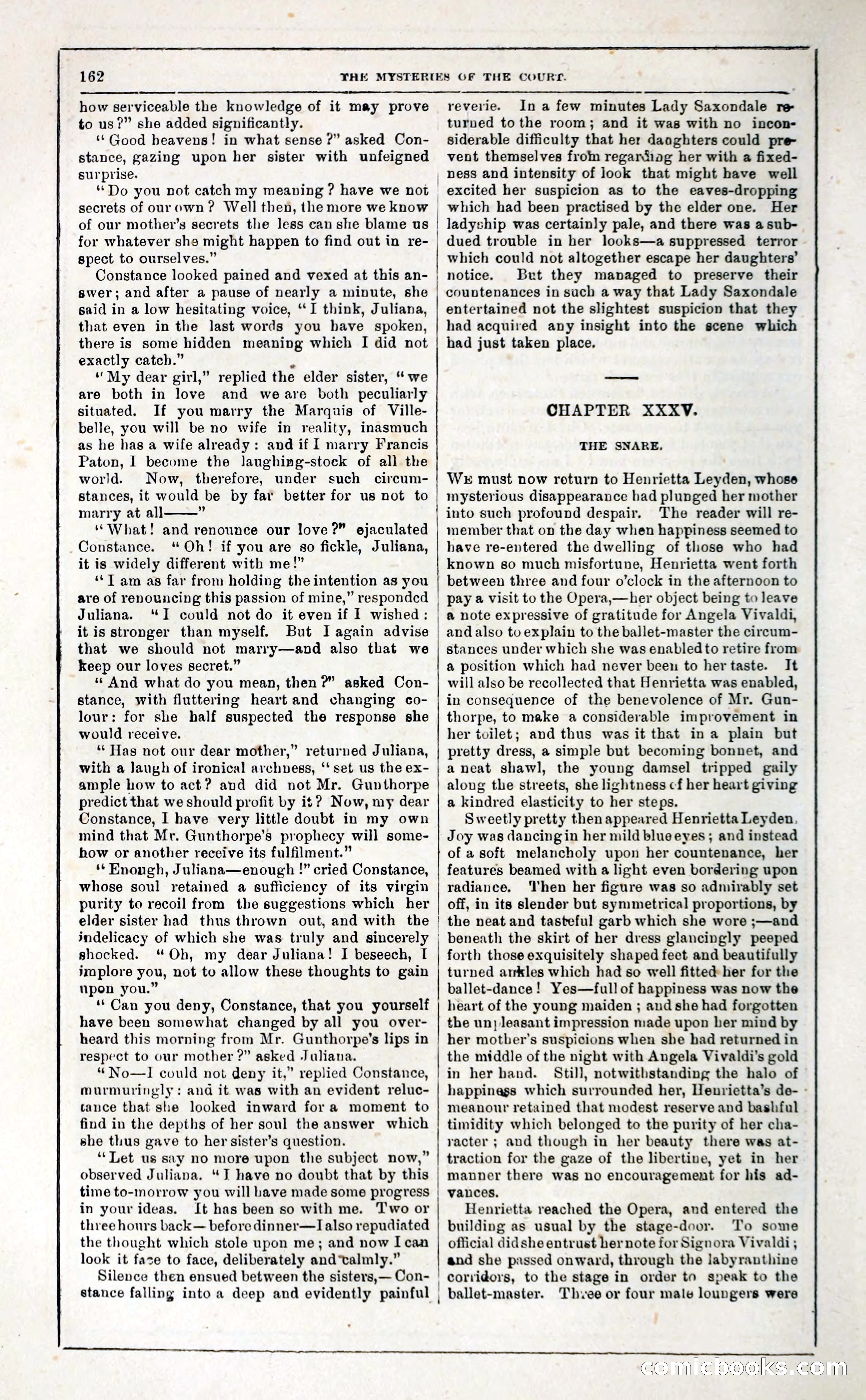
A restored page from Penny Dreadfuls, 1849. Page through the whole issue in the reader above.
📄 Transcribed text from this page (OCR, searchable)
Machine-transcribed from the original scan — historical spelling and the odd misread are preserved.
162 how serviceable the knowledge of it may prove to us?”’ she added significantly. ‘‘ Good heavens! in what sense ?” asked Con- stance, gazing upon her sister with unfeigned surprise. “Do you not catch my meaning ? have we not secrets of ourown? Well then, the more we know of our mother’s secrets the less can she blame us for whatever she might happen to find out in re- spect to ourselves.” Constance looked pained and vexed at this an- swer; and after a pause of nearly a minute, she said in a low hesitating voice, “I think, Juliana, that even in the last words you have spoken, there is some hidden meaning which I did not exactly catch.” “My dear girl,” replied the elder sister, ‘we are both in love and weare both peculiarly situated. If you marry the Marquis of Ville- belle, you will be no wife in reality, inasmuch as he has a wife already: and if I marry Francis Paton, I become the laughing-stoek of all the world. Now, therefore, under such circum- stances, it would be by far better for us not to marry at all q ‘What! and renounce our love ?” ejaculated Constance. “Oh! if you are so fickle, Juliana, it is widely different with me!” ‘‘T am as far from holding the intention as you are of renouncing this passion of mine,” responded Juliana. “I could not do it even if I wished: it is stronger than myself. But I again advise that we should not marry—and also that we keep our loves secret.” “ And what do you mean, then ?” asked Con- stance, with fluttering heart and changing co- lour: for she half suspected the response she would receive. ‘* Has not our dear mother,” returned Juliana, with a laugh of ironical archness, ‘‘ set us the ex- ample how to act? and did not Mr. Gunthorpe predict that we should profit by it? Now, my dear Constance, I have very little doubt in my own mind that Mr. Gunthorpe’s prophecy will some- how or another receive its fulfilment.” ‘* Enough, Juliana—enough !” cried Constance, whose soul retained a sufficiency of its virgin purity to recoil from the suggestions which her elder sister had thus thrown out, and with the indelicacy of which she was truly and sincerely shocked. ‘Oh, my dear Juliana! I beseech, I implore you, not to allow these thoughts to gain upon you.” “Can you deny, Constance, that you yourself have been somewhat changed by all you over- heard this morning from Mr. Gunthorpe’s lips in respect to our mother ?” asked Juliana. ““No—1 could not deny it,” replied Constance, murmuringly: and it was with an evident reluc- tance that she looked inward fora moment to find in the depths of her soul the answer which she thus gave to her sister’s question. ‘Let us say no more upon the subject now,” observed Juliana. “J have no doubt that by this time to-morrow you will bave made some progress in your ideas. It has been so with me. ‘Two or three hours back— before dinner—I also repudiated the thought which stole upon me; and now I can look it faze to face, deliberately and‘talmly.” Silence then ensued between the sisters,— Con- stance falling into a deep and evidently painful ’ THE MYSTERTES OF THE COURT. reverie. Ina few minutes Lady Saxondale re turned tothe room; and it was with no incon- siderable difficulty that her danghters could pre vent themselves from regarndiag her with a fixed- _ bess and intensity of look that might have well er i excited her suspicion as to the eaves-dropping which had been practised by the elder one. Her ladyship was certainly pale, and there was asub- dued trouble in her looks—a suppressed terror which could not altogether escape her daughters’ notice. Burt they managed to preserve their countenances in such a way that Lady Saxondale entertained not the slightest suspicion that they had acquired any insight into the scene which had just taken place, CHAPTER XXXV. THE SNARE, WE must now roturn to Henrietta Leyden, whose mysterious disappearance had plunged her mother into such profound despair. The reader will re- member that on the day when happiness seemed to have re-entered the dwelling of those who had known so much misfortune, Henrietta went forth between three and four o’clock in the afternoon to pay a visit to the Opera,—her object being to leave a note expressive of gratitude for Angela Vivaldi, and also tu explain to the ballet-master the circum- stances under which she was enabled to retire from a position which had never been to her taste. It will also be recollected that Henrietta was enabled, in consequence of the benevolence of Mr. Gun- thorpe, to make a considerable improvement in her toilet; and thus was it that ina plain but pretty dress, a simple but becoming bonnet, and a neat shawl, the young damsel tripped gaily along the streets, she lightness cf her heart giving a kindred elasticity to her steps. Sweetly pretty then appeared Henrietta Leyden, Joy was dancingin her mild blue eyes ; and instead of a soft melancholy upon her countenance, her features beamed with a light even bordering upon radiance. ‘hen her figure was so admirably set off, in its slender but symmetrical proportions, by the neat and tasteful garb which she wore ;—and beneath the skirt of her dress glancingly peeped forth those exquisitely shaped feet and beautifully turned atrkles which had so well fitted her for the ballet-dance! Yes—fullof happiness was now the heart of the young maiden ; and she had forgotten the un} leasant impression made upon ber mind by her motber’s suspicions when sbe had returned in the middle of the night with Angela Vivaldi’s gold in her hand. Still, notwithstanding the halo of happinass which surrounded her, Henrietta’s de- - meanour retained that modest reserve and bashful timidity which belonged to the purity of her cha- racter ; and though in her beauty there was at- traction for the gaze of the libertine, yet in her manner there was no encouragement for his ad- vances. Henrietta reached the Opera, and entered the building as usual by the stage-door. To some official didshe entrust her note for Signora Vivaldi; and she passed onward, through the labyranthine corridors, to the stage in order to speak to the ballet-master. Thvee or four male loungers were ee eee ee ee COMNICLOO <S) (€©)