
Penny Dreadfuls, 1849 · page 178 of 394
The Mysteries of the Court of London — page 178: what you’re looking at
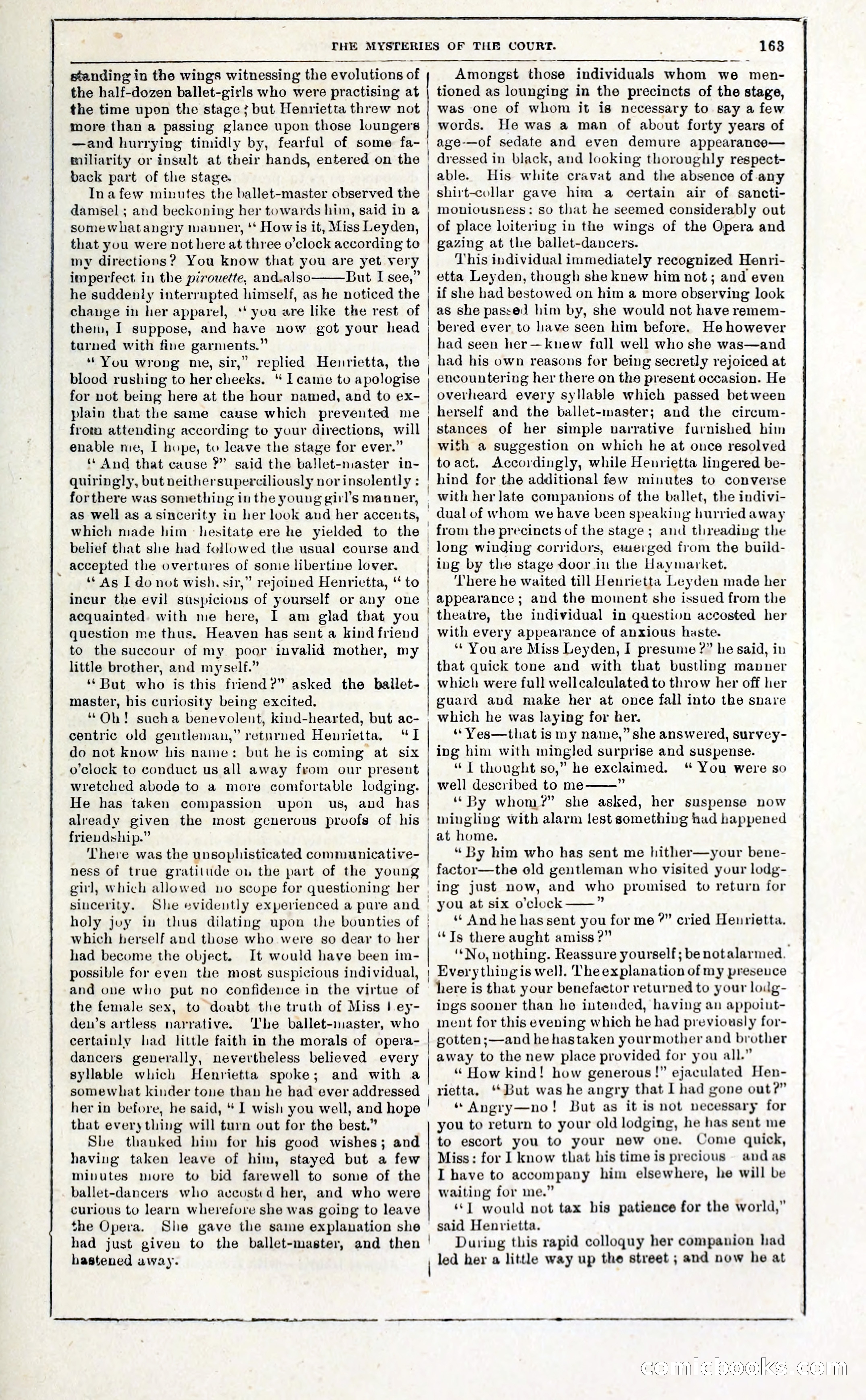
A restored page from Penny Dreadfuls, 1849. Page through the whole issue in the reader above.
📄 Transcribed text from this page (OCR, searchable)
Machine-transcribed from the original scan — historical spelling and the odd misread are preserved.
standing in the wings witnessing the evolutions of the half-dozen ballet-girls who were practising at the time upon the stage? but Henrietta threw not more than a passing glance upon those loungers —and hurrying timidly by, fearful of some fa- THE MYSTERIES OF THE COURT. tmiliarity or insult at their hands, entered on the | back part of the stage. Inafew minutes the ballet-master observed the damsel ; and beckoning her towards him, said in a somewhatangry manner, ‘* Howis it, Miss Leyden, that you were not here at three o’clock according to my directions? You know that you are yet very imperfect in the pirouette, and.also But I see,” he suddenly interrupted himself, as he noticed the change in her apparel, ‘‘ you are like the rest of them, I suppose, and have now got your head turned with fine garments.” “You wrong me, sir,” replied Henrietta, the blood rushing to her cheeks. “ I came to apologise for not being here at the hour named, and to ex- plain that the same cause which prevented me from attending according to your directions, will enable me, I hope, to leave the stage for ever.” ‘‘ And that cause ?” said the ballet-niaster in- quiringly, but neithersuperciliously nor insolently : forthere was something in the young girl’s manner, as well as asincerity in her look and her accents, which made him hesitate ere he yielded to the belief that she had followed the usual course and accepted the overtures of sonie libertine lover. “As I do not wish. sir,” rejoined Henrietta, “ to incur the evil suspicious of yourself or any one acquainted. with me here, I am glad that you question me thus. Heaven has seut a kind friend to the succour of my poor invalid mother, my little brother, and myself.” ‘‘But who is this friend?” asked the bailet- master, his curiosity being excited. “Oh! sucha benevolent, kind-hearted, but ac- centric old gentleman,” retnrued Henrietta. “I do not know his name: but he is coming at six o'clock to conduct us all away from our present wretched abode to a more comfortable lodging. He has taken compassion upon us, and has already given the most generous proofs of his frieudship.” ‘There was the unsophisticated communicative- ness of true gratitude on the part of the young girl, which allowed no scope for questioning her siucerity. She evidently experienced a pure and holy joy in thus dilating upon the bounties of which herself and those who were so dear to her had become the object. It would have been im- possible for even the most suspicious individual, and ove who put no confidence in the virtue of the female sex, to doubt the truth of Miss | ey- deu’s artless narrative. certainly had little faith in the morals of opera- dancers generally, nevertheless believed every syllable which Henrietta spoke; and with a somewhat kinder tone than he had ever addressed her in before, he said, “1 wish you well, and hope that everything will turn out for the best.” She thauked him for his good wishes; and having taken leave of him, stayed but a few minutes more to bid farewell to some of the ballet-dancers who avecuostid her, and who were curious to learn wherefore she was going to leave the Opera. She gave the same explanation she had just given to the ballet-master, and then hastened away. The ballet-master, who - 163 Amongst those individuals whom we men- tioned as lounging in the precincts of the stage, was one of whom it is necessary to say a few words. He was a man of about forty years of age-——of sedate and even demure appearance— dressed in black, and looking thoroughly respect- able. His white cravat and the absence of any shirt-collar gave him a certain air of sancti- mouiousness: so that he seemed considerably out of place luitering in the wings of the Opera and gazing at the ballet-dancers. This individual immediately recognized Henri- etta Leyden, though she knew him not; and even if she had bestowed on him a more observing look as she passed him by, she would not have remem- bered ever to lave seen him before. He however had seen her —knew full well who she was—and had his own reasous for being secretly rejoiced at encountering her there on the present occasion. He overheard every syllable which passed between herself and the ballet-master; and the circum- stances of her simple varrative furnished him with a suggestion on which he at once resolved toact. Accordingly, while Henrietta lingered be- hind for the additional few minutes to converse with her late companions of the ballet, the indivi- dual of whom we have been speaking hurried away from the precincts of the stage ; and tlireading the long winding corridors, ewerged from the build- ing by the stage door in the Haymarket. There he waited till Henrietta Leyden made her appearance ; and the moment she issued from the theatre, the individual in question accosted her with every appearance of anxious haste. ‘‘ You are Miss Leyden, I presume ?” he said, in that quick tone and with that bustling manner which were full wellcalculated to throw her off her guard aud make her at once fall into the snare which he was laying for her. ‘“Yes—that is my name,” she answered, survey- ing him with mingled surprise and suspense. “ T thought so,” he exclaimed. “ You were so well described to me - “By whom?” she asked, her suspense now mingling with alarm lest something had happened at home. “Gy him who has sent me hither—your bene- factor—the old gentleman who visited your lodg- ing just now, and who promised to return for you at six o’clock ——” * And he has sent you for me ?” cried Henrietta. ‘Ts there aught amiss ?” “No, nothing. Reassure yourself; be notalarmed. Every thingis well. Theexplanation of my preseuce here is that your benefactor returned to your lodg- ings sooner than he intended, having an appoint- ment for this evening which he had previously for- gotten ;—and he hastaken yourmother and brother away to the new place provided for you all.” “ How kind! how generous!” ejaculated Hen- rietta. ‘But was he angry that 1 had gone out?” * Anery—no! But as it is not necessary for you to return to your old lodging, he has sent me to escort you to your new one. Come quick, Miss: for I know that his time is precious andas I have to accompany him elsewhere, he will be waiting for me.” ‘‘T would not tax bis patience for the world,” said Henrietta. During this rapid colloquy her companion had led her a little way up the street ; and now he at EO JOO (Cc €5) (CO)