
Penny Dreadfuls, 1849 · page 293 of 394
The Mysteries of the Court of London — page 293: what you’re looking at
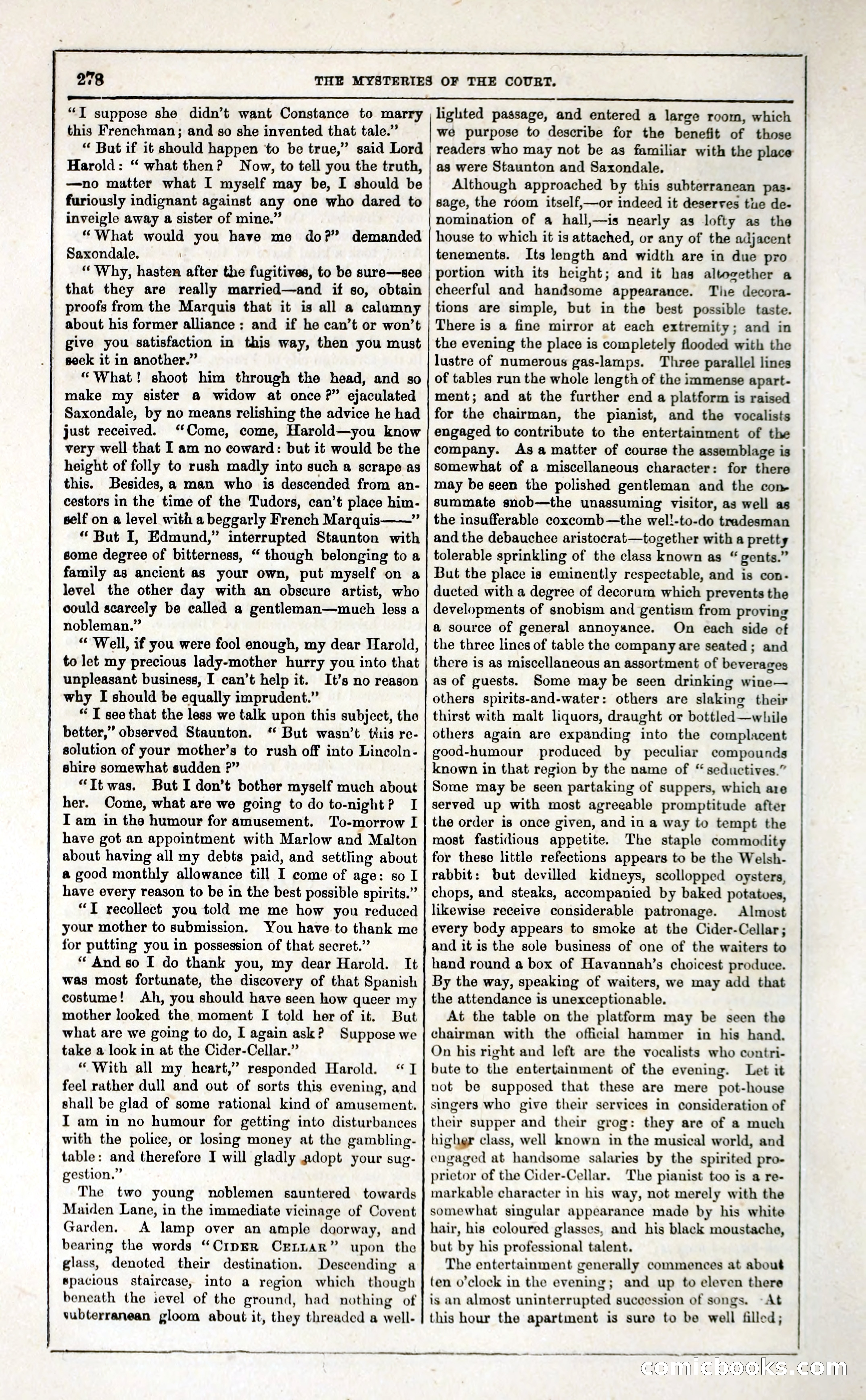
A restored page from Penny Dreadfuls, 1849. Page through the whole issue in the reader above.
📄 Transcribed text from this page (OCR, searchable)
Machine-transcribed from the original scan — historical spelling and the odd misread are preserved.
278 “IT suppose she didn’t want Constance to marry this Frenchman; and so she invented that tale.” “ But if it should happen to be true,” said Lord Harold: “ what then? Now, to tell you the truth, —no matter what I myself may be, I should be furiously indignant against any one who dared to inveigle away a sister of mine.” “What would you have me do?” demanded Saxondale. “ Why, hasten after the fugitives, to be sure—see that they are really married—and if so, obtain proofs from the Marquis that it is all a calumny about his former alliance; and if he can’t or won’t give you satisfaction in this way, then you must seek it in another.” “What! shoot him through the head, and so make my sister a widow at once ?” ejaculated Saxondale, by no means relishing the advice he had just received. ‘Come, come, Harold—you know very well that I am no coward: but it would be the height of folly to rush madly into such a scrape as this. Besides, a man who is descended from an- cestors in the time of the Tudors, can’t place him- self on a level with a beggarly French Marquis——”’ “ But I, Edmund,” interrupted Staunton with some degree of bitterness, “ though belonging to a family as ancient as your own, put myself on a level the other day with an obscure artist, who could scarcely be called a gentleman—much less a nobleman.” “ Well, if you were fool enough, my dear Harold, to let my precious lady-mother hurry you into that unpleasant business, I can’t help it. It’s no reason why I should be equally imprudent.” “ I see that the less we talk upon this subject, the better,” observed Staunton. ‘ But wasn’t this re- solution of your mother’s to rush off into Lincoln- shire somewhat sudden ?” “Itwas. But I don’t bother myself much about her. Come, what are we going to do to-night? I I am in the humour for amusement. To-morrow I have got an appointment with Marlow and Malton about having all my debts paid, and settling about a good monthly allowance till I come of age: so I have every reason to be in the best possible spirits.” “T recollect you told me me how you reduced your mother to submission. You have to thank me for putting you in possession of that secret.” “ And so I do thank you, my dear Harold. It was most fortunate, the discovery of that Spanish costume! Ah, you should have seen how queer my mother looked the moment I told her of it. But what are we going to do, I again ask? Suppose we take a look in at the Cider-Cellar.” “With all my heart,” responded Harold. “I feel rather dull and out of sorts this evening, and shall be glad of some rational kind of amusement. I am in no humour for getting into disturbances with the police, or losing money at the gambling- table: and therefore I will gladly ~dopt your sug- gestion.” The two young noblemen sauntered towards Maiden Lane, in the immediate vicinage of Covent Garden. A lamp over an ample doorway, and bearing the words “CrpEBR CELLAR” upon the glass, denoted their destination. Descending a spacious staircase, into a region which though beneath the ievel of the ground, had nothing of subterranean gloom about it, they threaded a well- ee THE MYSTERIES OF THE COURT. lighted passage, and entered a large room, which we purpose to describe for the benefit of those readers who may not be as familiar with the place as were Staunton and Saxondale, Although approached by this subterranean pas- sage, the room itself,—or indeed it deserres tue de- nomination of a hall,—is nearly as lofty as the house to which it is attached, or any of the adjacent tenements. Its length and width are in due pro portion with its height; and it bas altogether a cheerful and handsome appearance. The decora- tions are simple, but in the best possible taste. There is a fine mirror at each extremity; and in the evening the place is completely flooded with the lustre of numerous gas-lamps. Three parallel lines of tables run the whole length of the immense apart- ment; and at the further end a platform is raised for the chairman, the pianist, and the vocalists engaged to contribute to the entertainment of the company. Asa matter of course the assemblage is somewhat of a miscellaneous character: for there may be seen the polished gentleman and the com summate snob—the unassuming visitor, as well as the insufferable coxcomb—the wel!-to-do tradesman and the debauchee aristocrat—together with a pretty tolerable sprinkling of the class known as “ gents.” But the place is eminently respectable, and is con- ducted with a degree of decorum which prevents the developments of snobism and gentism from proving a source of general annoyance. On each side of the three lines of table the company are seated; and there is as miscellaneous an assortment of beverages as of guests. Some may be seen drinking wine— others spirits-and-water: others are slaking their thirst with malt liquors, draught or bottled—while others again are expanding into the complacent good-humour produced by peculiar compounds known in that region by the name of “seductives.” Some may be seen partaking of suppers, which are served up with most agreeable promptitude after the order is once given, and in a way to tempt the most fastidious appetite. The staple commodity for these little refections appears to be the Welsh- rabbit: but devilled kidneys, scollopped oysters, chops, and steaks, accompanied by baked potatues, likewise receive considerable patronage. Almost every body appears to smoke at the Cider-Cellar; and it is the sole business of one of the waiters to hand round a box of Havannah’s choicest produce. By the way, speaking of waiters, we may add that the attendance is unexceptionable. At the table on the platform may be seen the chairman with the official hammer in his hand. On his right and left are the vocalists who contri- bute to the entertainment of the evening. Let it not be supposed that these are mere pot-house singers who give their services in consideration of their supper and their grog: they are of a much higher class, well known in the musical world, and engaged at handsome salaries by the spirited pro- prietor of the Cider-Cellar. The pianist too is a re- markable character in his way, not merely with the somewhat singular appearance made by his white hair, his coloured glasses, and his black moustache, but by his professional talent. The entertainment generally commences at about ten o’clock in the evening; and up to eleven there is an almost uninterrupted succession of songs. -At this hour the apartment is sure to be well filled; ee eee ee ee CS COMMUNE 0)(0)(0) (E()