
Penny Dreadfuls, 1849 · page 294 of 394
The Mysteries of the Court of London — page 294: what you’re looking at
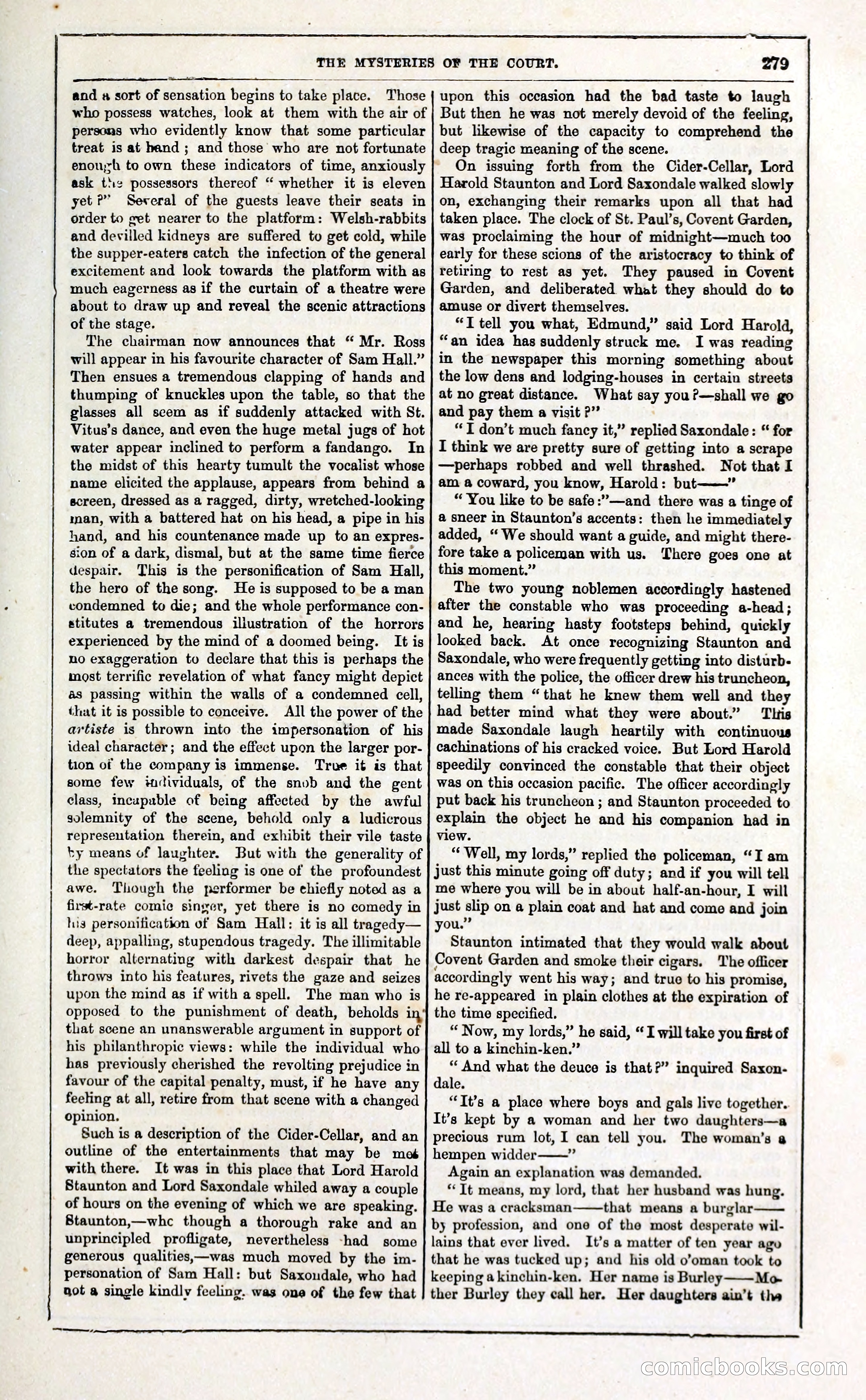
A restored page from Penny Dreadfuls, 1849. Page through the whole issue in the reader above.
📄 Transcribed text from this page (OCR, searchable)
Machine-transcribed from the original scan — historical spelling and the odd misread are preserved.
wate bet BS SL ea ll eee ne alae ee aS THE MYSTERIES OF THE COURT. and « sort of sensation begins to take place. Those who possess watches, look at them with the air of persons who evidently know that some particular treat is at hand ; and those who are not fortunate enou;h to own these indicators of time, anxiously ask tie possessors thereof “ whether it is eleven yet?” Several of the guests leave their seats in order to eet nearer to the platform: Welsh-rabbits and devilled kidneys are suffered to get cold, while the supper-eaters catch the infection of the general excitement and look towards the platform with as much eagerness as if the curtain of a theatre were about to draw up and reveal the scenic attractions of the stage. The chairman now announces that “ Mr. Ross will appear in his favourite character of Sam Hall.” Then ensues a tremendous clapping of hands and thumping of knuckles upon the table, so that the glasses all seem as if suddenly attacked with St. Vitus’s dance, and even the huge metal jugs of hot water appear inclined to perform a fandango. In the midst of this hearty tumult the vocalist whose name elicited the applause, appears from behind a ecreen, dressed as a ragged, dirty, wretched-looking man, with a battered hat on his head, a pipe in his hand, and his countenance made up to an expres- sion of a dark, dismal, but at the same time fierce despair. This is the personification of Sam Hall, the hero of the song. He is supposed to be a man condemned to die; and the whole performance con- stitutes a tremendous illustration of the horrors experienced by the mind of a doomed being. It is no exaggeration to declare that this is perhaps the most terrific revelation of what fancy might depict as passing within the walls of a condemned cell, that it is possible to conceive. All the power of the artiste is thrown into the impersonation of his ideal character; and the effect upon the larger por- tion of the company is immense. True it is that some few *tividuals, of the snob and the gent class, incapable of being affected by the awful solemnity of the scene, behold only a ludicrous representation therein, and exhibit their vile taste ty means of laughter. But with the generality of the spectators the feeling is one of the profoundest awe. Though the performer be ehiefly noted as a first-rate comic singer, yet there is no comedy in tus personification of Sam Hall: it is all tragedy— deep, appalling, stupendous tragedy. The illimitable horror alternating with darkest despair that he throws into his features, rivets the gaze and seizes upon the mind as if with a spell. The man who is opposed to the punishment of death, beholds that scene an unanswerable argument in support of his philanthropic views: while the individual who has previously cherished the revolting prejudice in favour of the capital penalty, must, if he have any feeling at all, retire from that scene with a changed opinion, Such is a description of the Cider-Cellar, and an outline of the entertainments that may be moé with there. It was in this place that Lord Harold Staunton and Lord Saxondale whiled away a couple of hours on the evening of which we are speaking. Staunton,—whc though a thorough rake and an unprincipled profligate, nevertheless -had some generous qualities,—was much moved by the im- personation of Sam Hall: but Saxoudale, who had not a single kindly feeling. was one of the few that 5 0 279 upon this oceasion had the bad taste to laugh But then he was not merely devoid of the feeling, but likewise of the capacity to comprehend the deep tragic meaning of the scene. On issuing forth from the Cider-Cellar, Lord Harold Staunton and Lord Saxondale walked slowly on, exchanging their remarks upon all that had taken place. The clock of St. Paul’s, Covent Garden, was proclaiming the hour of midnight—much too early for these scions of the aristocracy to think of retiring to rest as yet. They paused in Covent Garden, and deliberated what they should do to amuse or divert themselves. “T tell you what, Edmund,” said Lord Harold, “an idea has suddenly struck me. I was reading in the newspaper this morning something about the low dens and lodging-houses in certain streets at no great distance. What say you?—shall we go and pay them a visit P”’ “IT don’t much fancy it,” replied Saxondale : “ for I think we are pretty sure of getting into a scrape —perhaps robbed and well thrashed. Not that I am a coward, you know, Harold: but——” “You like to be safe:”—and there was a tinge of a sneer in Staunton’s accents: then he immediately added, ‘“ We should want a guide, and might there- fore take a policeman with us. There goes one at this moment.” The two young noblemen accordingly hastened after the constable who was proceeding a-head; and he, hearing hasty footsteps behind, quickly looked back. At once recognizing Staunton and Saxondale, who were frequently getting into disturb- ances with the police, the officer drew his truncheon, telling them “that he knew them well and they had better mind what they were about.” This made Saxondale laugh heartily with continuous cachinations of his cracked voice. But Lord Harold speedily convinced the constable that their object was on this occasion pacific. The officer accordingly put back his truncheon ; and Staunton proceeded to explain the object he and his companion had in view. “Well, my lords,” replied the policeman, “I am just this minute going off duty; and if you will tell me where you will be in about half-an-hour, I will just slip on a plain coat and hat and come and join you.” Staunton intimated that they would walk about Covent Garden and smoke their cigars. The officer accordingly went his way; and true to his promise, he re-appeared in plain clothes at the expiration of the time specified. “ Now, my lords,” he said, “I will take you first of all to a kinchin-ken.” “ And what the deuce is that?” inquired Saxon- dale. “It’s a place where boys and gals live together. It’s kept by a woman and her two daughters—a precious rum lot, I can tell you. The woman’s @ hempen widder rr Again an explanation was demanded. ** It means, my lord, that her husband was hung. He was a cracksman——that means a burglar by profession, and one of the most desperate wil- lains that ever lived. It’s a matter of ten year ago that he was tucked up; and his old o’oman took to keeping akinchin-ken. Her name is Burley——Mo- ther Burley they call her. Her daughters ain’t the a RR eee ECOMmMiclboooks (Cc)