
Penny Dreadfuls, 1860 · page 170 of 400
The Mysteries of the Court of London — page 170: what you’re looking at
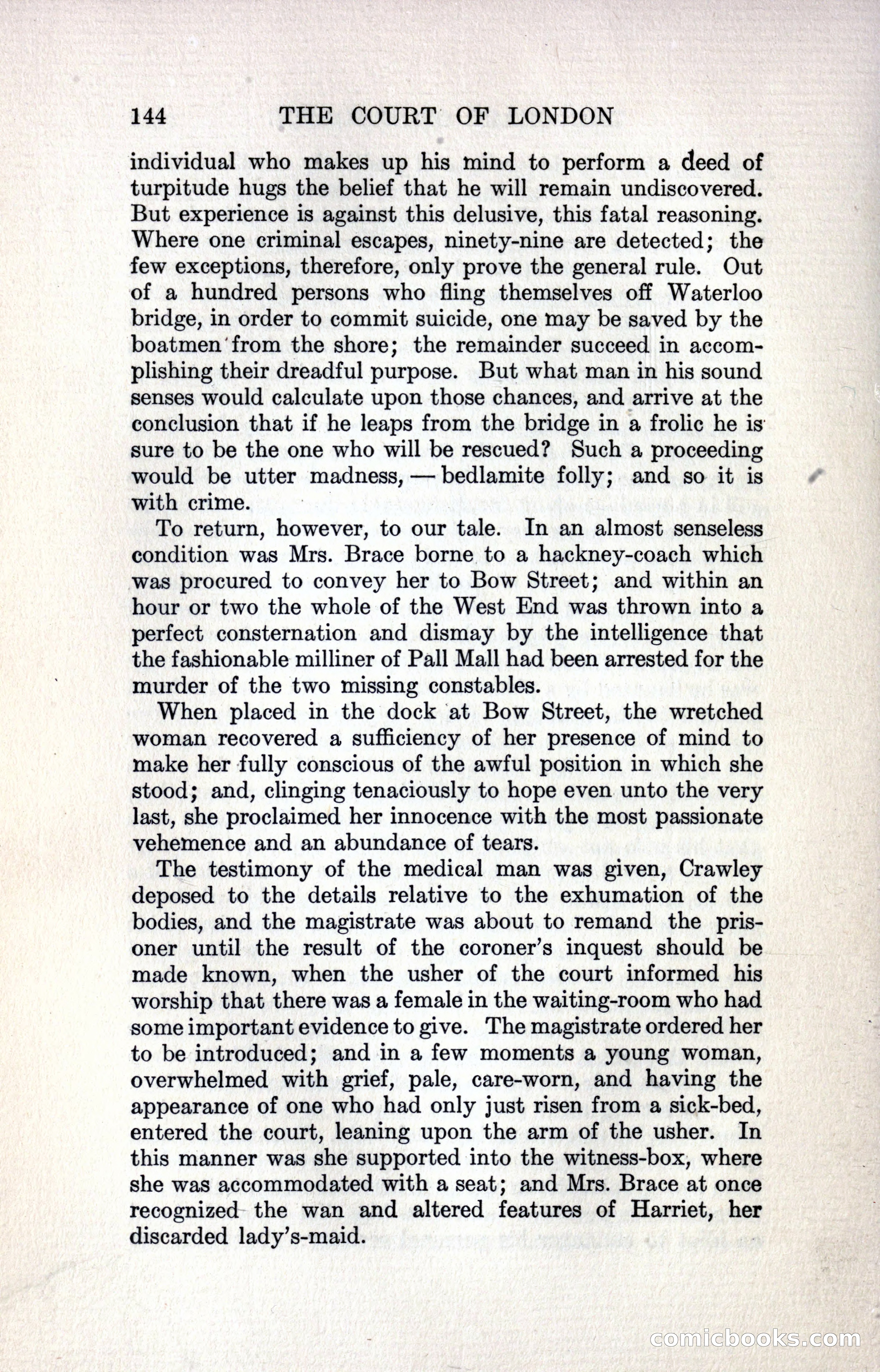
A restored page from Penny Dreadfuls, 1860. Page through the whole issue in the reader above.
📄 Transcribed text from this page (OCR, searchable)
Machine-transcribed from the original scan — historical spelling and the odd misread are preserved.
144 THE COURT OF LONDON individual who makes up his mind to perform a deed of turpitude hugs the belief that he will remain undiscovered. But experience is against this delusive, this fatal reasoning. Where one criminal escapes, ninety-nine are detected; the few exceptions, therefore, only prove the general rule. Out of a hundred persons who fling themselves off Waterloo bridge, in order to commit suicide, one may be saved by the boatmen‘from the shore; the remainder succeed in accom- plishing their dreadful purpose. But what man in his sound senses would calculate upon those chances, and arrive at the conclusion that if he leaps from the bridge in a frolic he is sure to be the one who will be rescued? Such a proceeding would be utter madness, — bedlamite folly; and so it is with crime. To return, however, to our tale. In an almost senseless condition was Mrs. Brace borne to a hackney-coach which was procured to convey her to Bow Street; and within an hour or two the whole of the West End was thrown into a perfect consternation and dismay by the intelligence that the fashionable milliner of Pall Mall had been arrested for the murder of the two missing constables. When placed in the dock at Bow Street, the wretched woman recovered a sufficiency of her presence of mind to make her fully conscious of the awful position in which she stood; and, clinging tenaciously to hope even unto the very last, she proclaimed her innocence with the most passionate vehemence and an abundance of tears. The testimony of the medical man was given, Crawley deposed to the details relative to the exhumation of the bodies, and the magistrate was about to remand the pris- oner until the result of the coroner’s inquest should be made known, when the usher of the court informed his worship that there was a female in the waiting-room who had some important evidence to give. The magistrate ordered her to be introduced; and in a few moments a young woman, overwhelmed with grief, pale, care-worn, and having the appearance of one who had only just risen from a sick-bed, entered the court, leaning upon the arm of the usher. In this manner was she supported into the witness-box, where she was accommodated with a seat; and Mrs. Brace at once recognized the wan and altered features of Harriet, her discarded lady’s-maid. | GOmics oo cS m