
Penny Dreadfuls, 1849 · page 180 of 394
The Mysteries of the Court of London — page 180: what you’re looking at
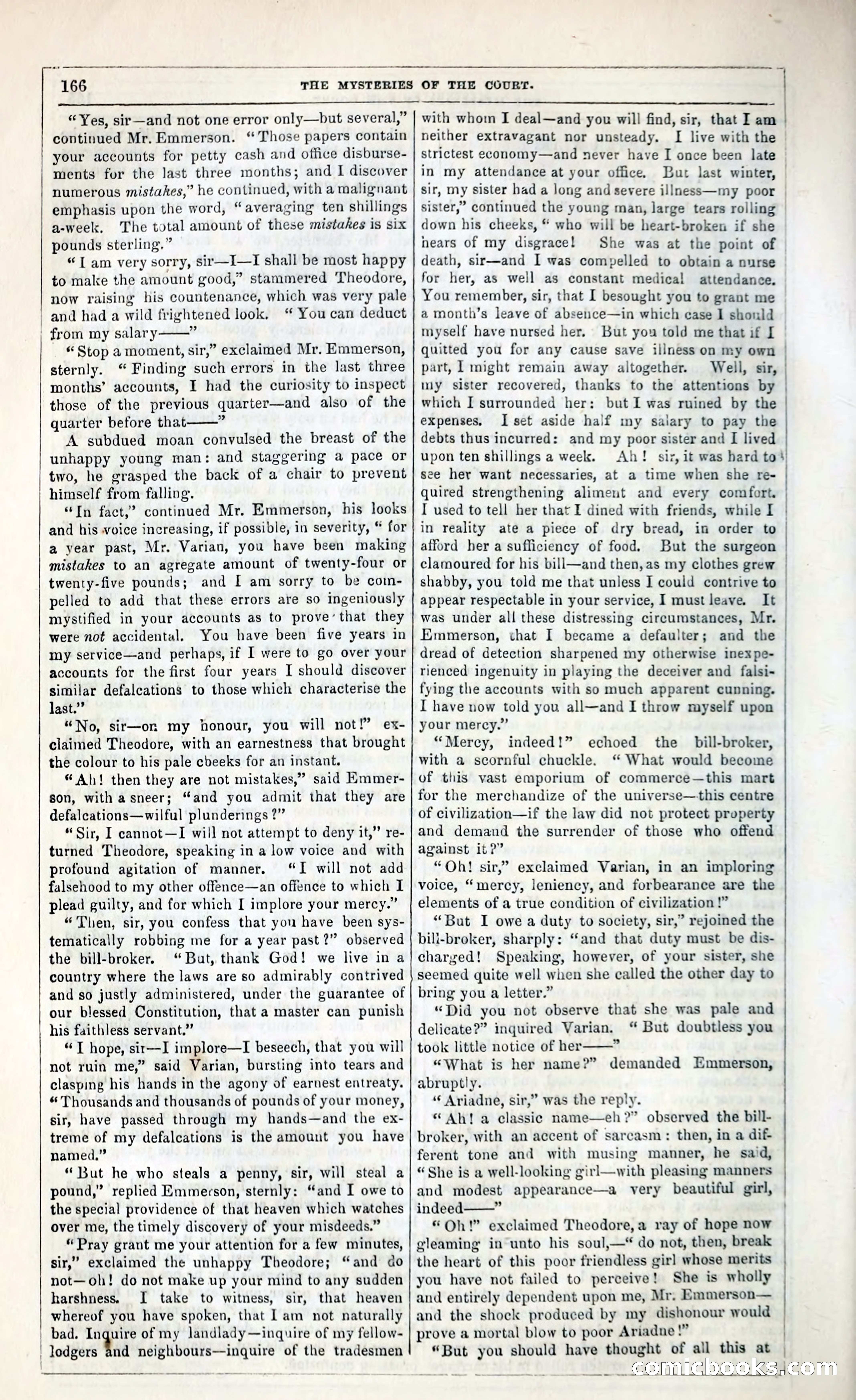
A restored page from Penny Dreadfuls, 1849. Page through the whole issue in the reader above.
📄 Transcribed text from this page (OCR, searchable)
Machine-transcribed from the original scan — historical spelling and the odd misread are preserved.
0 mr ee es me = erm ee ee 166 “Yes, sir—and not one error only—but several,” continued Mr. Emmerson. “Those papers contain your accounts for petty cash and office disburse- ments for the last three months; and I discover numerous mistakes,” he continued, with a malignant emphasis upon the word, “averaging ten shillings a-week, The total amount of these mistakes is six pounds sterling.” “I am very sorry, sir—I—I shall be most happy to make the amount good,” stammered Theodore, now raising his countenance, which was very pale and had a wild frightened look. ‘ You can deduct from my salary——” “Stop a moment, sir,” exclaimed Mr. Emmerson, sternly. “ Finding such errors in the last three months’ accounts, I had the curiosity to inspect those of the previous quarter—and also of the quarter before that ” A subdued moan convulsed the breast of the unhappy young man: and staggering a pace or two, he grasped the back of a chair to prevent himself from falling. “In fact,’ continued Mr. Emmerson, his looks and his voice increasing, if possible, in severity, “ for a year past, Mr. Varian, you have been making mistakes to an agregate amount of twenty-four or twenty-five pounds; and [ am sorry to be com- pelled to add that these errors are so ingeniously mystified in your accounts as to prove’that they were not accidental. You have been five years in my service—and perhaps, if I were to go over your accounts for the first four years I should discover similar defalcations to those which characterise the last.” “No, sir—on my honour, you will not!” ex- claimed Theodore, with an earnestness that brought the colour to his pale cbeeks for an instant. “Ah! then they are not mistakes,” said Emmer- son, with asneer; “and you admit that they are defalcations—wilful plunderings 2?” “Sir, I cannot—I will not attempt to deny it,” re- turned Theodore, speaking in a low voice and with profound agitation of manner. “I will not add falsehood to my other offence—an offence to which I plead guilty, and for which I implore your mercy.” “Then, sir, you confess that yon have been sys- tematically robbing me for a year past?” observed the bill-broker. “But, thank God! we live in a country where the laws are so admirably contrived and so justly administered, under the guarantee of our blessed Constitution, that a master can punish his faithless servant.” “T hope, sir—I implore—I beseech, that you will not ruin me,” said Varian, bursting into tears and clasping his hands in the agony of earnest entreaty. «Thousands and thousands of pounds of your money, sir, have passed through my hands—and the ex- treme of my defalcations is the amount you have named.” “ But he who steals a penny, sir, will steal a pound,” replied Emmerson, sternly: “and I owe to the special providence of that heaven which watches over me, the timely discovery of your misdeeds.” “Pray grant me your attention for a few minutes, sir,” exclaimed the unhappy Theodore; “and do not—ol! do not make up your mind to any sudden harshness. JI take to witness, sir, that heaven whereof you have spoken, that 1 am not naturally bad. Inquire of my landlady—inquire of my fellow- lodgers 4nd neighbours—inquire of the tradesmen THE MYSTERIES OF THE COURT. — with whom I deal—and you will find, sir, that I am neither extravagant nor unsteady. I live with the strictest economy—and never have I once been late in my attendance at your office, But last winter, | sir, my sister had a long and severe illness—my poor | sister,” continued the young man, large tears rolling down his cheeks, “ who will be heart-broken if she hears of my disgrace! She was at the point of death, sir—and I was compelled to obtain a nurse for her, as well as constant medical attendance. You remember, sir, that I besought you to grant me a month’s leave of absence—in which case I should myself have nursed her, But you told me that if I quitted you for any cause save illness on my own © part, 1 might remain away altogether. Well, sir, ily sister recovered, thanks to the attentions by | which I surrounded her: but I was ruined by the expenses, I set aside half my salary to pay the debts thus incurred: and my poor sister and I lived upon ten shillings a week. see her want necessaries, at a time when she re- quired strengthening alimenut and every comfort. I used to tell her that I dined with friends, while I in reality ate a piece of dry bread, in order to afford her a sufficiency of food. But the surgeon Ah! sir, it was hard to} | ' ' clamoured for his bill—and then, as my clothes grew | shabby, you told me that unless I could contrive to appear respectable in your service, I mustleave. It was under all these distressing circumstances, Mr. Eimmerson, that I became a defaulter; and the dread of detection sharpened my otherwise inexpe- rienced ingenuity in playing the deceiver and falsi- fying the accounts with so much apparent cunning. I have now told you all—and I throw myself upon your mercy.” “Mercy, indeed!” echoed the bill-broker, with a scornful chuckle. ‘“ What would become of this vast emporium of commerce—this mart for the merchandize of the universe—this centre of civilization—if the law did not protect property and demand the surrender of those who offend against it?” “Oh! sir,’ exclaimed Varian, in an imploring voice, “mercy, leniency, and forbearance are the elements of a true condition of civilization !” “But I owe a duty to society, sir,” rejoined the bili-broker, sharply: “and that duty must be dis- charged! Speaking, however, of your sister, she seemed quite well when she called the other day to bring you a letter.” “Did you not observe that she was pale and delicate?” inquired Varian. “ But doubtless you took little notice of her = “What is her name?” demanded Emmerson, abruptly. “‘ Ariadne, sir,” was the reply. “ Ah! a elassic name—eh?” observed the bill- broker, with an accent of sarcasm: then, in a dif ferent tone and with musing manner, he said, “ She is a well-looking girl—with pleasing manners and modest appearance—a very beautiful girl, indeed——” * Oh!” exclaimed Theodore,a ray of hope now gleaming in unto his soul,—* do not, then, break the heart of this poor friendless gir] whose merits you have not failed to perceive! She is wholly and entirely dependent upon me, Mr. Emmerson— and the shock produced by my dishonour would prove a mortal blow to poor Ariadne !” “But you should have thought of all this at PONE NO KS ACEO