
Penny Dreadfuls, 1849 · page 181 of 394
The Mysteries of the Court of London — page 181: what you’re looking at
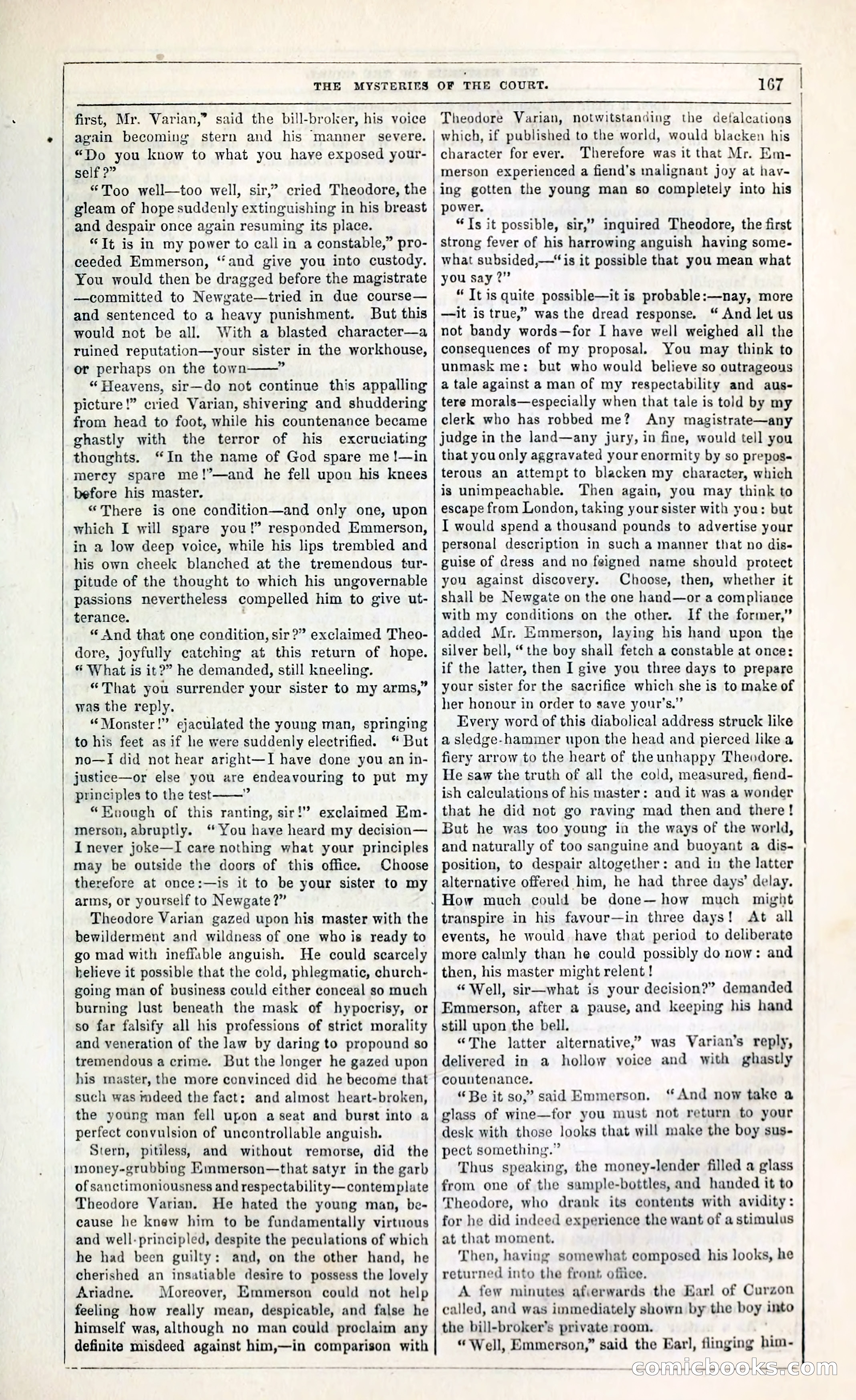
A restored page from Penny Dreadfuls, 1849. Page through the whole issue in the reader above.
📄 Transcribed text from this page (OCR, searchable)
Machine-transcribed from the original scan — historical spelling and the odd misread are preserved.
THE MYSTERIES OF THE COURT. first, Mr. Varian,” said the bill-broker, his voice again becoming stern and his manner severe. “Do you know to what you have exposed your- self ?” “Too well—too well, sir,” cried Theodore, the gleam of hope suddenly extinguishing in his breast and despair once again resuming its place. “Tt is in my power to callin a constable,” pro- ceeded Emmerson, “and give you into custody. You would then be dragged before the magistrate —committed to Newyate—tried in due course— and sentenced to a heavy punishment. But this would not be all. With a blasted character—a ruined reputation—your sister in the workhouse, or perhaps on the town——” “ Heavens, sir—do not continue this appalling picture!” cried Varian, shivering and shuddering from head to foot, while his countenance became ghastly with the terror of his excruciating thoughts. “In the name of God spare me !—in mercy spare me!’—and he fell upon his knees before his master. “There is one condition—and only one, upon which I will spare you!” responded Emmerson, in a low deep voice, while his lips trembled and his own cheek blanched at the tremendous tur- pitude of the thought to which his ungovernable passions nevertheless compelled him to give ut- terance. ' * And that one condition, sir?” exclaimed Theo- dore, joyfully catching at this return of hope. * What is it?” he demanded, still kneeling. “That you surrender your sister to my arms,” was the reply. “Monster!” ejaculated the young man, springing to his feet as if le were suddenly electrified. But no—I did not hear aright—I have done you an in- justice—or else you are endeavouring to put my principles to the test ? “Evough of this ranting, sir!” exclaimed Em- merson, abruptly. ‘ You have heard my decision— | Inever joke—I care nothing what your principles may be outside the doors of this office. Choose therefore at once:—is it to be your sister to my arms, or yourself to Newgate?” Theodore Varian gazed upon his master with the bewilderment and wildness of one who is ready to go mad with ineffable anguish. He could scarcely helieve it possible that the cold, phlegmatic, church- going man of business could either conceal so much burning lust beneath the mask of hypocrisy, or so far falsify all his professions of strict morality and veneration of the law by daring to propound so tremendous a crime. But the longer he gazed upon his master, the more convinced did he become that such was mdeed the fact: and almost heart-broken, the young man fell upon aseat and burst into a perfect convulsion of uncontrollable anguish. Stern, pitiless, and without remorse, did the money-grubbing Emmerson—that satyr in the garb of sanctimoniousness and respectability—contemplate Theodore Varian. He hated the young man, be- cause he knew him to be fundamentally virtuous and well-principled, despite the peculations of which he had been guilty: and, on the other hand, he cherished an insatiable desire to possess the lovely Ariadne. Moreover, Emmerson could not help feeling how really mean, despicable, and false he himself was, although no man could proclaim any definite misdeed against him,—in comparison with ee ee ee - — - - a — Theodore Varian, notwitstanding the defaleations | which, if published to the world, would blacken his character for ever. Therefore was it that Mr. Em- merson experienced a fiend’s malignant joy at hav- ing gotten the young man s0 completely into his power. “Ts it possible, sir,’ inquired Theodore, the first strong fever of his harrowing anguish having some- what subsided,—* is it possible that you mean what you say 2?” “Tt is quite possible—it is probable:—nay, more —it is true,” was the dread response. “ And let us not bandy words—for I have well weighed all the consequences of my proposal. You may think to unmask me: but who would believe so outrageous a tale against a man of my respectability and aus- tere morals—especially when that tale is told by my clerk who has robbed me? Any magistrate—any judge in the land—any jury, in fine, would tell you that you only aggravated your enormity by so prepos- terous an attempt to blacken my character, which is unimpeachable. Then again, you may think to escape from London, taking your sister with you: but I would spend a thousand pounds to advertise your personal description in such a manner that no dis- guise of dress and no feigned name should protect you against discovery. Choose, then, whether it shall be Newgate on the one hand—or a compliance with my conditions on the other. If the former,” added Mr. Emmerson, laying his hand upon the silver bell, “the boy shall fetch a constable at once: if the latter, then I give you three days to prepare your sister for the sacrifice which she is to make of her honour in order to save your's.” Every word of this diabolical address struck like a sledge-hammer upon the head and pierced like a fiery arrow to the heart of the unhappy Theodore. He saw the truth of all the cold, measured, fiend- ish calculations of his master: and it was a wonder that he did not go raving mad then and there! But he was too young in the ways of the world, and naturally of too sanguine and buoyant a dis- position, to despair altogether: and in the latter alternative offered him, he had three days’ delay. | How much could be done—how much might transpire in his favour—in three days! At all events, he would have that period to deliberate more calmly than he could possibly do now: and then, his master might relent ! “ Well, sir—what is your decision?” demanded Emmerson, after a pause, and keeping his hand still upon the bell. “The latter alternative,’ was Varian’s reply, delivered in a hollow voice and with ghastly countenance. “Be it so,” said Emmerson. “And now take a glass of wine—for you must not return to your desk with those looks that will make the boy sus- pect something.” Thus speaking, the money-lender filled a glass from one of the sample-bottles, and handed it to Theodore, who drank its contents with avidity: for he did indeed experience the want of a stimulus at that moment. Then, having somewhat composed his looks, he returned into the front office. A few minutes afierwards the Earl of Curzon called, and was immediately shown by the boy into the bill-broker’s private room. “ Well, Emmerson,” said the Earl, flinging him- 167 | a CORMEOOOKSaE