
Penny Dreadfuls, 1849 · page 182 of 394
The Mysteries of the Court of London — page 182: what you’re looking at
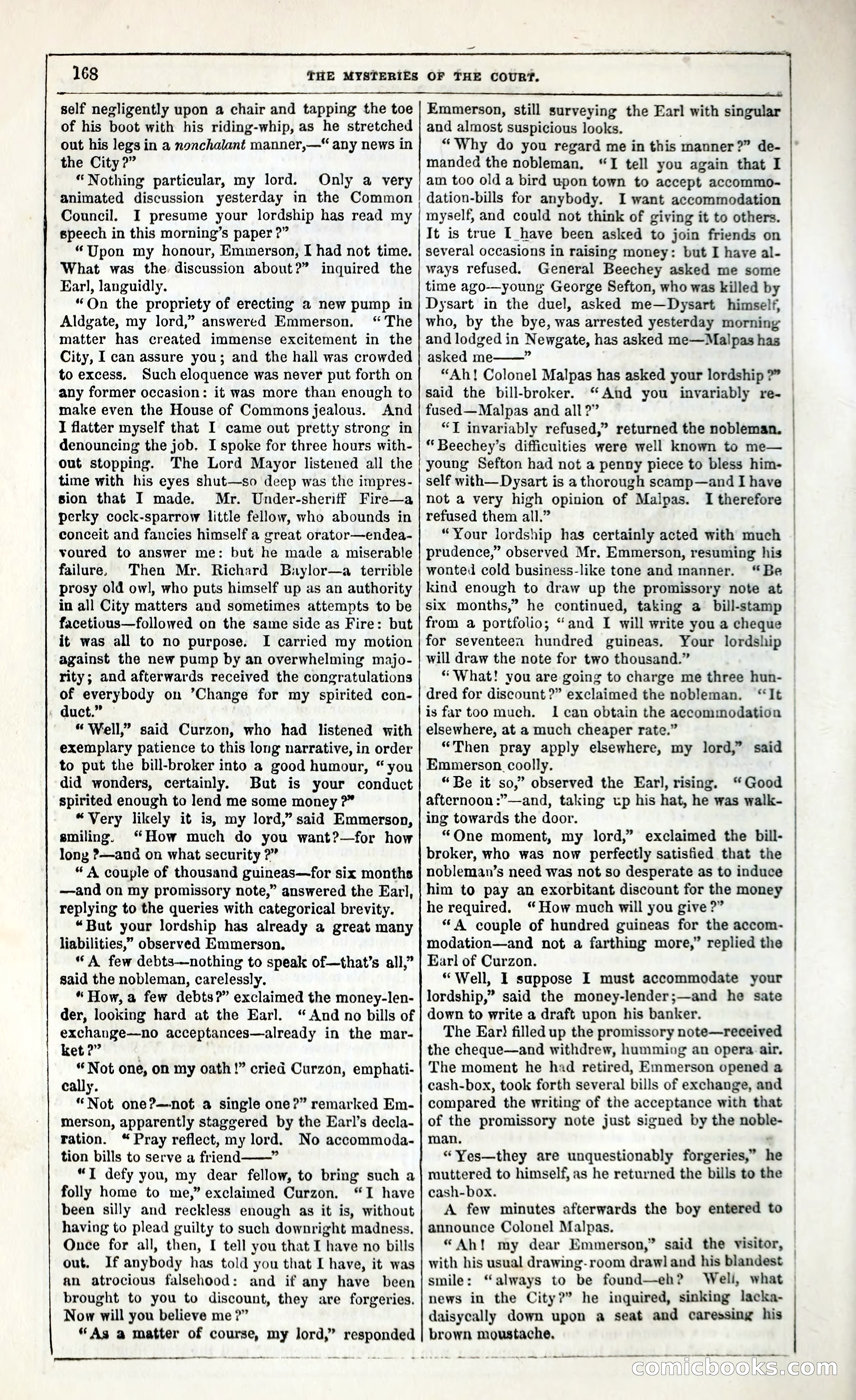
A restored page from Penny Dreadfuls, 1849. Page through the whole issue in the reader above.
📄 Transcribed text from this page (OCR, searchable)
Machine-transcribed from the original scan — historical spelling and the odd misread are preserved.
168 THE MYSTERIES OF THE COURT. self negligently upon a chair and tapping the toe of his boot with his riding-whip, as he stretched out his legs in a nonchalant manner,—“ any news in the City?” “Nothing particular, my lord. Only a very animated discussion yesterday in the Common Council. I presume your lordship has read my speech in this morning’s paper ?” “Upon my honour, Emmerson, I had not time. What was the discussion about?” inquired the Earl, languidly. “On the propriety of erecting a new pump in Aldgate, my lord,” answered Emmerson. “The matter has created immense excitement in the City, I can assure you; and the hall was crowded to excess. Such eloquence was never put forth on any former occasion: it was more than enough to make even the House of Commons jealous. And I flatter myself that I came out pretty strong in denouncing the job. I spoke for three hours with- out stopping. The Lord Mayor listened all the time with his eyes shut—so deep was the impres- sion that I made. Mr. Under-sheriff Fire—a perky cock-sparrow little fellow, who abounds in conceit and fancies himself a great orator—endea- voured to answer me: but he made a miserable failure. Then Mr. Richard Baylor—a terrible prosy old owl, who puts himself up as an authority in all City matters and sometimes attempts to be facetious—followed on the same side as Fire: but it was all to no purpose. I carried my motion against the new pump by an overwhelming majo- rity; and afterwards received the congratulations of everybody on ’Change for my spirited con- duct.” “ Well,” said Curzon, who had listened with exemplary patience to this long narrative, in order to put the bill-broker into a good humour, “you did wonders, certainly. But is your conduct spirited enough to lend me some money ?” “Very likely it is, my lord,” said Emmerson, smiling. “How much do you want?—for how lony ?——and on what security ?” “A couple of thousand guineas—for six months —and on my promissory note,” answered the Earl, replying to the queries with categorical brevity. “But your lordship has already a great many liabilities,” observed Emmerson. “A few debts—nothing to speak of—that’s all,” said the nobleman, carelessly. “How, a few debts?” exclaimed the money-len- der, looking hard at the Earl. “And no bills of exchange—no acceptances—already in the mar- ket 2” “Not one, on my oath!” cried Curzon, emphati- cally. “Not one?—not a single one?” remarked Em- merson, apparently staggered by the Earl’s decla- ration. “ Pray reflect, my lord. No accommoda- tion bills to serve a friend——” “I defy you, my dear fellow, to bring such a folly home to me,” exclaimed Curzon. “I have been silly and reckless enough as it is, without having to plead guilty to such downright madness, Once for all, then, I tell you that I have no bills out. If anybody has told you that I have, it was an atrocious falsehood: and if any have been brought to you to discount, they are forgeries. Now will you believe me ?” “As a matter of course, my lord,” responded es ——— oe - - -_— < Emmerson, still surveying the Earl with singular and almost suspicious looks. “Why do you regard me in this manner 2” de- manded the nobleman, “I tell you again that I am too old a bird upon town to accept accommo- dation-bills for anybody. I want accommodation | myself, and could not think of giving it to others. It is true [_have been asked to join friends on several occasions in raising money: but I have al- ways refused. General Beechey asked me some time ago—young George Sefton, who was killed by Dysart in the duel, asked me—Dysart himself, who, by the bye, was arrested yesterday morning and lodged in Newgate, has asked me—Malpas has asked me——” “Ah! Colonel Malpas has asked your lordship ?” said the bill-broker. “And you invariably re- fused— Malpas and all ?” “T invariably refused,” returned the nobleman. “Beechey’s difficuities were well known to me— young Sefton had not a penny piece to bless him- self with— Dysart is a thorough scamp—and I have not a very high opinion of Maipas. I therefore refused them all.” “Your lordship has certainly acted with much | prudence,” observed Mr. Emmerson, resuming his | wonted cold business-like tone and manner. kind enough to draw up the promissory note at | six months,” he continued, taking a bill-stamp from a portfolio; “and I will write you a cheque for seventeen hundred guineas. Your lordship will draw the note for two thousand.” “What! you are going to charge me three hun- dred for discount ?” exclaimed the nobleman. “It is far too much. I can obtain the accommodation elsewhere, at a much cheaper rate.” “Then pray apply elsewhere, my lord,” said Emmerson. coolly. “Be it so,” observed the Earl, rising. “Good afternoon :”—and, taking up his hat, he was walk- ing towards the door. “One moment, my lord,” exclaimed the bill- broker, who was now perfectly satisfied that the nobleman’s need was not so desperate as to induce him to pay an exorbitant discount for the money he required. “How much will you give ?” “A couple of hundred guineas for the accom- modation—and not a farthing more,” replied the Earl of Curzon. “Well, I suppose I must accommodate your lordship,” said the money-lender;—and he sate down to write a draft upon his banker. The Ear} filled up the promissory note—received | the cheque—and withdrew, humming an opera. air. The moment he had retired, Emmerson opened a cash-box, took forth several bills of exchange, and compared the writing of the acceptance with that of the promissory note just signed by the noble- | man. “Yes—they are unquestionably forgeries,” he rmouttered to himself, as he returned the bills to the cash-box. A few minutes afterwards the boy entered to announce Colonel Malpas. “Ah! my dear Emmerson,” said the visitor, with his usual drawing-room drawl and his blandest smile: “always to be found—eh? Well, what news in the City?” he inquired, sinking lacka- daisycally down upon a seat and caressing his brown moustache, — 8 ae oe eee eee ee ee iClO@O -COml S) (€()