
Penny Dreadfuls, 1849 · page 202 of 394
The Mysteries of the Court of London — page 202: what you’re looking at
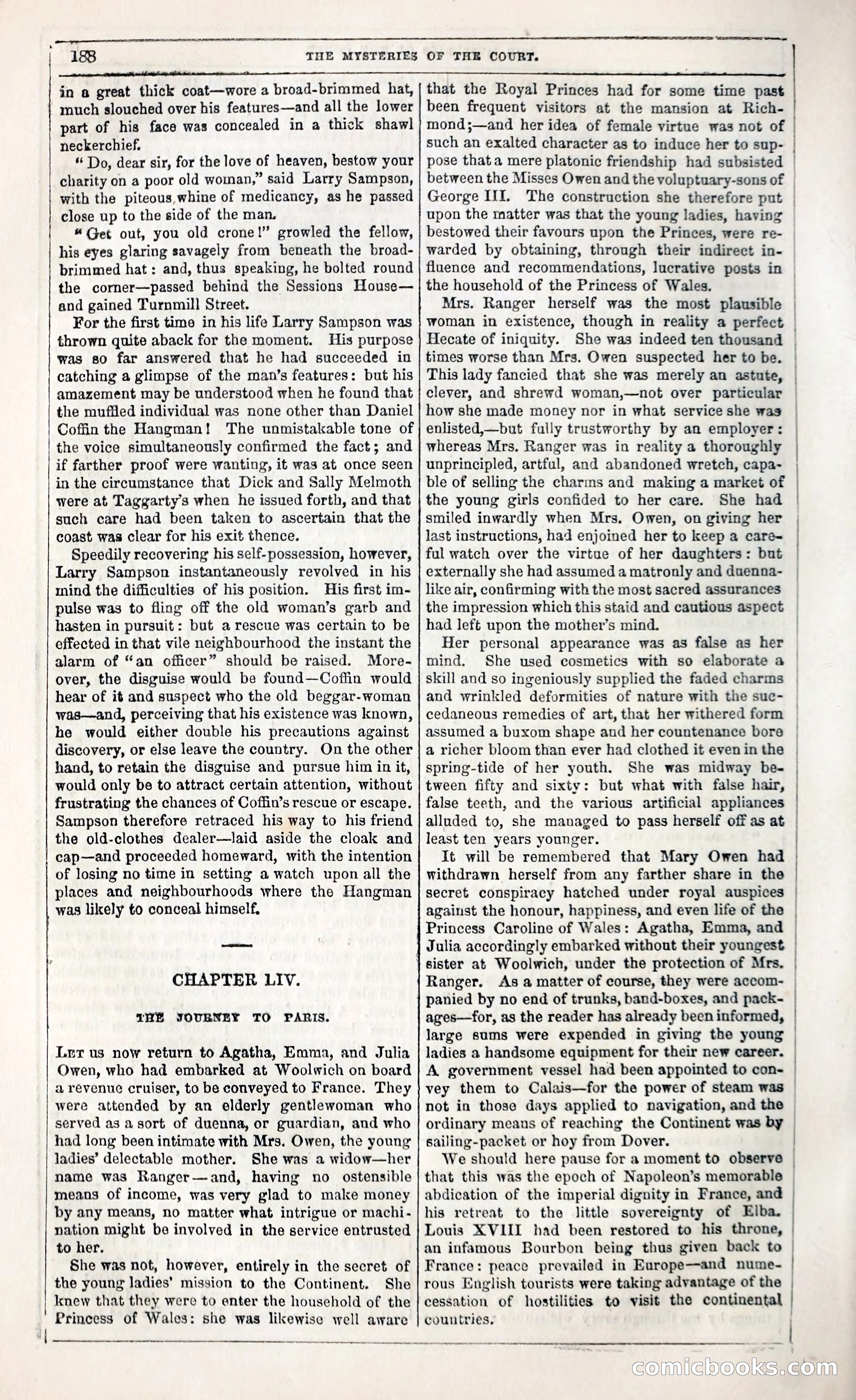
A restored page from Penny Dreadfuls, 1849. Page through the whole issue in the reader above.
📄 Transcribed text from this page (OCR, searchable)
Machine-transcribed from the original scan — historical spelling and the odd misread are preserved.
Hee a a a IT + 138 THE MYSTERIES OF THE COURT. ——— in a great thick coat—wore a broad-brimmed hat, - much slouched over his features—and all the lower part of his face was concealed in a thick shawl neckerchief. ‘Do, dear sir, for the love of heaven, bestow your charity on a poor old woman,” said Larry Sampson, with the piteous,whine of medicancy, as he passed close up to the side of the man. “Get out, you old crone!” growled the fellow, his eyes glaring savagely from beneath the broad- brimmed hat: and, thus speaking, he bolted round the corner—passed behind the Sessions House— and gained Turnmill Street. For the first time in his life Larry Sampson was thrown quite aback for the moment. His purpose was so far answered that he had succeeded in catching a glimpse of the man’s features: but his amazement may be understood when he found that the muffled individual was none other than Daniel Coffin the Hangman! The unmistakable tone of the voice simultaneously confirmed the fact; and if farther proof were wanting, it was at once seen in the circumstance that Dick and Sally Melmoth were at Taggarty’s when he issued forth, and that such care had been taken to ascertain that the coast was clear for his exit thence. Speedily recovering his self-possession, however, Larry Sampson instantaneously revolved in his mind the difficulties of his position. His first im- pulse was to fling off the old woman’s garb and hasten in pursuit: but a rescue was certain to be effected in that vile neighbourhood the instant the alarm of “an officer” should be raised. More- over, the disguise would be found—Coffin would hear of it and suspect who the old beggar-woman was—and, perceiving that his existence was known, he would either double his precautions against discovery, or else leave the country. On the other hand, to retain the disguise and pursue him in it, would only be to attract certain attention, without frustrating the chances of Coffin’s rescue or escape. Sampson therefore retraced his way to his friend the old-clothes dealer—laid aside the cloak and cap—and proceeded homeward, with the intention of losing no time in setting a watch upon all the places and neighbourhoods where the Hangman was likely to conceal himself, CHAPTER LIV. 1H# JOURNEY TO PARIS. Let us now return to Agatha, Emma, and Julia Owen, who had embarked at Woolwich on board a revenue cruiser, to be conveyed to France. They were attended by an elderly gentlewoman who served as a sort of duenna, or guardian, and who had long been intimate with Mrs. Owen, the young ladies’ delectable mother. She was a widow—her name was Ranger—and, having no ostensible means of income, was very glad to make money by any means, no matter what intrigue or machi- nation might be involved in the service entrusted to her. She was not, however, entirely in the secret of the young ladies’ mission to the Continent. She knew that they were to enter the household of the Princess of Wales: she was likewise well aware { a me we er ee +e ee _— + { sister at Woolwich, under the protection of Mrs. -_ a a ee ee that the Royal Princes had for some time past been frequent visitors at the mansion at Rich- mond;—and her idea of female virtue was not of such an exalted character as to induce her to sup- pose thata mere platonic friendship had subsisted between the Misses Owen and the voluptuary-sons of — George III. The construction she therefore put | upon the matter was that the young ladies, having bestowed their favours upon the Princes, were re- warded by obtaining, through their indirect in- fluence and recommendations, lucrative posts in — the household of the Princess of Wales. Mrs. Ranger herself was the most plausible | woman in existence, though in reality a perfect — Hecate of iniquity. She was indeed ten thousand | times worse than Mrs. Owen suspected her to be. This lady fancied that she was merely an astute, clever, and shrewd woman,—not over particular how she made money nor in what service she was enlisted,—but fully trustworthy by an employer: whereas Mrs. Ranger was in reality a thoroughly unprincipled, artful, and abandoned wretch, capa- ble of selling the charms and making a market of the young girls confided to her care. She had smiled inwardly when Mrs. Owen, on giving her last instructions, had enjoined her to keep a care- ful watch over the virtue of her daughters: but externally she had assumed a matronly and duenna- like air, confirming with the most sacred assurances the impression which this staid and cautious aspect | had left upon the mother’s mind. Her personal appearance was as false as her mind. She used cosmetics with so elaborate a skill and so ingeniously supplied the faded charms | and wrinkled deformities of nature with the suc- cedaneous remedies of art, that her withered form — assumed a buxom shape and her countenance bore | a richer bloom than ever had clothed it even in the spring-tide of her youth. She was midway be- tween fifty and sixty: but what with false hair, false teeth, and the various artificial appliances alluded to, she managed to pass herself off as at least ten years younger. It will be remembered that Mary Owen had withdrawn herself from any farther share in the secret conspiracy hatched under royal auspices against the honour, happiness, and even life of the Princess Caroline of Wales: Agatha, Emma, and Julia accordingly embarked without their youngest ——— — ——Eeee = a . -_— stm Ranger. Asa matter of course, they were accom- panied by no end of trunks, band-boxes, and pack- ages—for, as the reader has already been informed, large sums were expended in giving the young ladies a handsome equipment for their new career. A government vessel had been appointed to con- vey them to Calais—for the power of steam was not in those days applied to navigation, and the © ordinary means of reaching the Continent was by sailing-packet or hoy from Dover. We should here pause for a moment to observe that this was the epoch of Napoleon’s memorable — abdication of the imperial dignity in France, and his retreat to the little sovereignty of Elba. Louis XVIII had been restored to his throne, an infamous Bourbon being thus given back to France: peace prevailed in Europe—and nume- rous English tourists were taking advantage of the cessation of hostilities to visit the continental | countries, | A Se - = on a -_— CORNIECLOOOKS (<0)