
Penny Dreadfuls, 1849 · page 203 of 394
The Mysteries of the Court of London — page 203: what you’re looking at
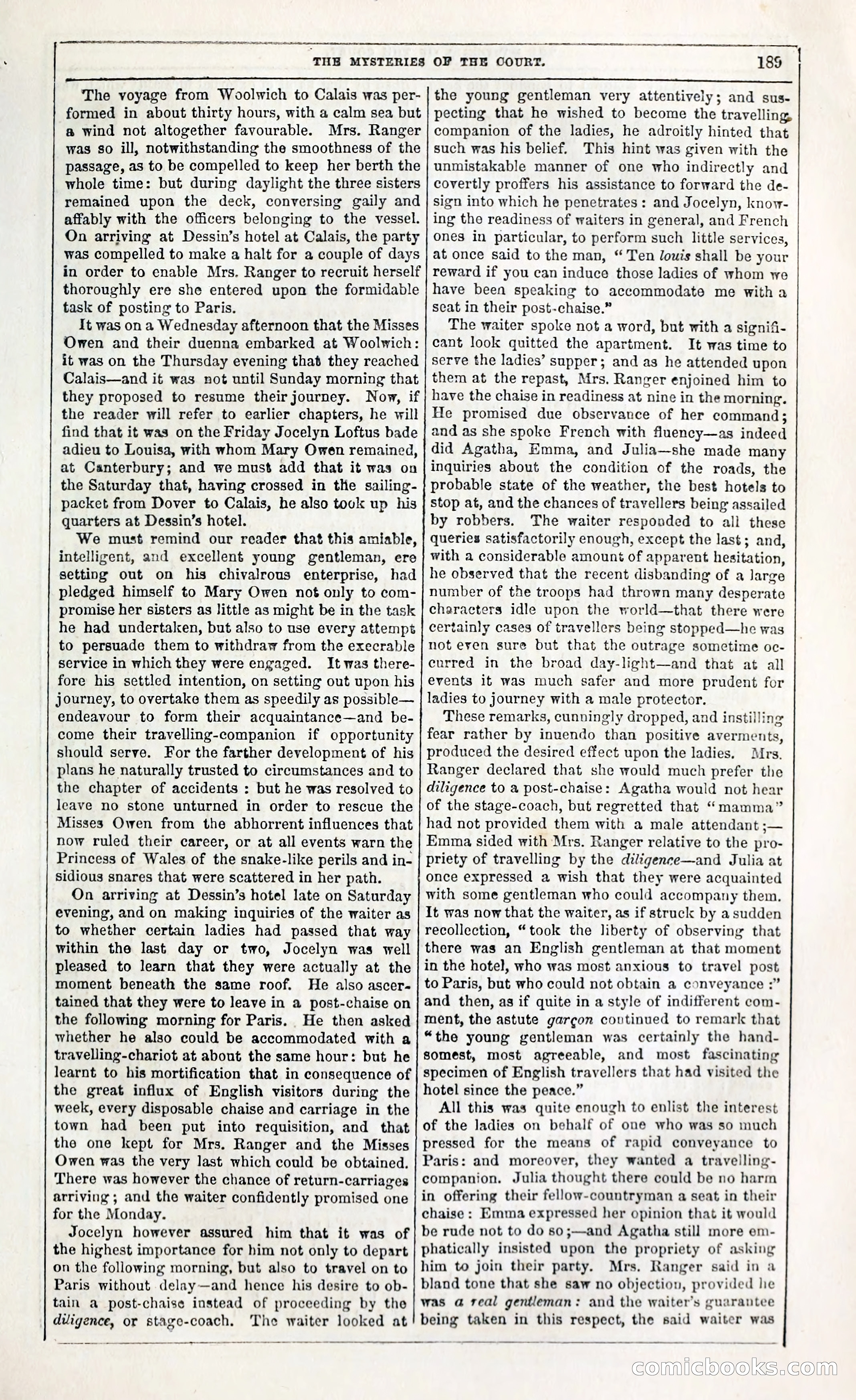
A restored page from Penny Dreadfuls, 1849. Page through the whole issue in the reader above.
📄 Transcribed text from this page (OCR, searchable)
Machine-transcribed from the original scan — historical spelling and the odd misread are preserved.
o LPI FIO NAIA LE IP OE Por THB MYSTERIES OF THE COURT. The voyage from Woolwich to Calais was per- formed in about thirty hours, with a calm sea but @ wind not altogether favourable. Mrs. Ranger was so ill, notwithstanding the smoothness of the passage, as to be compelled to keep her berth the whole time: but during daylight the three sisters remained upon the deck, conversing gaily and affably with the officers belonging to the vessel. On arriving at Dessin’s hotel at Calais, the party was compelled to make a halt for a couple of days in order to enable Mrs. Ranger to recruit herself thoroughly ere she entered upon the formidable task of posting to Paris. It was on a Wednesday afternoon that the Misses Owen and their duenna embarked at Woolwich: it was on the Thursday evening that they reached Calais—and it was not until Sunday morning that they proposed to resume their journey. the reader will refer to earlier chapters, he will find that it was on the Friday Jocelyn Loftus bade adieu to Louisa, with whom Mary Owen remained, at Canterbury; and we must add that it was on the Saturday that, having crossed in the sailing- packet from Dover to Calais, he also took up his quarters at Dessin’s hotel. We must remind our reader that this amiable, intelligent, and excellent young gentleman, ere setting out on his chivalrous enterprise, had pledged himself to Mary Owen not only to com- promise her sisters as little as might be in the task he had undertaken, but also to use every attempt to persuade them to withdraw from the execrable service in which they were engaged. It was there- fore his settled intention, on setting out upon his journey, to overtake them as speedily as possible— endeavour to form their acquaintance—and be- come their travelling-companion if opportunity should serve. For the farther development of his plans he naturally trusted to circumstances and to the chapter of accidents : but he was resolved to leave no stone unturned in order to rescue the Misses Owen from the abhorrent influences that now ruled their career, or at all events warn the Princess of Wales of the snake-like perils and in- Sidious snares that were scattered in her path. On arriving at Dessin’s hotel late on Saturday evening, and on making inquiries of the waiter as to whether certain ladies had passed that way within the last day or two, Jocelyn was well pleased to learn that they were actually at the moment beneath the same roof. He also ascer- tained that they were to leave in a post-chaise on the following morning for Paris. He then asked whether he also could be accommodated with a travelling-chariot at about the same hour: but he learnt to his mortification that in consequence of the great influx of English visitors during the week, every disposable chaise and carriage in the town had been put into requisition, and that the one kept for Mrs. Ranger and the Misses Owen was the very last which could be obtained. There was however the chance of return-carriages arriving; and the waiter confidently promised one for the Monday. Jocelyn however assured him that it was of the highest importance for him not only to depart on the following morning, but also to travel on to Paris without delay—and hence his desire to ob- tain a post-chaise instead of proceeding by the diligence, or stage-coach. The waiter looked at Now, if ee a mee ee ee eS Se ee ee - LL EE A a A a I te the young gentleman very attentively; and sus- pecting that he wished to become the travelling companion of the ladies, he adroitly hinted that such was his belief. This hint was given with the unmistakable manner of one who indirectly and covertly proffers his assistance to forward the de- sign into which he penetrates: and Jocelyn, know- ing the readiness of waiters in general, and French ones in particular, to perform such little services, at once said to the man, “ Ten louis shall be your reward if you can induce those ladies of whom we have been speaking to accommodate me with a seat in their post-chaise.” The waiter spoke not a word, but with a signifi- cant look quitted the apartment. It was time to serve the ladies’ supper; and as he attended upon them at the repast, Mrs. Ranger enjoined him to have the chaise in readiness at nine in the morning. He promised due observance of her command; and as she spoke French with fluency—as indeed did Agatha, Emma, and Julia—she made many inquiries about the condition of the roads, the probable state of the weather, the best hotels to stop at, and the chances of travellers being assailed by robbers. The waiter responded to all these queries satisfactorily enough, except the last; and, with a considerable amount of apparent hesitation, he observed that the recent disbanding of a Jarge number of the troops had thrown many desperate characters idle upon the world—that there were certainly cases of travellers being stopped—he was not even sure but that the outrage sometime oc- curred in the broad day-light—and that at all events it was much safer and more prudent for ladies to journey with a male protector. These remarks, cunningly dropped, and instilling fear rather by inuendo than positive averments, produced the desired effect upon the ladies, Mrs. Ranger declared that she would much prefer the diligence to a post-chaise: Agatha would not hear of the stage-coach, but regretted that “mamma” had not provided them with a male attendant ;— Emma sided with Mrs. Ranger relative to the pro- priety of travelling by the diligence—and Julia at once expressed a wish that they were acquainted with some gentleman who could accompany them. It was now that the waiter, as if struck by a sudden recollection, “took the liberty of observing that there was an English gentleman at that moment in the hotel, who was most anxious to travel post to Paris, but who could not obtain a conveyance :” and then, as if quite in a style of indifferent com- ment, the astute garcon continued to remark that “the young gentleman was certainly the hand- somest, most agreeable, and most fascinating specimen of English travellers that had visited the hotel since the peace.” All this was quite enough to enlist the interest of the ladies on behalf of one who was so much pressed for the means of rapid conveyance to Paris: and moreover, they wanted a travelling- companion. Julia thought there could be no harm in offering their fellow-countryman a seat in their chaise : Emma expressed her opinion that it would be rude not to do so;—and Agatha still more em- phatically insisted upon the propriety of asking him to join their party. Mrs. Ranger said in a bland tone that she saw no objection, provided lie was a real gentleman: and the waiter’s guarantee being taken in this respect, the said waiter was ECOMICLMOoOkKS (©)